Mastering Google’s E-E-A-T: Guide for Health and Wellness Brands
The E-E-A-T framework is very simple at its core, and it will always favor health content that proves real-world experience, credible expertise, earned authority, and long-term honesty.
The health and wellness space is crowded. With roughly 1 billion health-related searches happening on Google daily, you’ll need more than just content to stand out. You’ll need trust.
Google treats health content as YMYL (Your Money or Your Life), meaning it holds fitness websites to higher standards. Major Google updates show why weak trust signals can become a long-term ranking risk. For example, following Google’s March 2024 core update, many health sites without clear first-hand expertise saw significant visibility losses. (We cover these in-depth in our article on Google Updates that affected fitness businesses).
Here’s a real example: This broad health and fitness website saw traffic and impressions plummet after the November 2023 and March 2024 core updates.
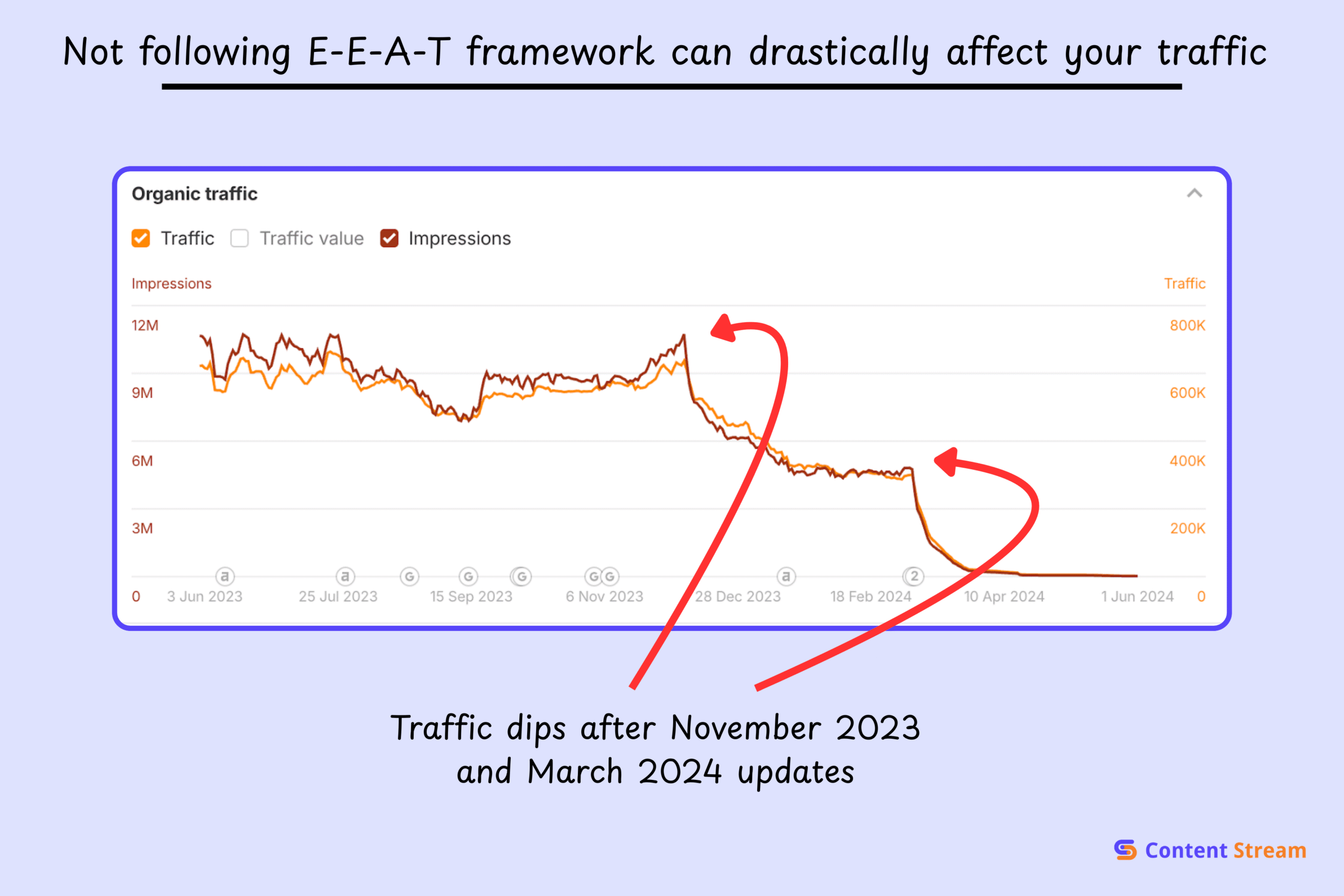
This shows how Google now evaluates fitness sites. Without demonstrating the E-E-A-T framework, fitness websites struggle to rank.
So what exactly is E-E-A-T? How does it relate to YMYL? And how can your fitness business use it to improve rankings?
Let’s break it down one by one.
The E-E-A-T framework is a set of guidelines Google’s Human Search Quality Raters use to evaluate the credibility and quality of web content.
It’s not a direct ranking factor in the algorithm, but it serves as a sort of “blue print” for what Google wants its search results to look like.
It stands for:
For fitness businesses, “Experience” and “Expertise” are often what separate high-ranking sites from those that lost traffic. A blog post written by an anonymous writer using stock photos is Low E-E-A-T and will struggle to outrank a post by a certified coach that includes original photos and video of them performing the exercises (High E-E-A-T).
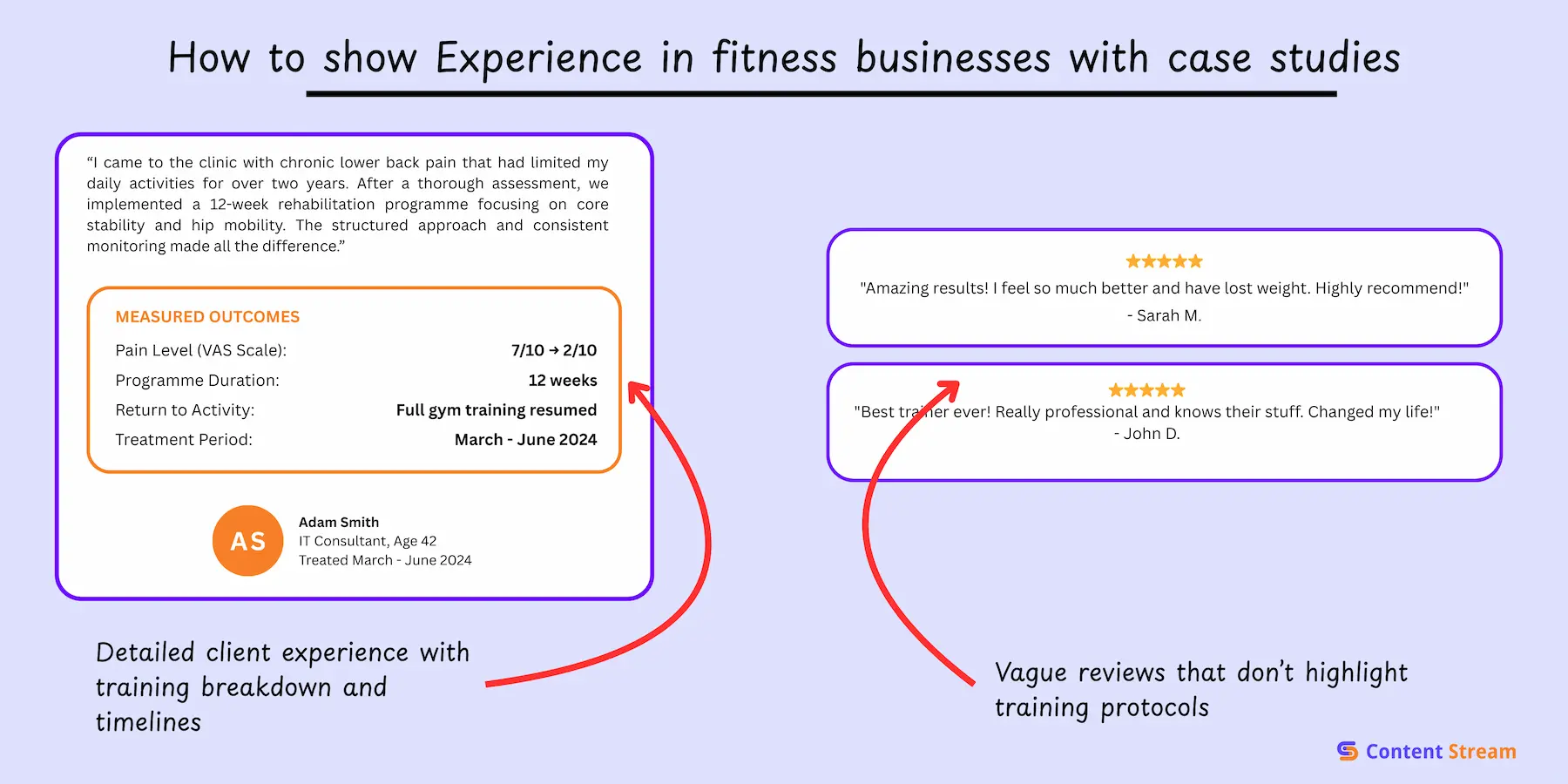
When Google added the extra “E” to the E-E-A-T framework in 2022, they were solving for something specific. The internet was drowning in theoretical advice from people who’d never actually done the thing they were explaining.
Experience isn’t anecdotes, it’s evidence of real-world application with proof to back it up. In practice, this could mean:
Why does this matter?
Because fitness is practical (what works on paper may fail in real gyms), often individual (everyone responds differently), and specific (sleep and stress influence results more than perfect macros).
According to the Experience in the framework, the best content doesn’t say “do this.” It says: “We tried this with 200 people. Here’s what worked, what didn’t, and who it’s probably not for.”
Expertise means having the credentials to back up your claims and the judgment to know when to stay in your lane. If you’re giving nutrition advice, having a registered dietitian on your team isn’t optional.
And if you’re programming workouts, you need certified trainers. Google’s quality raters actively look for author credentials, professional backgrounds, and qualifications, especially for YMYL content.
But credentials are just the starting point. Real expertise appears in how you handle uncertainty and limits. So if a supplement brand excludes a trendy ingredient and explains why, it demonstrates more expertise than one that throws everything into the formula.
Look at how authoritative sources like the NIH, NHS, or Mayo Clinic approach health content. They dedicate significant space to limitations, when to seek professional help, and what remains unknown.
The insight: knowing what you won’t advise might be the most important form of expertise. It’s knowing when you don’t have the right answer and being honest about it.
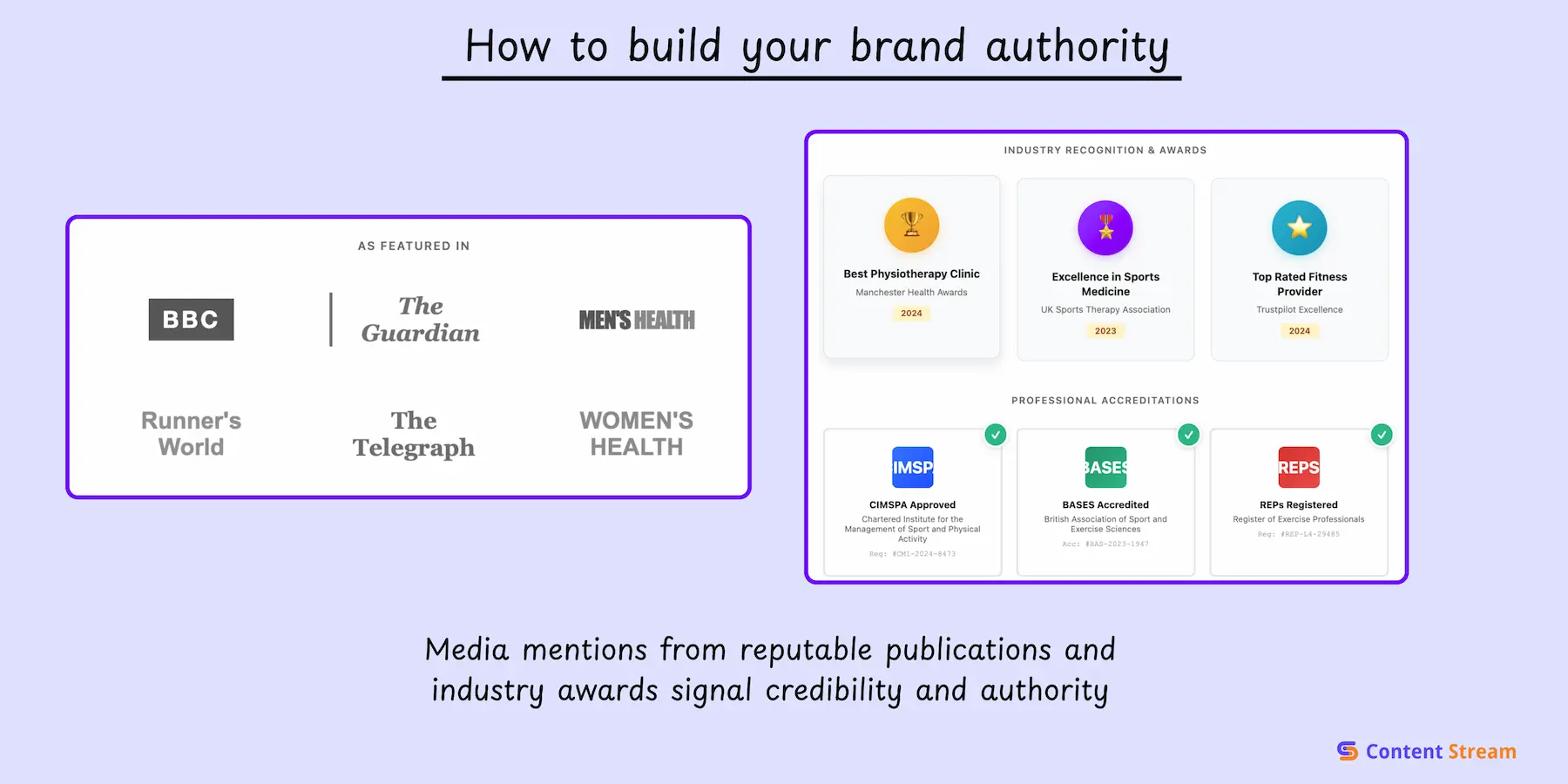
Authoritativeness means your brand is recognized as a credible source within your industry, not by your own claims, but by how others treat your content..
And even though it’s tempting to chase backlinks alone, it’s more than that. It’s about which credible sites trust your content enough to cite you (with or without a follow link), and in what context.
That means:
In my experience, authoritativeness compounds quietly over time, as a combined result of consistently clear positioning, repeatedly showing up with useful perspectives, and constantly sharing new ideas.
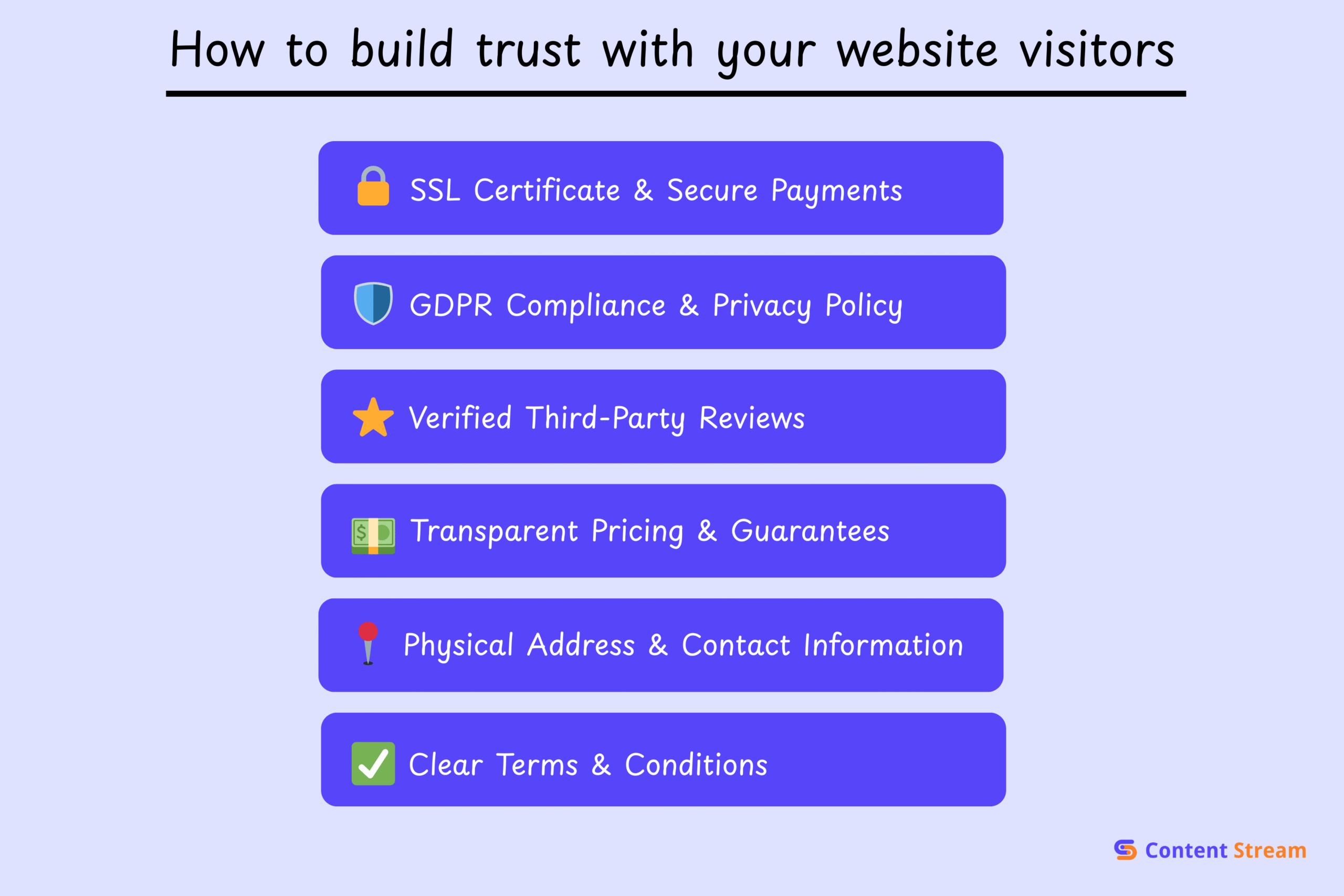
Trust is the hardest element to build on this list, and the easiest to destroy. Experience, expertise, and authoritativeness can be demonstrated through credentials and citations. But with Trust, your business needs to be consistently honest about what you can’t do, what might not work, and who your content isn’t for.
Trust is built when a brand is transparent about limits, risks, and trade-offs. Google’s quality raters look for trust signals beyond content. They look out for HTTPS security, clear contact information, transparent privacy policies, and accessible terms of service.
However, technical trust signals only matter if your content backs them up.
So naturally, you can’t build trust in a single blog post. It’s more like when users realize, over time, that you’ve never tried to manipulate them into a purchase or oversell a benefit.
For your fitness business, YMYL is the category you are in, and E-E-A-T determines how your content and website are graded and ranked.
Here is how the two frameworks interact to determine your search visibility:
YMYL is the reason Google is “hard” on your website. E-E-A-T is the solution you use to prove to Google that your fitness business is safe and professional enough to be recommended to users.
Here are three strategies you can try. These work because they demonstrate real expertise Google’s algorithms can verify, instead of simply claiming expertise.
You don’t need a lab or a PhD to publish original findings. Survey 50 clients about their supplement timing habits and publish the results. Track recovery times across 100 training sessions in your gym and share patterns you notice. Analyze your nutrition coaching data to identify common deficiencies in your client base.
Original data gets cited, and that’s how authoritativeness is built.
Google rewards fresh content because it’s genuinely helpful to users. If your 5 year old article can share up-to-date information that newer ones miss, the algorithm will prioritize it.
One hack I like to use is adding publish dates to our content calendar. That way, we can tell how old a blog is from one central location, and decide if it’s due for an update.
You can also add dated revision notes to show you’re still paying attention:
“Updated March 2024: Added new research from Journal of Strength & Conditioning on protein timing”
Additional Reading: How to Create Health Content for Fitness SaaS without YMYL penalties.
Instead of polished case studies, document decisions as you make them.
Don’t say: “We helped Client X lose 50 pounds”
Instead try: “Week 4 update: Client struggled with weekend eating. Here’s how we adjusted the approach”
Use Instagram Stories or LinkedIn posts to share your methodology as you develop new programs. Transparency beats perfection for E-E-A-T.
It may seem redundant, or even unpolished, but that’s how you build trust, both with the algorithm and your users.
E-E-A-T isn’t a checklist (although having one can help.) It’s a long-term commitment to demonstrating experience, proving expertise, earning authority through industry recognition, and building trust through transparency.
If you need help aligning your brand with the E-E-A-T framework, book a 20 minute consultation and let’s talk. Or if you prefer, request a free site audit and we’ll tell you the parts of your content that need work.

I’m Matthew, a personal trainer turned SEO who’s worked with brands like Gymfluencers, Sailo, ClickCease, and Fraud Blocker. These days, I help small to medium sized companies grow their reach with smart, search-focused content.
