How to Find Top Fitness Keywords with Low Competition | Step by Step Guide

Health and fitness remains one of the most competitive industries today, with total revenue estimated to reach $50 Billion by 2030. That means health and fitness keywords are among the most competitive to rank for. You have gyms, fitness studios, equipment manufacturers, supplement retailers, and even wellness coaches, all competing for many of the same keywords.
If you’re a small outfit, a new business, or simply an established organization looking to expand, this means you’re up against stiff competition.
But there are still tons of opportunities to rank, pull in AFFORDABLE organic search traffic,and grow your business. And it’s all thanks to low difficulty fitness keywords.
If you can identify low difficulty keywords that the biggest websites aren’t ranking for, and that your website can easily rank for, you have the potential to really grow your business. Stats show that organic traffic makes up more than half of revenue for B2B organizations.
And we’ve created this guide to show you exactly how to do that: Identify low difficulty keywords and rank for them.
So if you run any of these businesses (gyms, studios, coaching businesses, health and fitness ecommerce etc), this is how you can dominate search for your niche-specific keywords, and effectively rank for them.
When we talk about low keyword difficulty, we usually mean a difficulty score assigned by tools like ahrefs, SEMRush, and Ubersuggest.
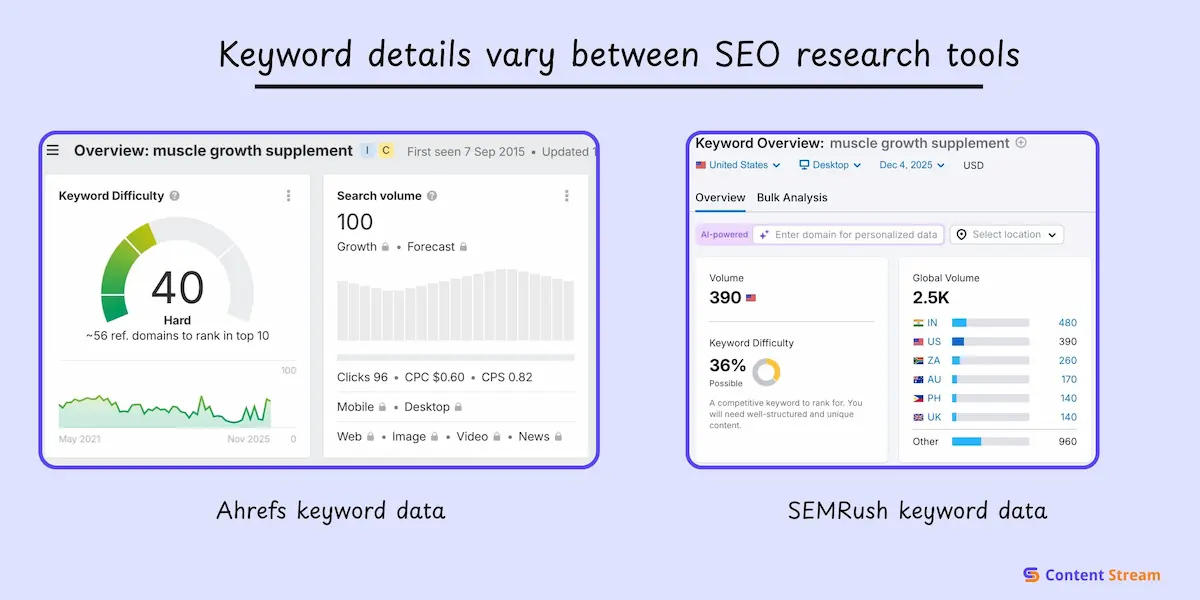
The keyword difficulty score tells you how hard it’ll be to rank on Google’s first page for a search term or keyword. Most SEO tools measure this on a scale of 0 to 100, where 0 is super easy and 100 means you’re competing with huge websites like Men’s Health or Healthline.
Here’s why this matters for your fitness business.
If you’re targeting “muscle growth supplement” (a high difficulty keyword), you’re up against websites with millions of visitors, hundreds of backlinks, and content teams working full-time. You could write the best article ever and still never crack the first page.
But “hot yoga in [your city]”? That’s a different story.
Fewer sites are competing for it, and the ones that do might not have great content. That’s a low difficulty keyword, and that’s where you win.
So, look for lower difficulty keywords in your search.
Seed keywords are basic terms that describe what you do (“home gym equipment,” “self defense, “pilates for flexibility” things like that.
But don’t just guess. Pay attention to what your students actually ask about.
When someone contacts you or engages with your business, what questions do they have?
These real conversations tell you what people are already searching for, and they’re often more specific than the generic terms you’d come up with on your own.
Make a list of 10-15 seed keywords. Keep them simple and broad for now.
Now you’ll take those seed keywords and plug them into a keyword research tool. There are several options:
Ahrefs (paid, but powerful)
SEMrush (another paid option with tons of data)
Ubersuggest (more affordable, good for beginners)
Google Keyword Planner (free, though you’ll need a Google Ads account)
Let’s say one of your seed keywords is “yoga for stress.” Type that into your tool and it’ll show you dozens of variations people actually search for: “yoga for stress relief,” “yoga poses for anxiety,” “can yoga help with stress,” and so on.
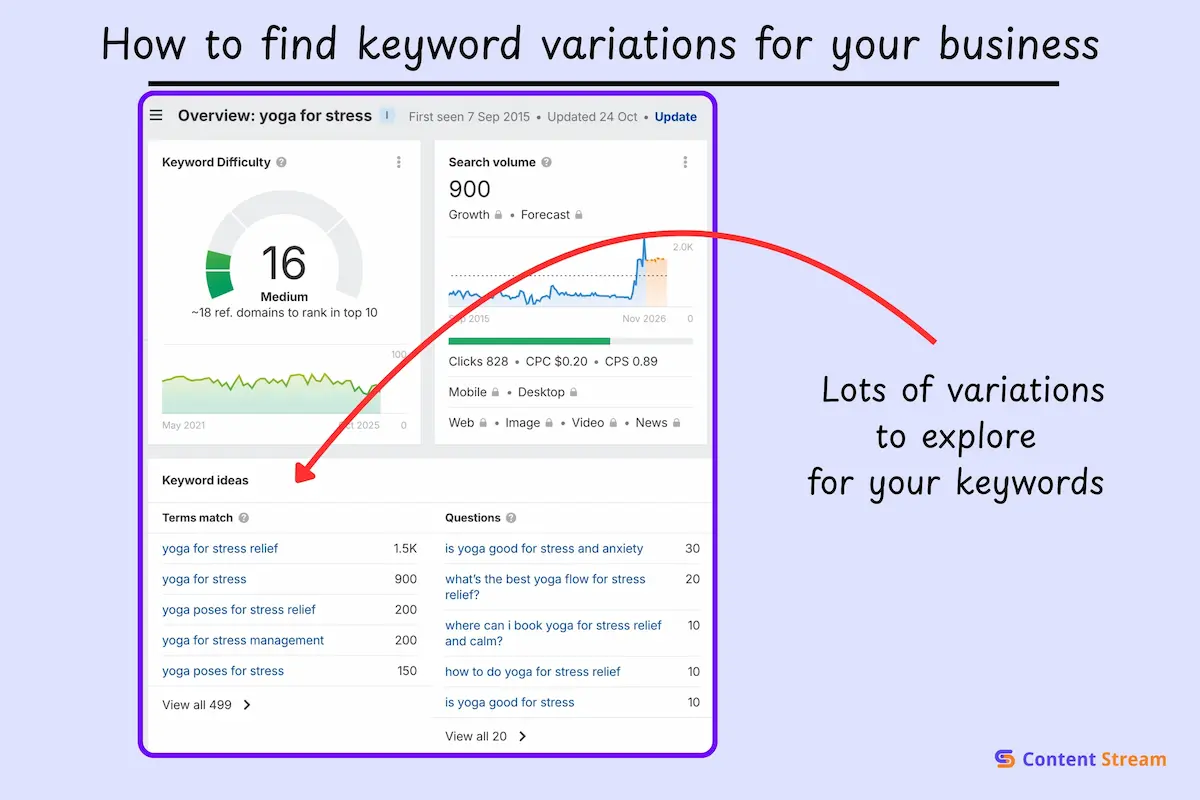
The tool will also show you each keyword’s search volume, difficulty score, and sometimes, traffic potential (the amount of traffic your one website can expect to get.)
These are the metrics that will tell you which keywords to target.
Make a note of the easiest ones.
In your keyword research tool, look for the “KD” or “Keyword Difficulty” column. Sort your list so the lowest difficulty keywords appear at the top.
Your goal is to find keywords under 30. If you’re just building your site’s authority, stick with keywords under 20.
Here’s what different difficulty ranges usually mean:
0-10: Very low competition. You can probably rank with decent content and basic on-page search engine optimization.
11-30: Low to medium competition. You’ll need good content and a few backlinks, but it’s doable.
31-50: Medium competition. This takes more time and a stronger site.
50+: High competition. Save these for later.
As your site grows and you publish more content, your website will build topical authority as you Google begins to see it as a reliable source of information in your niche. Then, you can target these keywords..
SEO tip: Most tools only give you estimates so don’t take their word as gospel. Simply use it as a range to find what’s potentially easy for you to rank for.
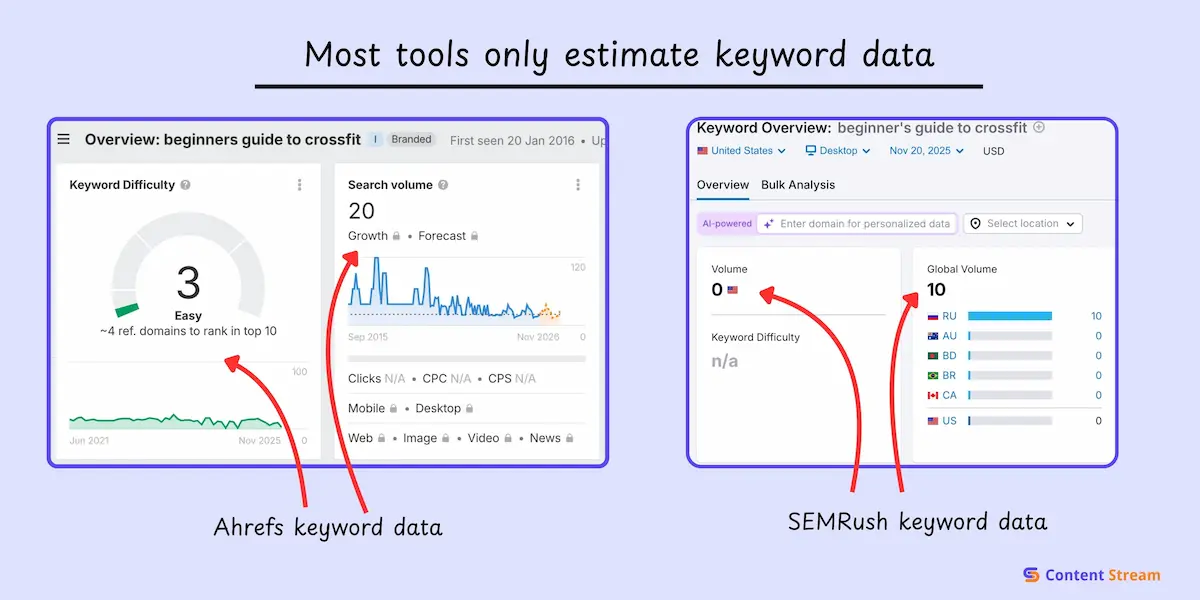
A keyword could have a difficulty score of 5, but if only 10 people search for it each month, is it worth your time?
Maybe, maybe not.
Search volume tells you how many people are looking for that keyword every month. You’ll see this as a number in your research tool, usually labeled “Volume” or “Monthly Searches.”
You want searches within the 100-1000 range. These have a huge potential to make your site traffic jump!
But, don’t ignore keywords with 50-100 searches either. If they’re super relevant to your studio and have low difficulty, they’re still worth it.
Also keep an eye on traffic potential. It tells you how much traffic you’re likely to get for the keyword. Low traffic potential keywords are not worth your time since they may never yield any visitors.
Search intent is what someone actually wants when they type a keyword into Google. And if your content doesn’t match that intent, you won’t rank, no matter how well-optimized your page is.
There are four main types of search intent:

The person wants to learn something. They’re researching, not ready to buy or book anything yet.
Examples: “benefits of strength training,” “what is CrossFit,” “how to do a proper squat,” “difference between Muay Thai and kickboxing.”
Google rewards these searches with blog posts, guides, and educational videos.
In tools like ahrefs, you’ll see the search intent highlighted above the summary, like in the screenshot above.
With SEMRush, you’ll see it under the “Intent” section.
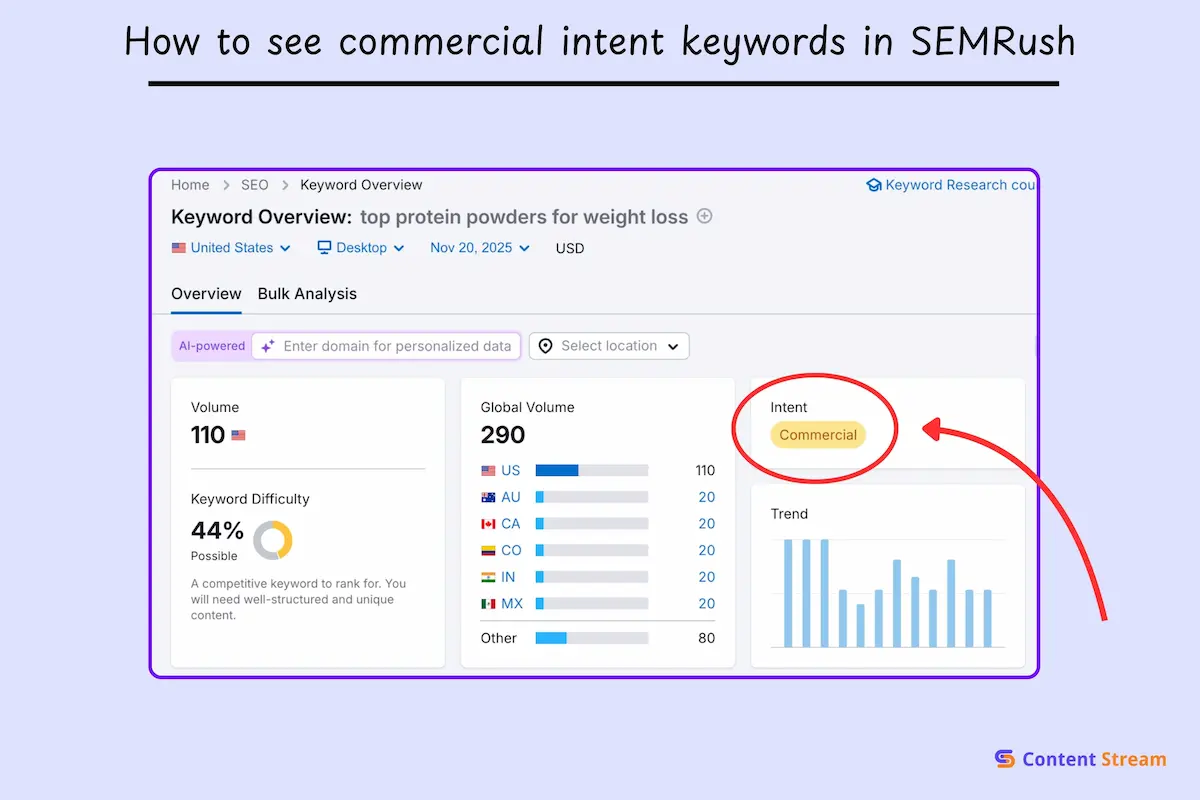
The person is researching their options before making a decision. They’re comparing, looking for recommendations, or trying to figure out what’s best for them.
These could be keywords like “top protein powders for weight loss,” or “CrossFit vs Orange Theory.”
For these, Google usually serves listicles, comparison posts, and review content.
The person is ready to take action right now. They want to buy, book, sign up, or register. That means keywords like, “buy resistance bands,” and “boxing gym membership Boston.”
Google prioritizes service pages, product pages, and local business listings here.
Searches here are looking for a specific website or brand. Like when you search “LA Fitness hours” to see what their schedule details on the website.
Google will almost always show the exact site they’re looking for. Don’t bother targeting these unless it’s your own brand name.
Let’s say you find a keyword with low difficulty and decent volume: “personal trainers Chicago.” That looks perfect, right?
But when you check the SERP, the top results are all Google Business listings and directory sites like Yelp. That’s transactional intent. Writing a blog post about “How to Choose a Personal Trainer in Chicago” won’t rank because that’s informational content for a transactional search.
And that brings us to the next point: checking what’s actually ranking.
Sometimes, you see a keyword that looks good in the tools. But on the search engine results page (SERP), the top articles are actually focusing on a different keyword, or you find it dominated by huge websites.
Or, your SERP analysis may reveal that the search intent doesn’t match your expectations.
For example, this keyword on stress-free yoga. It looks great; low KD, with relatively low volume. But when you check the SERP, you find giants like Apple and YouTube dominating the top 10.
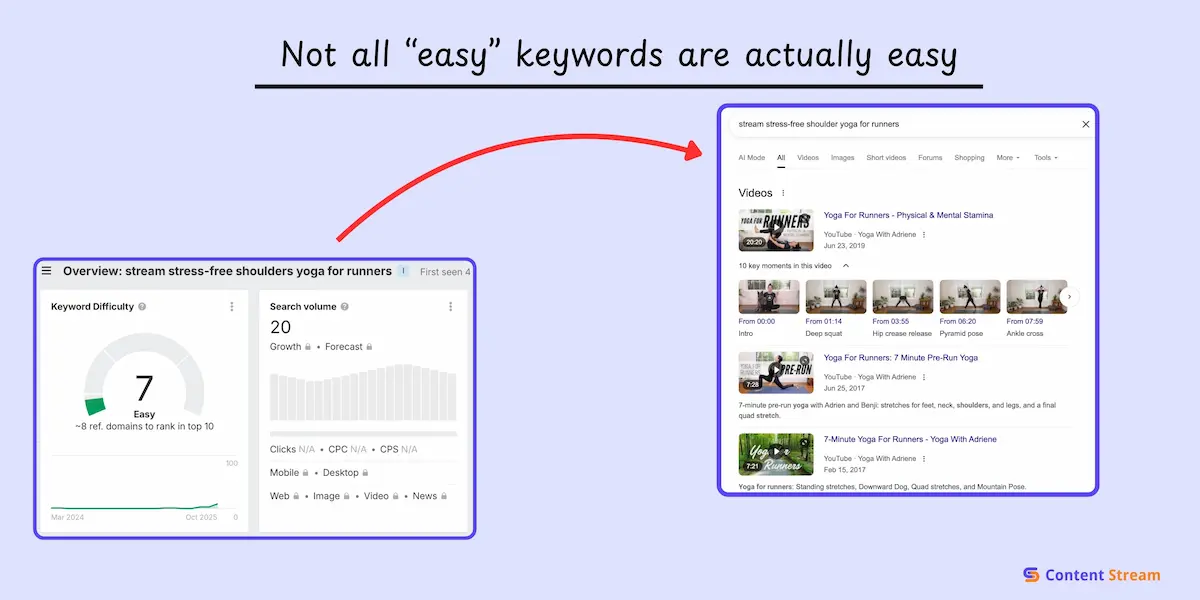
You’ll probably never rank for this.
Here’s another example.
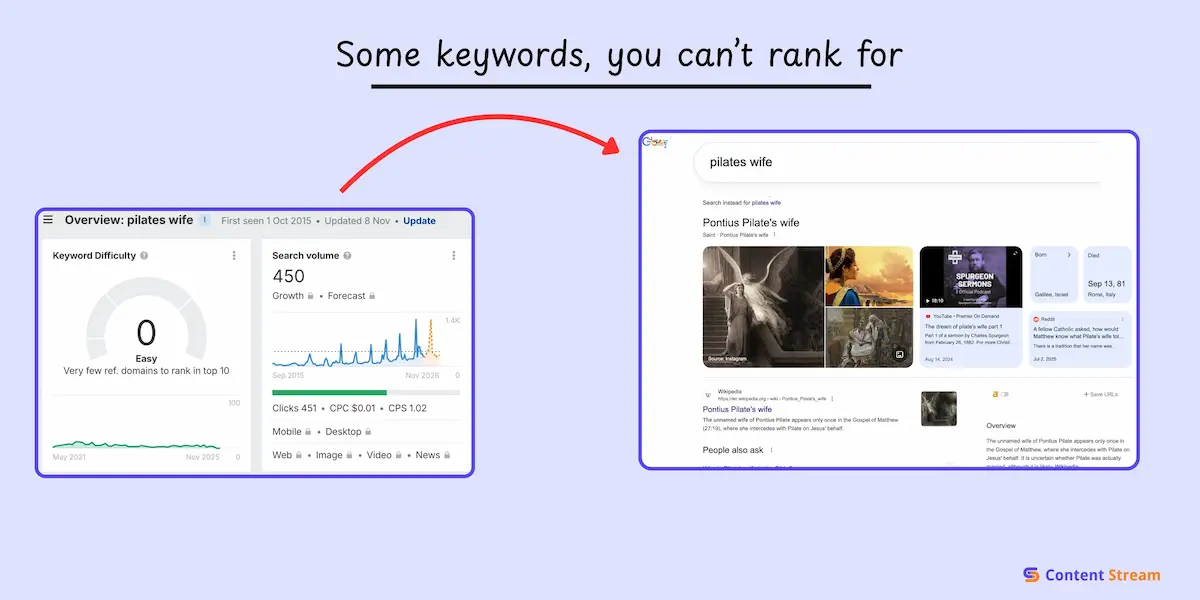
Here’s an easy keyword about Pilates wife. At first glance, it could be referring to doing pilates with your wife.
But one look at the SERP and it becomes obvious the query is actually about the wife of Pontius Pilate, the Roman Official.
Other questions you want to ask are:
What type of content is ranking? Are the top results blog posts, videos, local business listings, or product pages? Google shows you what format it thinks best answers that search. And your content needs to match what you see on there.
How good is the content? Read through a few of the top results. If the current content is mediocre, you have an opening to do better.
Local searches are a huge win for small fitness businesses.
Why?
Well, when someone types “martial arts gym near me” or “best CrossFit gym in Portland,” Google prioritizes businesses in that area. Your studio in Portland doesn’t have to compete with every yoga website on the internet; you’re only competing with other studios in Portland.
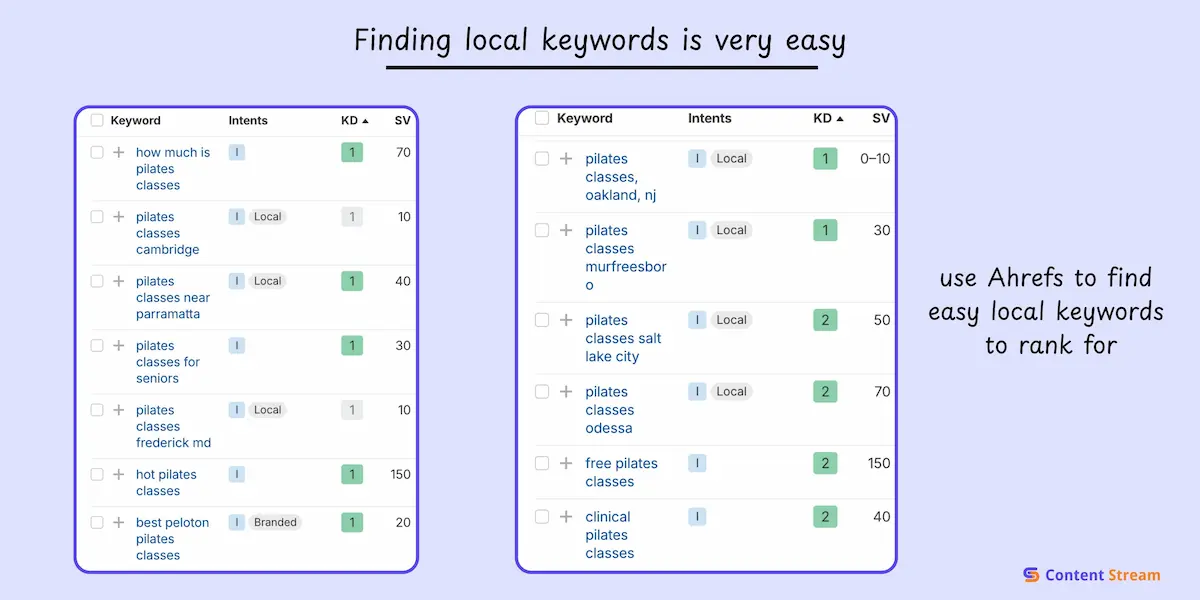
Local keywords almost always have lower difficulty because the competition pool is smaller. Plus, these searches have high intent. Someone searching “gym near me” or “Pilates downtown Seattle” is looking to book a Pilates class right now.
Here’s how to find local keyword opportunities:
Add your city or neighborhood to your seed keywords. Take “beginner yoga” and turn it into “beginner yoga classes in [your city].”
Look for “near me” variations. Keywords like “hot yoga near me” are searched thousands of times every month, and they’re geographically filtered.
Check the list of keywords in your SEO tool. You may find your city listed there.
Target neighborhood-specific terms. If you’re in a big city, people often search by neighborhood. Add your neighborhood to the list and see what comes up.
If a keyword is branded (the name of a business or product), that’s a clear no-go. That’s because Google will automatically prioritize the original website, and other high authority information sources.
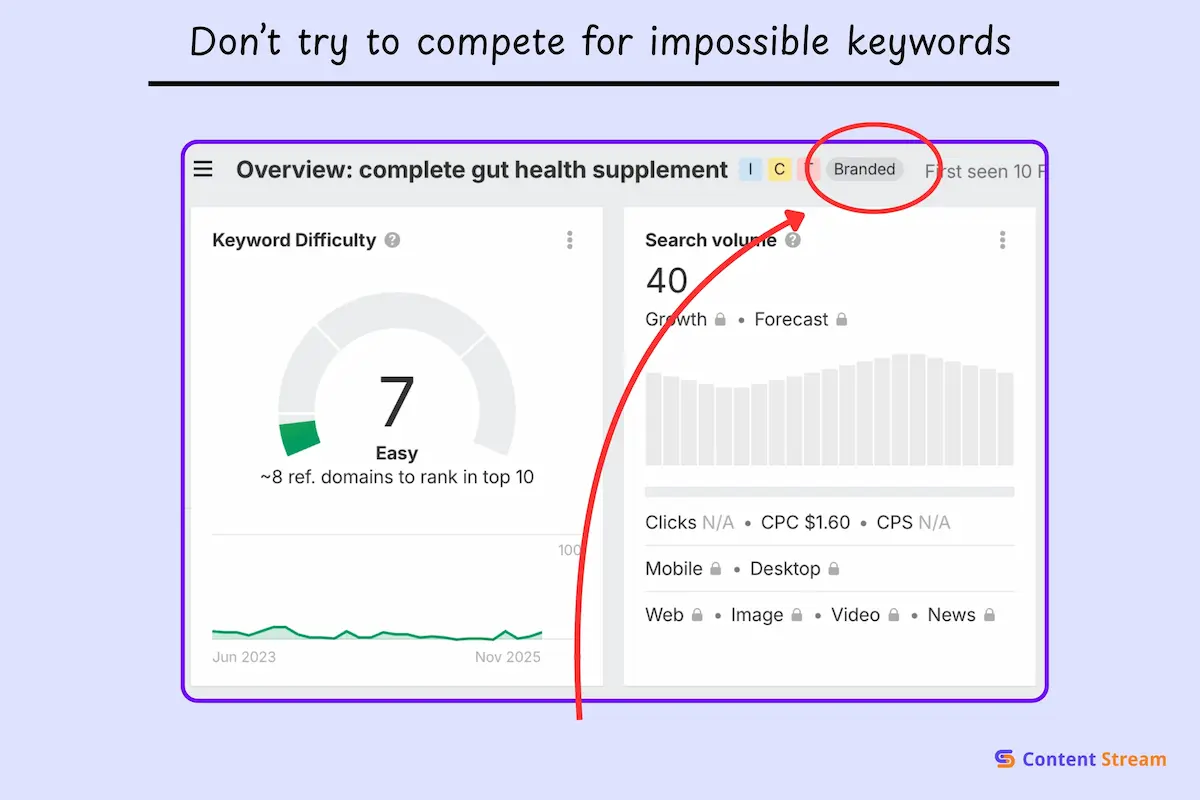
Like in the example above, “complete gut health” is a supplement brand, and the ecommerce store, plus other retailers, will likely show up before your website. If you’re trying to rank your page on a “complete” gut health supplement stack, it’s a good idea to find keyword variations.
Now that you have a nice shortlist of keywords with low difficulty, decent volume, and you know you can meet the search intent, it’s time to create a simple tracking system.
A spreadsheet works great. Create columns for:
Keyword: The exact phrase you’re targeting
Difficulty score and search volume: So you remember why you picked it
URL: Where you published content for this keyword
Current ranking: Check Google Search Console or manually search to see where you rank
Date published: So you know how long it’s been live
Check your search engine rankings once a month. SEO takes time, so don’t obsess over daily changes. You’re looking for trends: Are you moving up over time? Are certain types of keywords working better than others?
Google Search Console is free and shows you which keywords are already bringing people to your site. Set it up if you haven’t already.
You’ve done the research. You have your list of low difficulty yoga studio keywords. Now it’s time to actually create content that ranks.
Start by picking one keyword from your list and building content around it. This could be a blog post, a service page, or even a FAQ section, depending on what you saw ranking in the SERPs. Then, make sure your content answers the question behind the search.
Here are other key elements to include:
Work in those keyword variations you found naturally throughout your content. If your main keyword is “hot yoga benefits,” also include terms like “Bikram yoga advantages” or “heated yoga for weight loss.”
Write a clear, compelling description of 150-160 characters that includes your target keyword. This appears under your page title in Google search results and affects click-through rates.
Link your articles together when relevant. This helps Google understand your content structure and keeps visitors on your site longer.
Mention your city and neighborhood naturally in your content. Create a Google Business Profile, add your address to your contact page, and get listed in local directories.
Give your content 2-3 months to start ranking, then check Google search results to see where you appear. If you’re on page 2 or 3, you’re close; consider updating your content to make it even better.
Before you start writing, make sure you understand what the searcher actually wants.
Someone searching “best yoga mats” wants product recommendations and comparisons. Someone searching “how to clean a yoga mat” wants a tutorial. And someone searching “yoga mats near me” wants to buy one locally, right now.
If you write a blog post when Google is showing product pages, or create a product page when people want how-to guides, you won’t rank no matter how good your content is.
The keyword you’re targeting tells you what type of content to create.
Blog posts work for informational searches like “benefits of HIIT training” or “how to start CrossFit.” These are top-of-funnel content that builds trust and brings in traffic.
Product or service pages are for commercial searches like “personal training in Boston” or “Pull up bars for sale.” These pages should clearly explain what you offer, your pricing, and how to book/order.
FAQ sections handle quick questions people have, like “Do I need to be flexible for yoga?” or “What should I wear to my first BJJ class?” These often show up in Google’s “People Also Ask” boxes.
Your content will also need regular updates to maintain and improve rankings.
You’ll need to add new information, take out irrelevant details, and constantly check the SERP to see what new pages Google is prioritizing. A competitor may have published something better, or, search intent changed and so, different pages are getting priority.
All this will inform the updates you make to your content.
You now have everything you need to find low difficulty keywords that actually bring traffic to your gym or fitness business.
The process is straightforward: start with seed keywords, use a research tool to find variations, evaluate difficulty and volume, check the SERPs, and organize your keywords into a content plan. Then create content that matches search intent and tracks your progress over time.
We talk with business owners all the time, and one theme is consistent: keyword research is time consuming, and they’d rather be focusing on getting clients and customers.
That’s why we’ve done the heavy lifting for you.
We’ve researched and compiled curated lists of low difficulty keywords across multiple fitness niches, each with difficulty scores, search volumes, and strategic insights specific to that industry.
Check out our keyword lists:
Martial Arts Keywords
CrossFit Keywords
Personal Training Keywords
Pilates Keywords
Nutrition Coaching Keywords
Or, if you’d rather have experts handle your entire SEO strategy, from keyword research to content creation to tracking results, book a free website audit with Content Stream. We’ll show you exactly what opportunities you’re missing and how to start ranking for keywords that bring in new clients.

I’m Matthew, a personal trainer turned SEO who’s worked with brands like Gymfluencers, Sailo, ClickCease, and Fraud Blocker. These days, I help small to medium sized companies grow their reach with smart, search-focused content.
Get a free SEO audit and discover the exact keywords and strategies that will grow your fitness business. Or, jump straight into a consultation to discuss your goals.
No sales pitch. No obligations. Just a detailed analysis of your site's SEO performance or a strategic conversation about growing your business—with a clear roadmap to more traffic, leads, and revenue.
