Complete Guide to SEO for Gym Chains and Franchises
If you run a gym chain, the following problem might be all too familiar to you. And if you manage a stand-alone gym, I bet you’re somewhat familiar with it as well.
A gym chain with 12 locations has a problem: Their Denver location dominates Google first page for “gym near me,” their morning classes are packed, and there’s steady memberships rolling in.
But, their two Austin gyms are invisible. Same brand, same equipment, same marketing budget at every location.
The owner is baffled. They’re doing everything identically across all markets.
Part of the problem is that SEO for gyms doesn’t work that way when you operate multiple locations.
In fact, a good chunk of gym SEO advice online is written for single studios. That advice falls apart when you’re managing 5, 10, or 20 gyms across different markets.
Duplicate content across location pages will drag down your rankings. Outdated contact information on Yelp could disappoint customers and attract negative reviews, even when your other locations are crushing it.
In this guide, I’ll be sharing what actually works for multi-location gym SEO. If you run a single location, you can apply a lot of these tips to your business as well.
Single-location gyms and multi-location chains aren’t playing the same SEO game. The strategies that work for an independent studio in one city can’t “scale up” when you add 10 more locations.
But as the complexity increases, the opportunities also follow, if you know how to handle them.
Running multiple gyms gives you something single studios can’t match: you can dominate Google search across multiple regions.
Someone in Southeast Portland searches “gym near me” Your Southeast location shows up. When someone across town searches the same phrase, your Northwest gym appears.
You’re not fighting for one spot; you’re competing for multiple spots across different neighborhoods and cities.
This matters because 46% of all Google searches have local intent. People aren’t looking for the “best gym in America.” They want the gym near their apartment, close to work, or on their commute home.
But more locations also mean more things that can break. Each gym needs its own Google Business Profile, its own location page with unique content, and consistent info across all your directories.
The challenges you face aren’t just “more work.” They’re fundamentally different problems that independent studios rarely deal with. Here are the four biggest differences.
That last point deserves more explanation because it’s an easy mistake to make as a gym chain.
Cannibalization is when your own locations fight each other in search results instead of working together.
Here’s how it happens:
Someone searches “gym in Dallas.” You have three Dallas locations. Google doesn’t know which one to show them, so it picks randomly or worse, shows none of them.
If every page is optimized for “gym in [city]” without distinguishing between neighborhoods, Google could see them as competing pages from the same domain.
The fix involves proper keyword targeting and location page structure. Each location needs to target its specific neighborhood, not just the city.
Here’s what that might look like in practice:
Your Dallas North location should rank for “gym in North Dallas” or “gym near Highland Park.” Your Dallas South location targets “gym in Oak Cliff” or “gym near Downtown Dallas.”
But before we get into tactics, let’s start with the foundation every location needs.
Google doesn’t rank your chain as a whole. It ranks the specific address someone is trying to find. If you want to show up for searches like “gym near me,” “personal training in Denver,” or “CrossFit gym in Miami,” each location needs its own groundwork (Google Business Profile reviews, maybe even Yelp pages) in place.
So instead of treating SEO as one large project, think of it as building the basics for ten or twenty separate gyms that all carry the same name.
Let’s start with the area that affects visibility the most: your Google Business Profiles.
Your Google Business Profile, often called GBP, controls how you appear in Google Maps, the local pack, and the high-intent searches that bring people in the door.
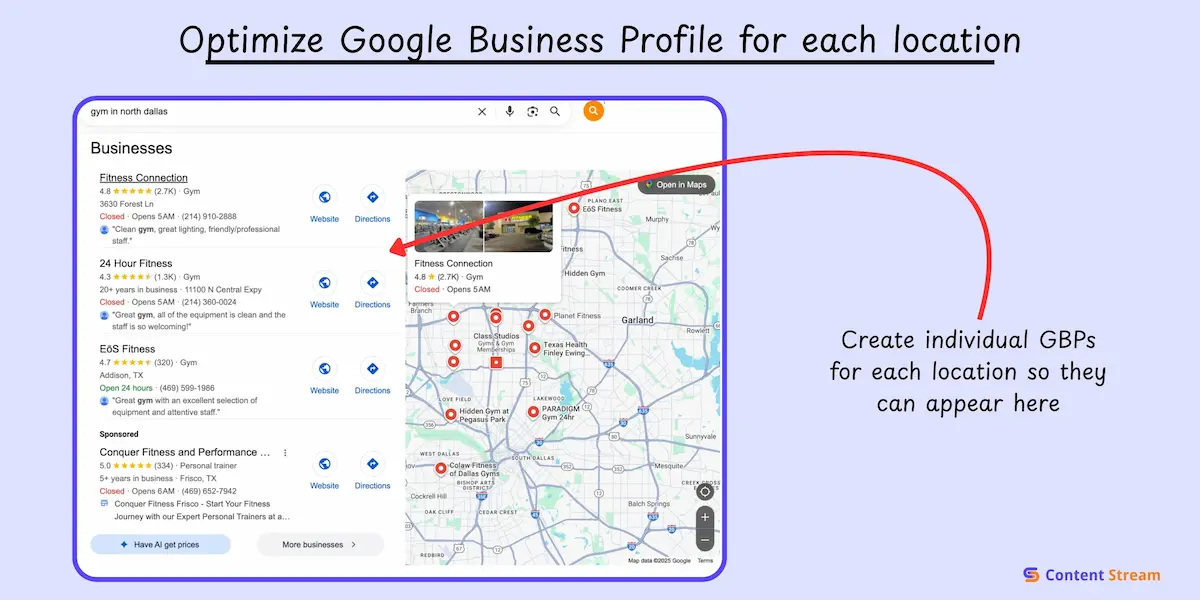
Here’s how you can optimize the GBP pages for your gym or fitness chain
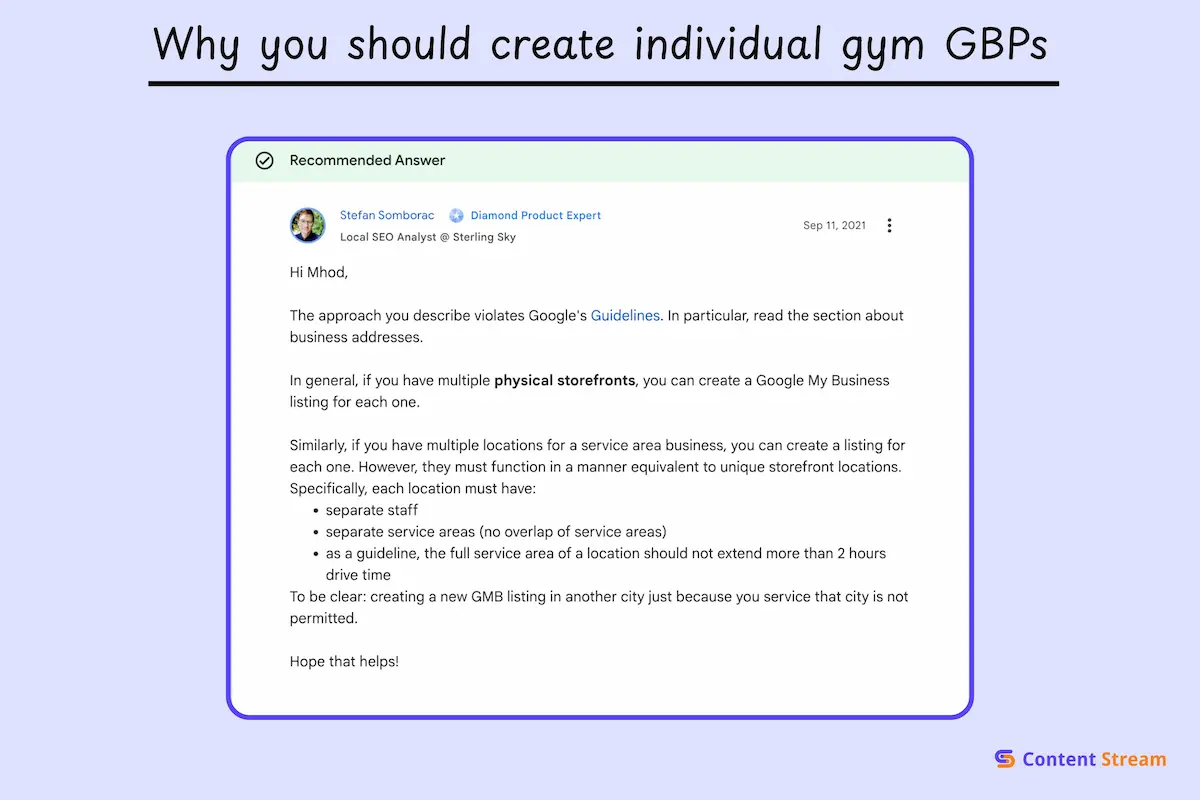
Every gym location needs its own verified Google Business Profile. No shared profiles. No listings that include multiple addresses. If you have twelve locations, you need twelve separate profiles.
This exact point is covered in this Google Business Profile Help Forum.
Each listing must reflect the real address, phone number, and business hours for that specific gym. Google uses this data to confirm your business is legitimate and relevant to local searchers.
Your NAP information is one of the strongest ranking signals in local SEO. Google uses it to verify that your business is real, and that it can help users
An easy way to track this is creating a spreadsheet with correct NAP details for every gym, then check major directories to make sure the details are up-to-date.
Since each location is unique, it only makes sense to post updates that reflect its community. For instance,
Google wants real local signals. People searching for your gym can benefit from it too! When your Scottsdale gym posts about its instructors and nearby parks, Google gains confidence that that listing belongs in the top results for that area.
More locations mean more reviews to manage. We’ve seen that actively responding to reviews (both positive and negative) can boost your SEO and improve user experience.
That means you shouldn’t ignore negative reviews at your Phoenix gym even if the LA locations are crushing it. Google evaluates each location separately.
Here’s how you can set up a consistent review system:
Most gym chains rely on a single “Locations” page with a map and a list of addresses. It feels efficient, but it does nothing for your SEO.
A strong location page acts like a mini homepage for that gym. It speaks to the neighborhood, shows real people, and answers the questions someone has before they walk through your door.
Each location page needs a few key elements. Start with a unique address and contact info: correct address, phone, and hours. Add 200-300 words of unique content that describe the neighborhood, vibe, and member experience.
Also, reference local landmarks like “Two blocks from Central Park” or “Right off Highway 101 near Westfield Mall.” Highlight location-specific details like morning yoga crowds, cold plunge amenities, staff names, or what makes this gym different.
The difference between a weak page and a strong one is striking. A bad location page looks like this:
“Chicago Location: 123 Main St, Chicago, IL. Call us today.”
This tells Google nothing and gives visitors no reason to click.
Compare that to a strong location page:
“Our Lincoln Park gym sits in the heart of Chicago’s north side, just minutes from DePaul University and the lakefront trail. The gym features a turf training area, a dedicated strength zone, and a community-focused team that knows you by name.“
This version paints a picture, speaks to the community, and gives Google real content to work with.
Local keyword targeting is where multi-location SEO becomes powerful. People don’t search for “gym” the same way across cities. Someone in Denver might type “gym near me,” while someone in Miami searches “hot yoga in Brickell.”
Google adjusts results based on where the person is standing, which means every location needs its own keyword strategy.
This means each gym should target location-specific phrases like:
These signals help Google understand exactly which market your gym belongs to.
If you offer a service, people are almost certainly searching for it with a location attached. That’s why every gym page should target service plus city keywords:
This approach also helps you avoid competing with yourself. When each location focuses on its own service keywords, Google knows which page to rank for that market.
But that’s not all.
Some of your highest-converting keywords will come from content that speaks directly to the neighborhood. This type of content makes your gym feel local and gives you long-tail search visibility that competitors ignore.
Simple examples include “Best running routes near our Denver gym,” which tells Google your Denver location is connected to local outdoor fitness culture. Or “Where to grab a protein smoothie after working out in Austin,” which helps your Austin gym show up for food and fitness-adjacent searches.
These articles send strong local signals while helping your members discover new spots around the neighborhood. Google loves this type of relevance because it sees you as part of the community rather than just another business.
Now that each location has its foundation, let’s talk about the technical side that supports your entire network.
Technical SEO is what happens behind the scenes. For chains, getting this wrong means Google can’t properly index your locations.
We already have a full guide on technical optimization for fitness websites. So we’ll only touch on this briefly here.
The way you structure your website affects how Google understands your business. For starters, your location pages need clean, simple URLs that make sense. Best practice is something like:
yourgymbrand.com/locations/denver
or
yourgymbrand.com/denver.
Both work fine. Pick one and use it consistently.
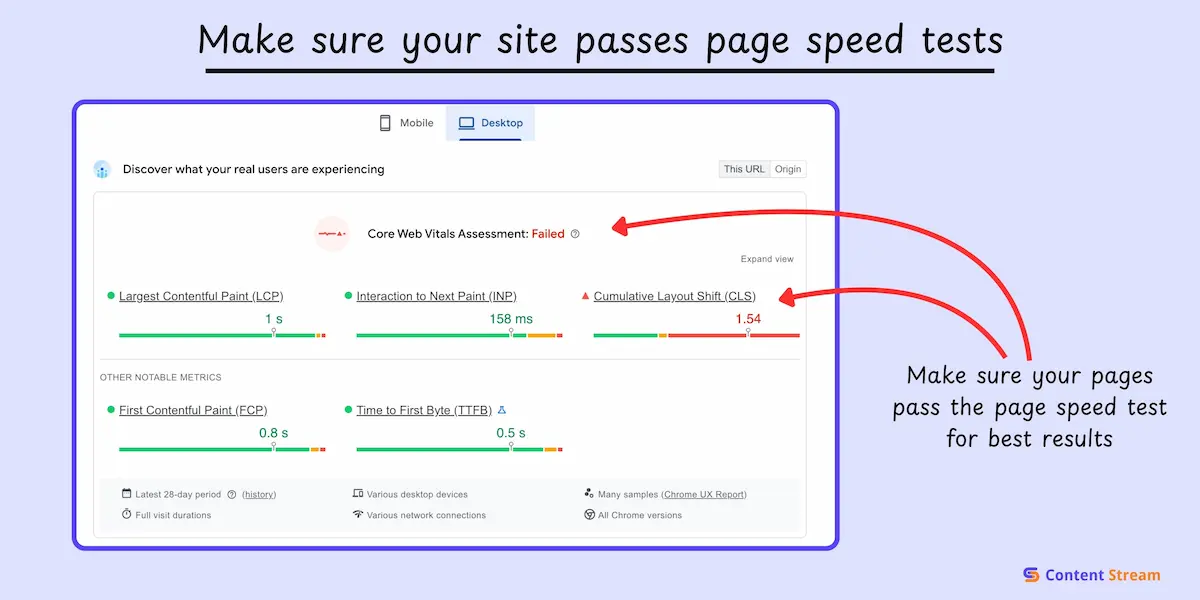
Many people searching for gyms are on their phones. According to statistics, over 56% of global internet traffic is from mobile phones. They’re driving home from work, thinking “I should finally join a gym,” and they pull out their phone at a red light.
Most people will move on if your site doesn’t load in a few seconds, and the odds of users bouncing increases 32% when your site load time goes from 1 second to 3 seconds.
Run Google PageSpeed Insights. It’ll show you exactly what’s slowing things down. Fix the big stuff first. Aim for pages that load in under 3 seconds on mobile.
Also, compress your images because high-res photos take much longer to load. Consider using TinyPNG or similar tools.
Schema for local business tells Google what your business is and where it’s located. Users never see it, but it matters for rankings.
Schema helps you show up in that map pack at the top of search results when someone searches “gym near me.” Each location page needs its own schema with that specific address, phone number, hours, and services. This tells Google exactly what that page is about.
LIke in the example below, the flint branch of plant Fitness has its own page on the website, complete with local business schema. They have this for all of their branches!
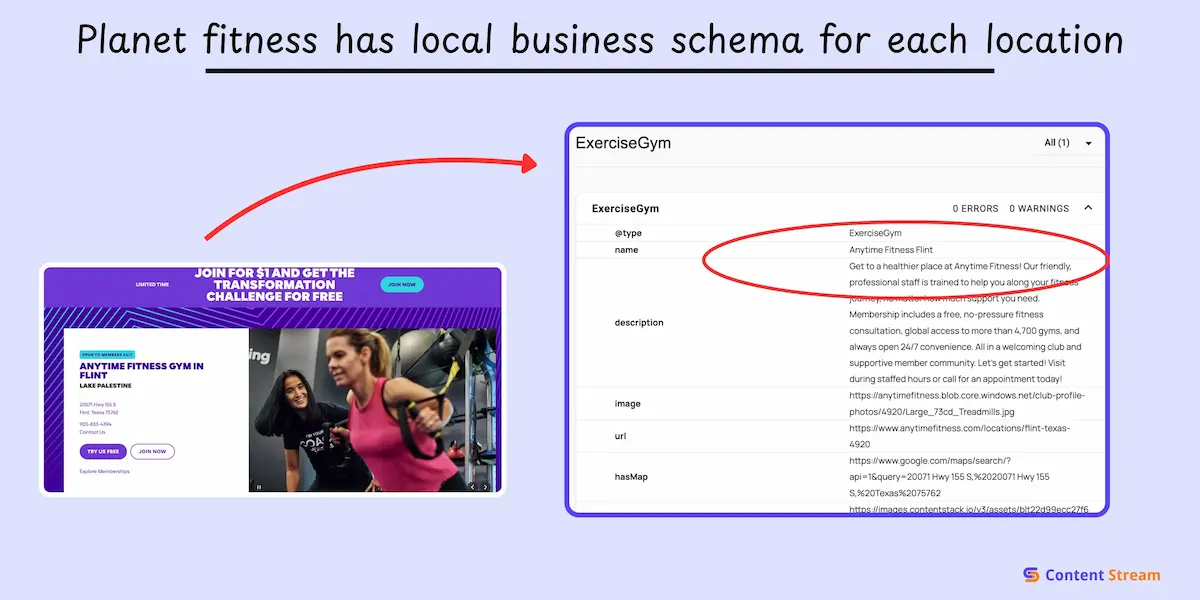
Google has a Structured Data Markup Helper that generates the code. Or hire a developer if this feels too technical.
How do you scale content without duplicating it? We already showed that duplicates don’t work on critical site pages like “About Us” but that goes double for overall helpful content.
Here are some strategies you can use to create content without getting dinged for duplicates.
I recommend content at two levels: one is brand content that serves your entire network, and the second is local content that drives traffic to specific gyms.
Brand-level content are topics that work for your entire audience, regardless of which gym they visit. Topics like:
This content ranks nationally and builds awareness across all your markets.
However, create location-specific content when local search volume justifies the effort. Not every location needs its own blog, but larger markets might.
Examples:
These rank locally and drive foot traffic to specific gyms.
One easy way we usually create multiple pieces of content is simply using a template/structure you can reuse. For each content you make from this mould, you need to customize the details for each location.
You can also reference local fitness trends, demographics, or health data that’s specific to each market. For instance, “Arlington, VA is consistently ranked the fittest city in the US. Here’s how our Rosslyn gym supports that lifestyle” only works for Arlington. You can’t copy that to Phoenix.
Alternatively, interview members at different gyms and feature their stories. These are inherently unique because they’re about real people at specific locations.
Google ranks websites it trusts. For chains, trust comes from links, citations, and mentions across the web. The good news? Your scale gives you an advantage here.
Independent gyms struggle to build authority because they’re working with limited resources in one market. You’re operating in multiple markets with more opportunities to earn links, get press coverage, and build citations. Use that advantage.
Google sees backlinks as votes of confidence for your website. The more quality sites linking to you, the more Google trusts you.
National backlink opportunities can serve your website’s brand image and the all-purpose guides we were talking about. These include press coverage about your brand expansion or partnerships. When a national site links to your homepage, every location benefits from that authority boost.
But with local opportunities, the best link building opportunities for fitness businesses will come from websites tied to the community. For example, you might sponsor a 5K race in Dallas and the event website links to your Dallas location. Or get mentioned in a neighborhood blog covering local businesses.
Citations are different from backlinks but just as important for local SEO. A citation is any mention of your business name, address, and phone number on another website.
It doesn’t have to be a clickable link. Just your NAP information appearing on a directory counts. Examples include Yelp, Yellow Pages, Apple Maps, Facebook, Healthgrades, and hundreds of other directory sites.
It’s also helpful to pay attention to directories specific to the fitness industry like ClassPass.
Keyword research for chains is different because you’re not targeting one market. You’re targeting 10, 15, or 20 markets. Each market has different search volume, different competition, and different opportunities.
The good news is that we published a long list of easy to rank for gym keywords that you can target. We also have keywords for different fitness categories, from yoga and pilates to martial arts.
You can also explore our ultimate guide for tips on finding fitness keyword opportunities for yourself.
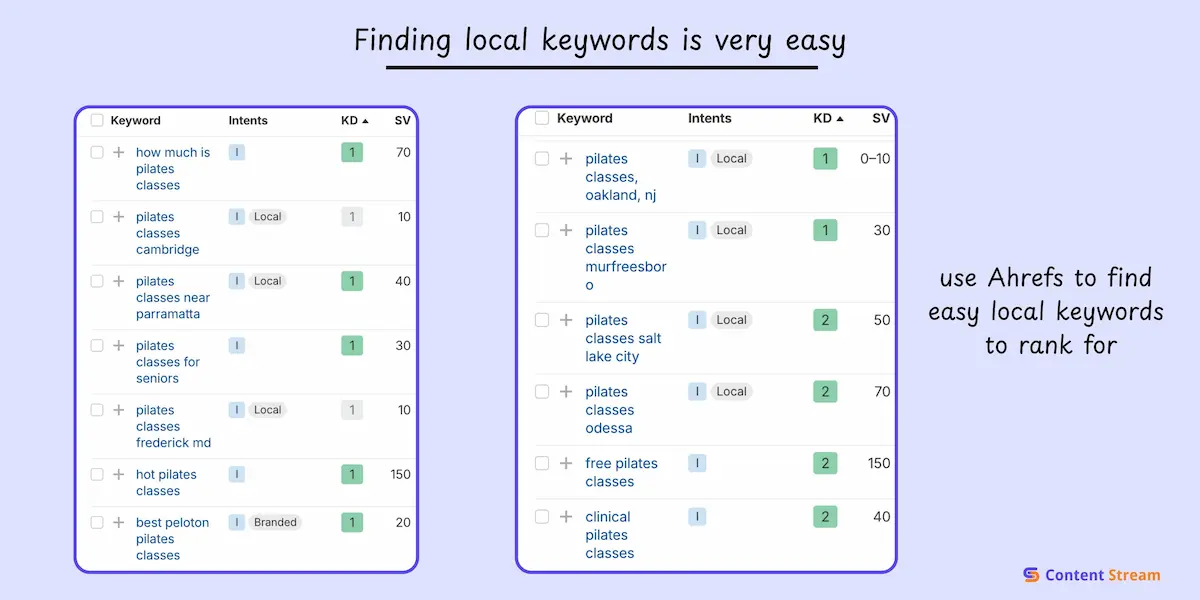
I won’t go into details here, but here are some important tips to keep in mind.
At the end of the day, here’s what gives gym chains an advantage: more locations mean more opportunities to dominate local search across multiple markets.
And it’s true, SEO for 10 or 20 locations is harder than SEO for one gym. But it’s also more profitable when done right.
But, managing SEO for 10 or 20 locations isn’t something you handle between managing staff and opening new gyms. It’s a full-time operation that requires expertise in local SEO, content strategy, and technical optimization.
That’s why you need Content Stream. We handle the entire process for multi-location brands so you can focus on running your gyms.
Book a free audit and we’ll show you which of your locations are leaving money on the table and exactly how to fix it.

I’m Matthew, a personal trainer turned SEO who’s worked with brands like Gymfluencers, Sailo, ClickCease, and Fraud Blocker. These days, I help small to medium sized companies grow their reach with smart, search-focused content.
