Every Major Google Update That Affected Fitness Businesses (2018-2026)
Every time Google updates its algorithm, the changes are almost always tilted towards user experience. They aim to reduce spam and low-quality content served (spam update), improve the user’s experience (page experience update), and ensure users only get expert, reliable information (medic update)
What I’ve seen is, websites that keep the user at the core of their content always benefit from algorithm updates. Not always in the short term, but almost certainly in the long term.
Google algorithm updates reshape the way websites rank online; some in major ways and some in minor ways. But they are always geared towards improving how people find information. That’s why grey hat tactics that generated huge traffic five years ago—mass-produced content, keyword stuffing, generic product reviews—can destroy your organic visibility today.
If you run a fitness business with an established SEO budget, you’ve likely felt the impact. Maybe your supplement review site lost 60% of its traffic after the Product Reviews Update. Or your wellness blog dropped rankings after the Medic Update because author credentials weren’t displayed.
It’s not just you though. 42% of sites affected by the 2018 Medic Update were in health and fitness. And some sites lost 95% of their organic traffic after the 2023 Helpful Content Update.
But great news!
Not all websites are negatively affected. In fact, many businesses see increased visibility following these updates because they’re doing something right.
Let’s break down every major Google algorithm update from 2018-2026 that specifically impacted fitness websites. You’ll learn what changed, exactly how fitness businesses were affected, and what you need to do to protect your rankings.
While Google called this a “Broad core algorithm update,” the SEO community dubbed it Medic because it affected health, fitness and medical websites.
During the Medic update, Google introduced strict quality standards for websites that fall under the “Your Money or Your Life” (YMYL) framework. This includes topics that could impact someone’s health, finances, or safety.
42% of sites hit by this update were in health, fitness, wellness, or medical spaces. Fitness blogs run by enthusiasts without any real qualifications dipped overnight. The same with supplement e-commerce sites that didn’t have credentialed reviewers.
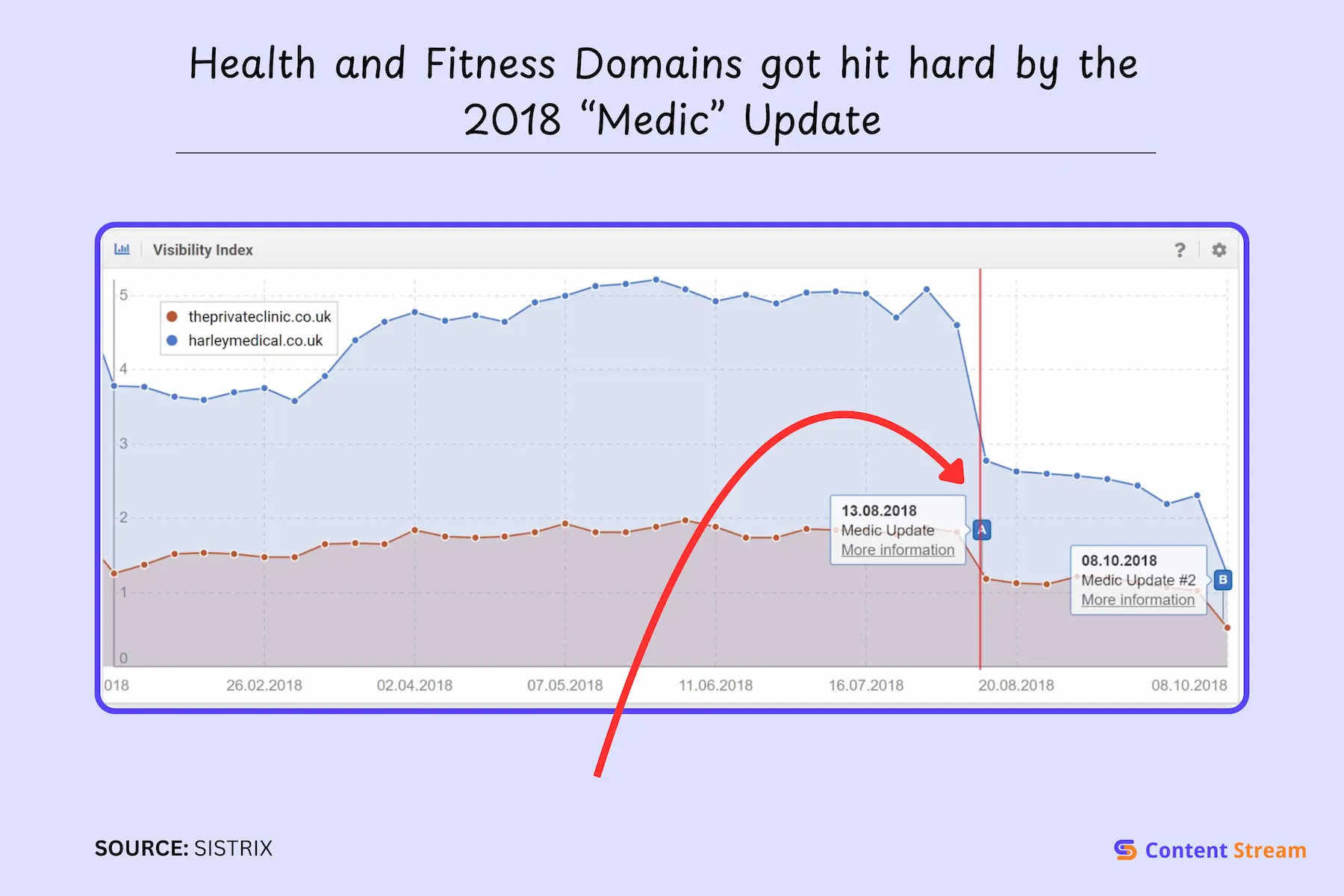
The update essentially deprioritized content from “unqualified” sources. Below is a chart from SISTRIX showing how two domains got hit hard when the Medic Update was rolled out, with one losing over 50% organic traffic.
The Medic Update was also when Google started measuring E-A-T signals:
A year after the Medic Update, Google published a comprehensive blog post on Google Search Central that serves as the definitive documentation for all core updates, including the 2018 Medic update. It contained helpful information, inc
Following the medic update, here’s what was required of fitness websites that wanted to rank:
A year after the Medic Update, Google published a comprehensive blog post on Google Search Central that serves as the definitive documentation for all core updates, including the 2018 Medic update.
During the Page Experience Update, Google made Core Web Vitals an official ranking factor, fundamentally changing how site performance affects rankings. You may be thinking of this in terms of how fast your site loads, and that’s part of it. But it was also about specific, measurable benchmarks that websites needed to meet.
Fitness websites are image-heavy by nature. Think product galleries for equipment retailers, before/after transformation photos, workout demonstration videos etc. The problem is that these can all slow down your site. Unsurprisingly, the update hit fitness e-commerce sites particularly hard.
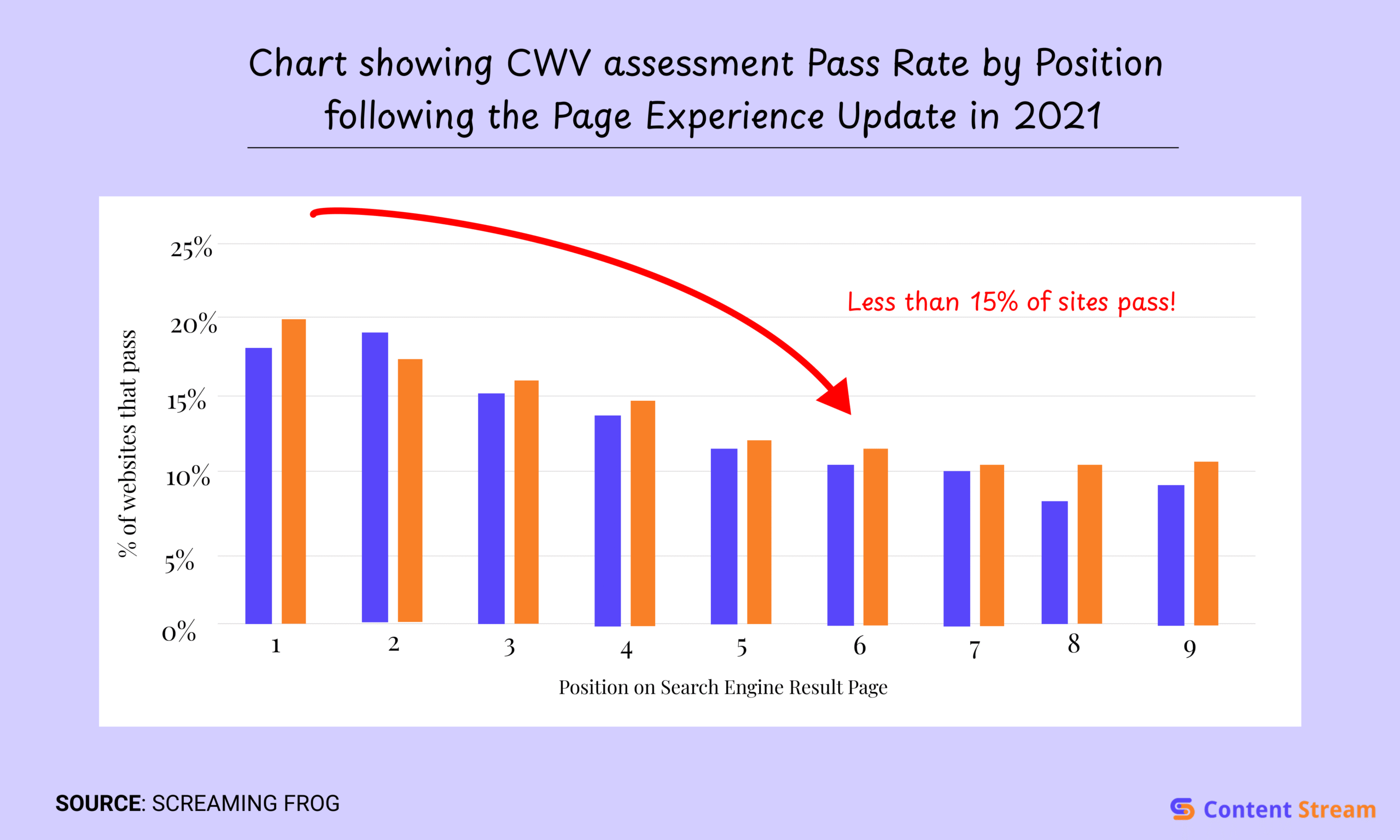
According to Screaming frog’s data, less than 15% of websites met these benchmarks when the update was announced.
Below are the core web vital metrics Google started measuring, along with their ideal benchmarks:
Search Engine Land has a great breakdown of Google’s Core Web Vitals. In our technical optimizations guide, we also cover how to optimize your website’s Core Web Vitals.
The SEO community had a lot of time to understand how core web vitals work since the Page Experience Update first rolled out, and passing them boils down to optimizing your website. Here are some strategies for that:
You can use PageSpeed Insights or Google Search Console Core Web Vitals Report to see how your website performs, and get recommendations on improvements.
Between April 2021 and April 2023, Google rolled out multiple versions of its Product Reviews Update, changing how review content ranks. The update started with product reviews but later expanded to include services, destinations, games, and other review content.
The update was gradual, rather than a single one. Here are the biggest dates:
Unsurprisingly, The Product Reviews Update affected many websites, inside and outside of the fitness industry. Back then, generic listicles were common and an easy hack to gain traffic. It was all about who could pump out the most authentic sounding reviews.
So, guides like “10 Best [product category] for 2022” lost up to 60% of their traffic. So did affiliate sites that were consistently churning out templated roundups claiming to test the products, but not really.
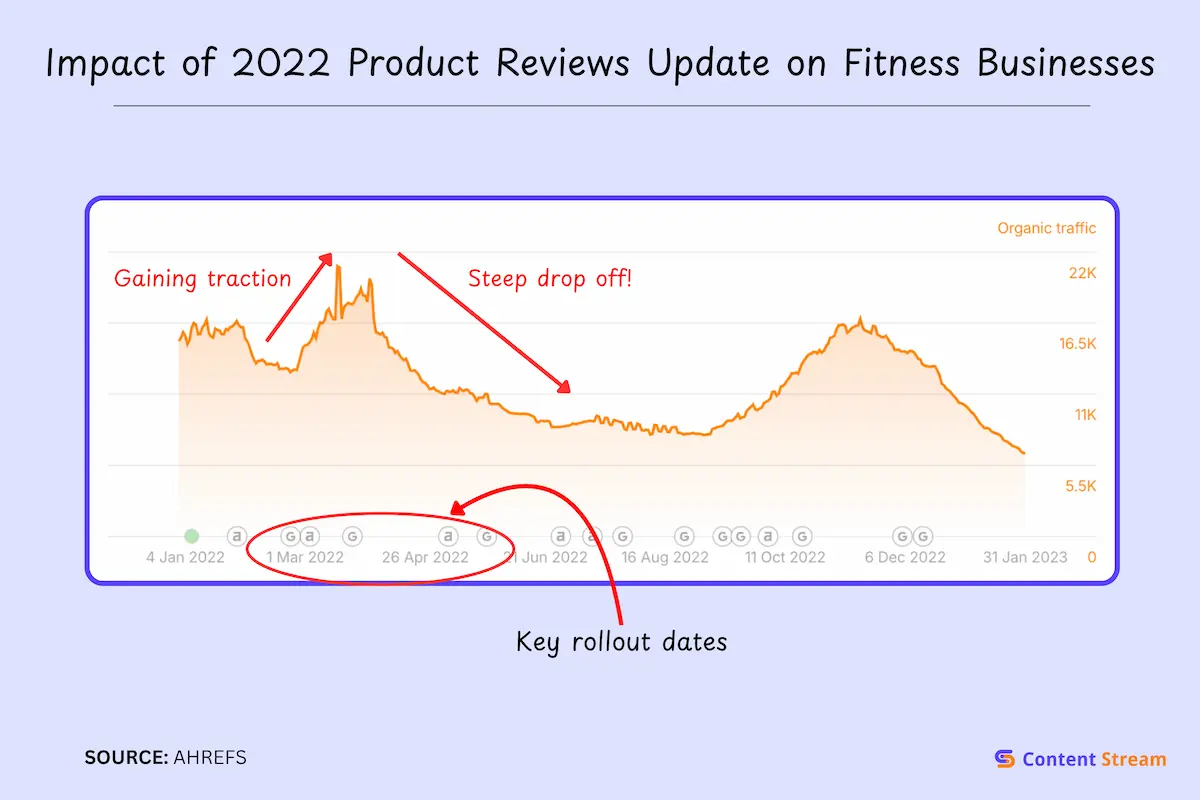
Here’s an example of a website in the fitness niche that was picking up steam before the update rolled out in September 2022, with an impact in November. The result was, their traffic found a new year-long low.
Here’s an even bigger example, from when the first update rolled out in 2021. SEMrush data published on Search engine Land showed that 30% more URLs changed positions during the product review update rollout in 2021 than pre-update days. The chat below shows that volatility.
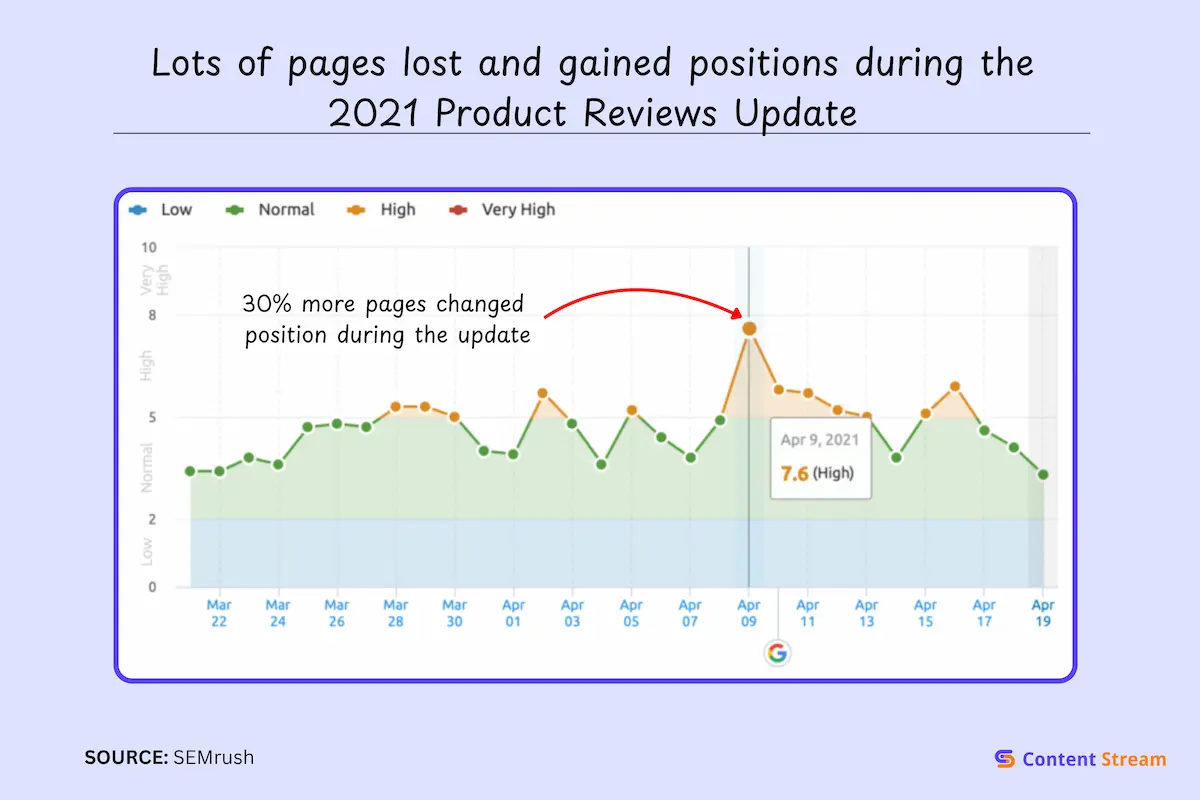
But the Product Reviews Update wasn’t all bad news. In fact, after the February 2023 update, data from SEMRush shows that Beauty and Fitness had a 6.7% increase in URLs moving into the top 10 rankings from outside the top 20.
Here’s what the algorithm update rewarded:
If you want your business website to stand out and actually rank for product reviews, here’s what you need to do:
Important note: In April 2023, Google expanded this beyond just products to include reviews of services, destinations, movies, and games. For fitness businesses, this means gym reviews, personal training service reviews, and fitness app reviews now fall under the same standards.
Google launched the Helpful Content Update in August 2022, and then refined it through multiple updates, before integrating it into core ranking systems in March 2024. This was a big one because it evaluated site-wide signals.
Google’s algorithm rewarded helpful content and penalized content created primarily to rank well in search (not to help users).
Examples of unhelpful content include:
Here are some findings from a study published on paulteitelman.com that involved over 7,000 sites and looked at the long-term impact of the Helpful Content Update. It showed the average monthly organic traffic observed decreased by over 80%, and 27% of sites lost 91-99% of their organic traffic, while 22% lost all traffic.
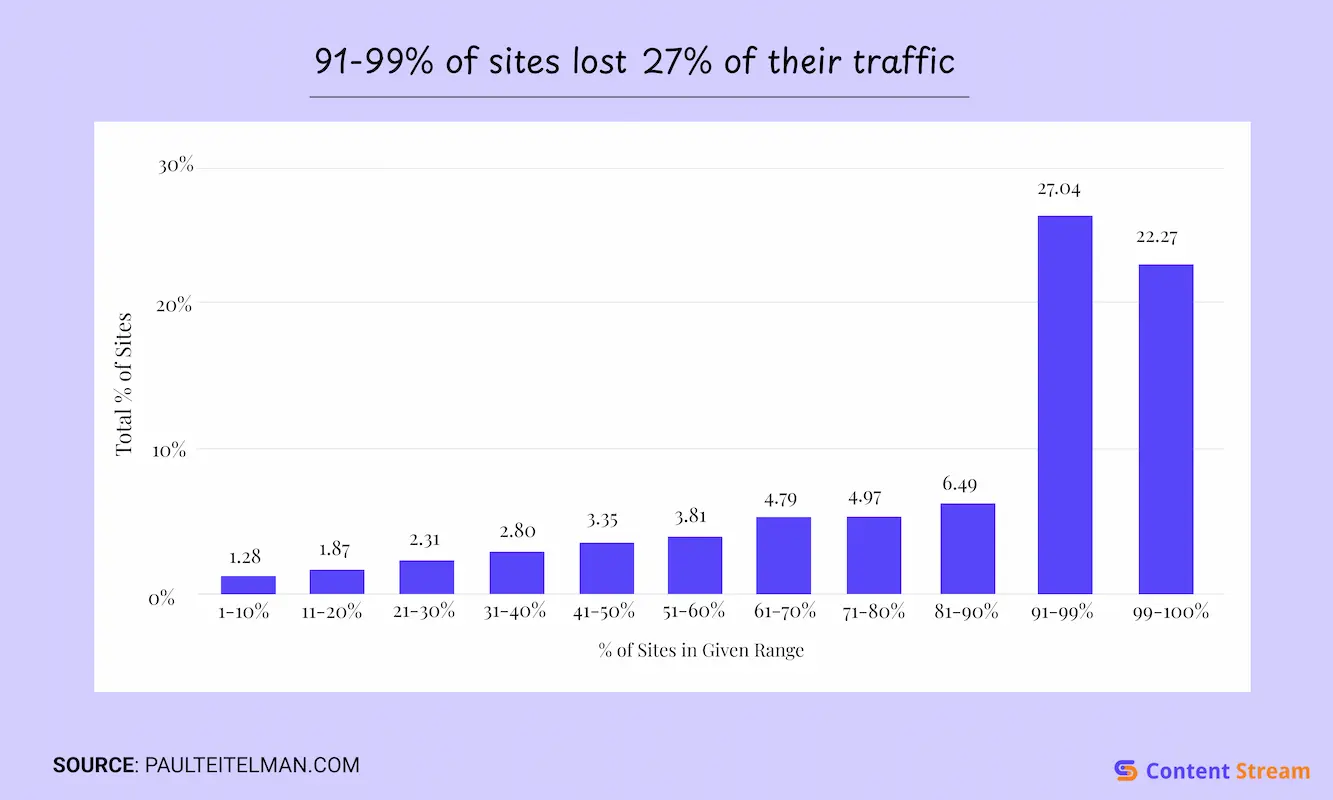
But while some sources report websites being wiped out, others show only mild drops in traffic and visibility. For example, data from Mediavine shows that only 5.8% of their represented websites were negatively impacted by the September 2023 HCU.
This shows that, as with all Google updates, it actually benefited websites that were focused on creating helpful, useful content for visitors. The same Mediavine source shows that almost as many health and fitness websites saw a decline as those that saw a bump in traffic.
Author’s note
During the HCU rollout, Google added an extra “E” – Experience – to the E-E-A-T framework of rating websites.
Also, we also saw Google’s guidance shift from “content written by people, for people” to “content created for people,” removing the “by people” requirement. This meant that AI-generated content isn’t penalized as long as it’s valuable. Google still penalized poor content, regardless of if it had a human source.
Now we know that the HCU update rewards helpful content.
But what does that mean in practice?
Here are some points to keep in mind when deciding on helpful content:
Between 2021 and 2025, Google rolled out multiple spam updates targeting manipulative practices, mass-produced content at scale, and link schemes. These didn’t affect a lot of legitimate businesses, but they did catch sites using questionable tactics.
The March 2024 update was especially memorable because it introduced three new spam policies that changed the way many businesses and websites had been operating.
More than 800 websites were de-indexed, lost 20.7 million organic monthly visitors, and an estimated $446,552 in monthly revenue. By the end, Google announced they achieved a 45% reduction in low-quality content.
We saw sites lose a lot of their rankings across several industries, including fitness. Hardest hit were affiliate sites that scaled to thousands of articles using auto-generated templates. The same was true of websites with 5,000+ product pages, but without any real brand presence, community engagement or natural citations.
Here’s an example of a website that rapidly climbed in organic traffic, partly due to AI-content at scale. The sharp decline in its organic traffic provides immediate feedback on how Google’s algorithm views the content practice.
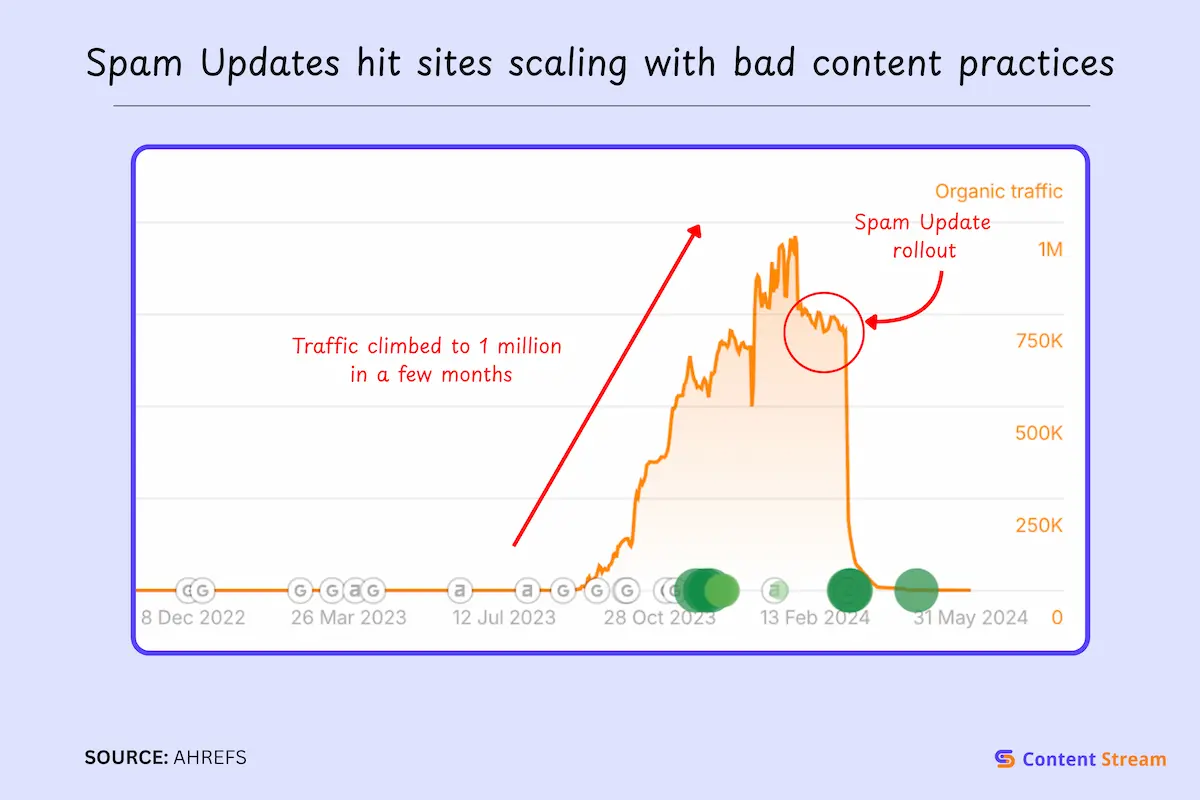
As with the other algorithm updates we’ve reviewed, the requirements are the same for fitness businesses looking to retain visibility: Keep the user in mind when creating content. That means:
Besides the major named updates, Google has rolled out several broad core updates over the years that affect how fitness and health websites are ranked, because of their YMYL classification.
Some of these have minor impacts that slowly ramp up, while others affect websites almost immediately. Here are the core updates with verified, immediate impact on fitness websites.
When this update rolled out, we saw significant volatility in health and fitness niches. Reporting from Sixtrix showed us that some health and fitness websites gained as much as 33% visibility, while some lost 50%!
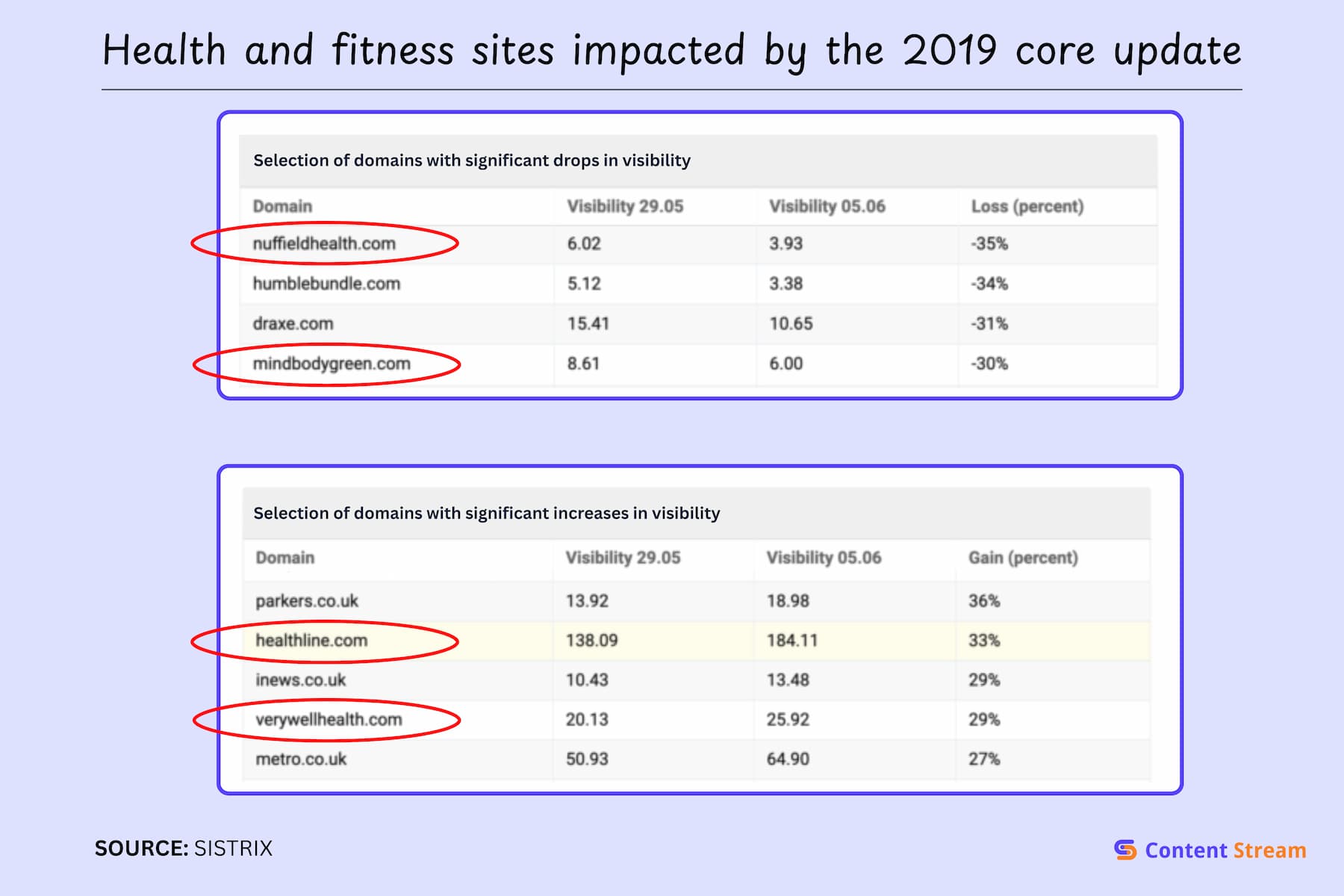
So what happened?
Well, the update continued the E-A-T emphasis introduced by the 2018 Medic Update, with Google refining how it assessed author credentials and medical accuracy in health content.
These two updates are closely linked, with the May 2022 update following the November 2021 one, after a six-month gap. Both showed similar volatility patterns and continued Google’s refinement of quality assessment for YMYL sites.
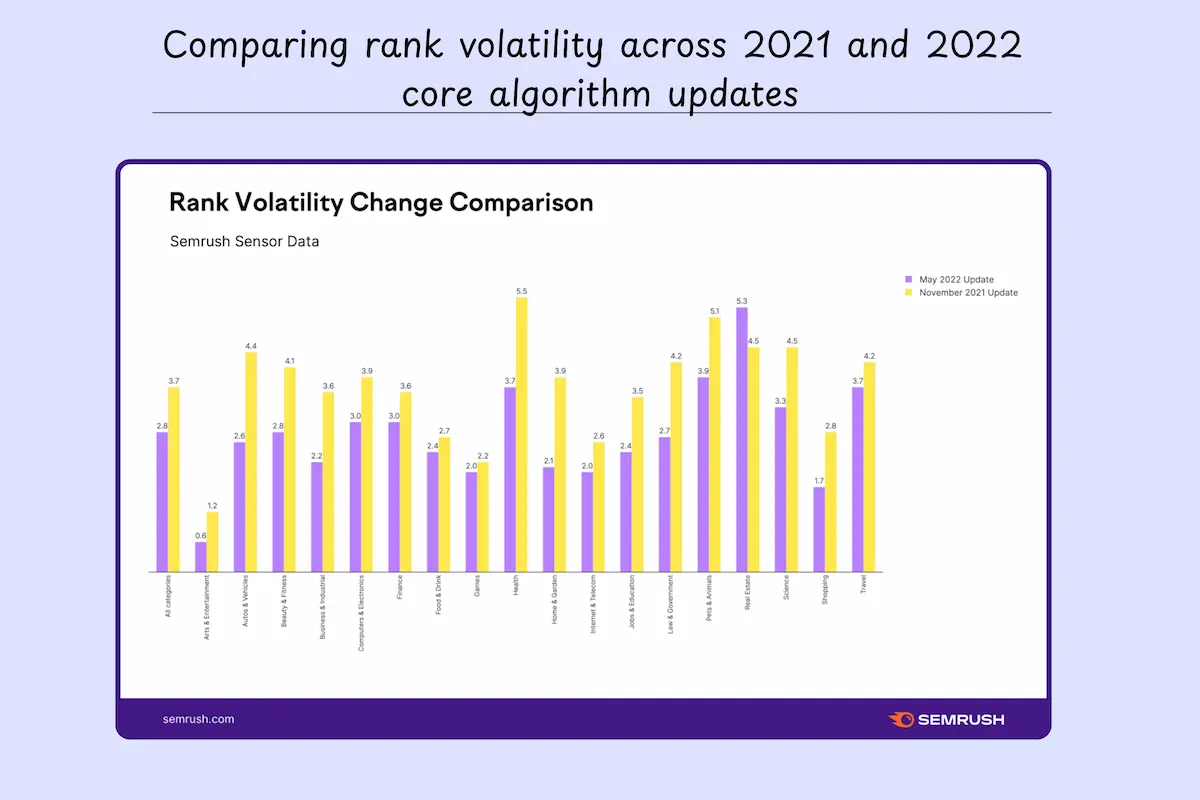
According to analysis from multiple sources, the updates showed strong emphasis on E-E-A-T (the newly added “Experience” element). Here’s a chart from SEMRush showing that volatility ripple out across several industries, with health and fitness seeing the most instability, both in 2021 and 2022.
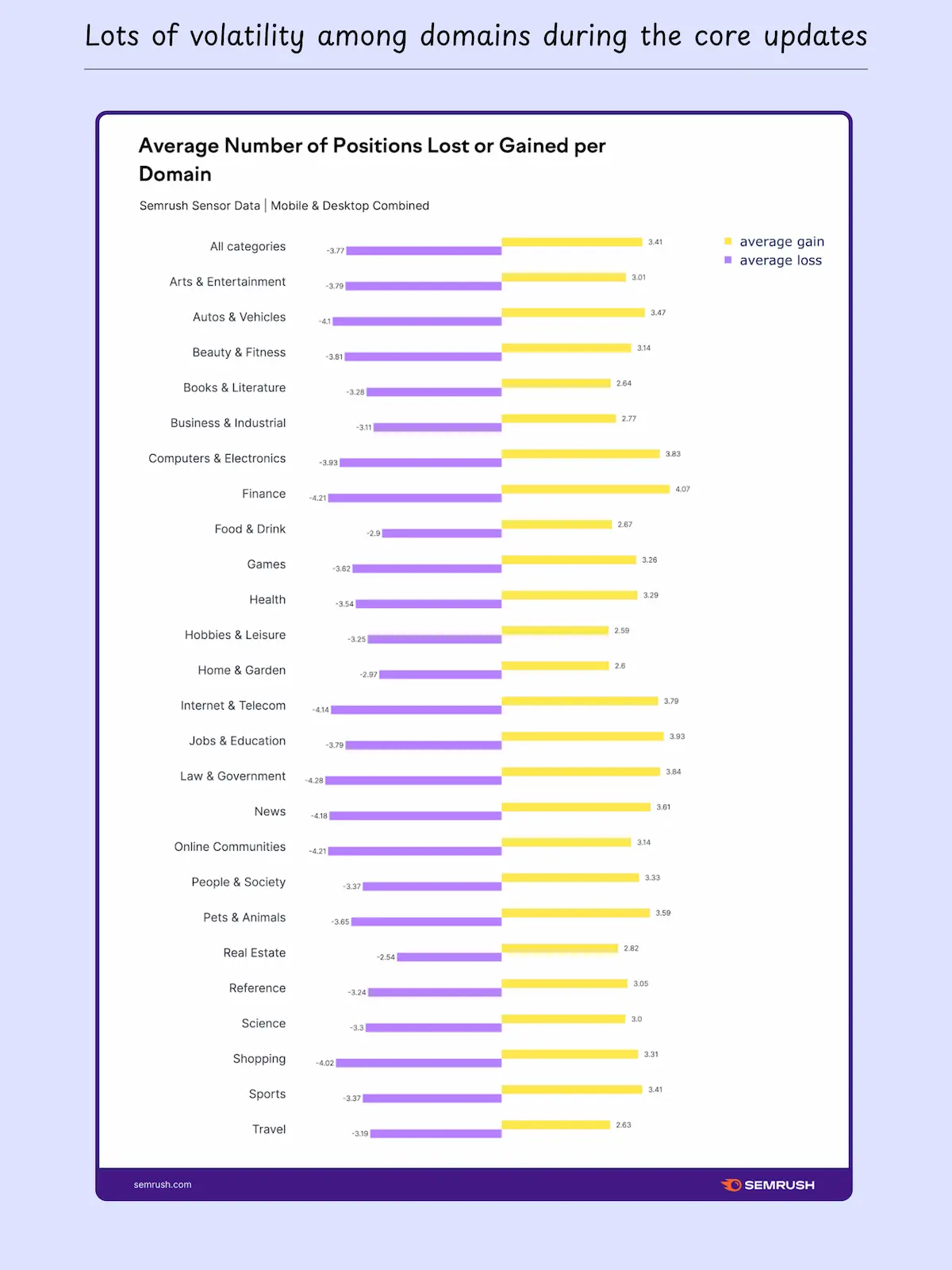
During this update, we also saw ranking shift considerably, as websites gained and lost positions in a way we’ve never seen before. See chart below.
I think for many sites, not going into anything too risky as far as their SEO approach, more often than not, won’t be heavily impacted by core updates… just don’t do that stuff and you should be okay.
This is especially important for your fitness business, where you’re held to a higher YMYL standard than most other niches.
Google’s algorithm updates from 2018-2024 have established clear, non-negotiable standards for fitness and health websites. Here’s what you need to survive future updates:
The pattern that stands out across all these updates is pretty simple: Google rewards websites that put users first, demonstrate expertise, and provide genuine value.
To quote SEO Expert Lily Ray,
Here’s what I recommend you do next:
Can’t decide where to start?
Book a free consultation call with me and let’s talk about next steps for your fitness business.

I’m Matthew, a personal trainer turned SEO who’s worked with brands like Gymfluencers, Sailo, ClickCease, and Fraud Blocker. These days, I help small to medium sized companies grow their reach with smart, search-focused content.
