The “Your Money Your Life” (YMYL) Framework Explained: Why Your Health and Fitness Blog Isn’t Ranking
You’re publishing consistently. Your content is well-researched. You’ve even nailed the keyword research and targeting. But your fitness blog still isn’t ranking.
Here’s what’s probably happening: Google doesn’t trust you yet, and it’s all thanks to the YMYL framework, a filter applied to content that can have lasting impact on people’s health and finances.
It means the difference between publishing one blog every few months and still landing on page 1 vs publishing high quality content every other day with zero traffic to show for it.
So what is the YMYL framework? How does it work? And how can you align your website to meet it’s requirements? Read on.
Your Money Your Life (YMYL) is a classification framework Google uses to identify content that could significantly affect a person’s health, financial stability, safety, or overall well-being. Google uses stricter evaluation standards to YMYL content because wrong information in these areas can cause real-world harm.
Health and fitness falls right in the middle of this framework because of advice on exercise techniques, supplement recommendations, nutrition guidance, and injury prevention.
So for example, improper deadlift form instructions or dangerous supplement advice are examples of fitness content that could directly harm readers if the information is wrong, or even slightly inaccurate.
Google doesn’t use a separate “YMYL algorithm” that operates differently from the algorithm that sorts the rest of internet traffic. Instead, YMYL is more of a content classification and everything under it triggers greater scrutiny. That means the quality signals that Google already uses for all the content are intensified when looking at these kinds of content.
Think of the YMYL classification as a volume knob. For a standard lifestyle blog sharing ‘top kitchen decor trends,’ the volume is set to a normal. Google checks content quality, authority, backlinks, etc, and moves on.
However, for a fitness website advising on ‘how to lower blood pressure,’ Google turns that volume all the way up. Now everything is held to a higher level of scrutiny. Are these claims true? Who is saying them? Have they written similar content before?
The ‘algorithm’ hasn’t changed, but the standard for what qualifies as a trustworthy answer has become significantly more rigorous because the stakes for the reader are much higher.
When Google identifies content as YMYL, it also increases scrutiny of the E-E-A-T signals: Experience, Expertise, Authoritativeness, and Trustworthiness. Fitness content will need to demonstrate SEO competence, genuine authority, and credibility that justifies giving health advice to the public.
Here’s the E-E-A-T framework broken down:
To fully understand how it works, read our blog on Google’s E-E-A-T framework.
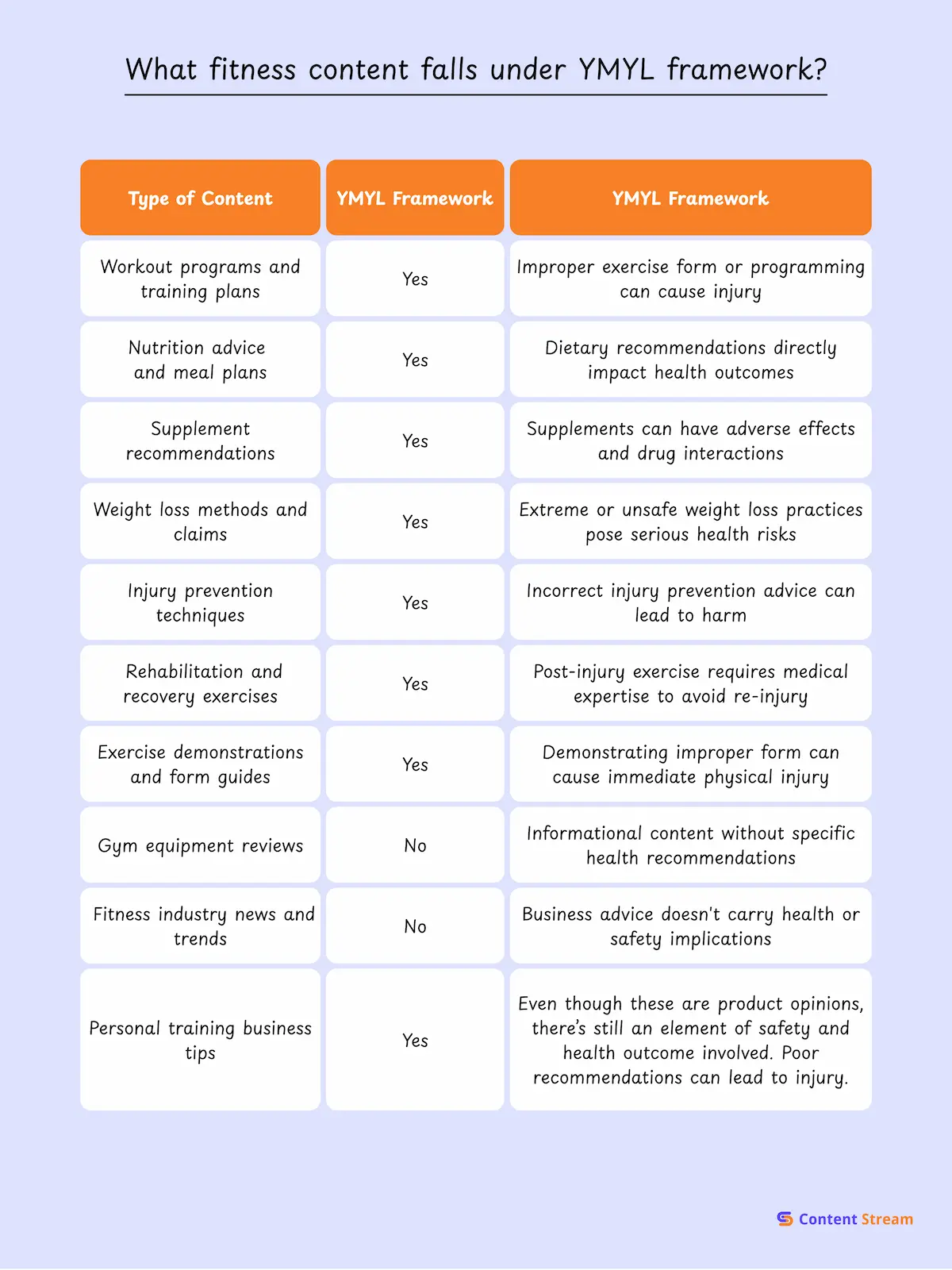
If your content could impact someone’s physical health or safety, Google classifies it as YMYL. This includes health, fitness, some lifestyle brands, finance, legal, government and civic information, and other
For health and fitness related businesses, this includes:
Here’s a table that breaks this down further. It shows which content types trigger YMYL classification and why.
The reason is, your fitness business isn’t meeting Google’s YMYL standards.
Below is a simple list that consolidates all the points we’ve discussed so far.
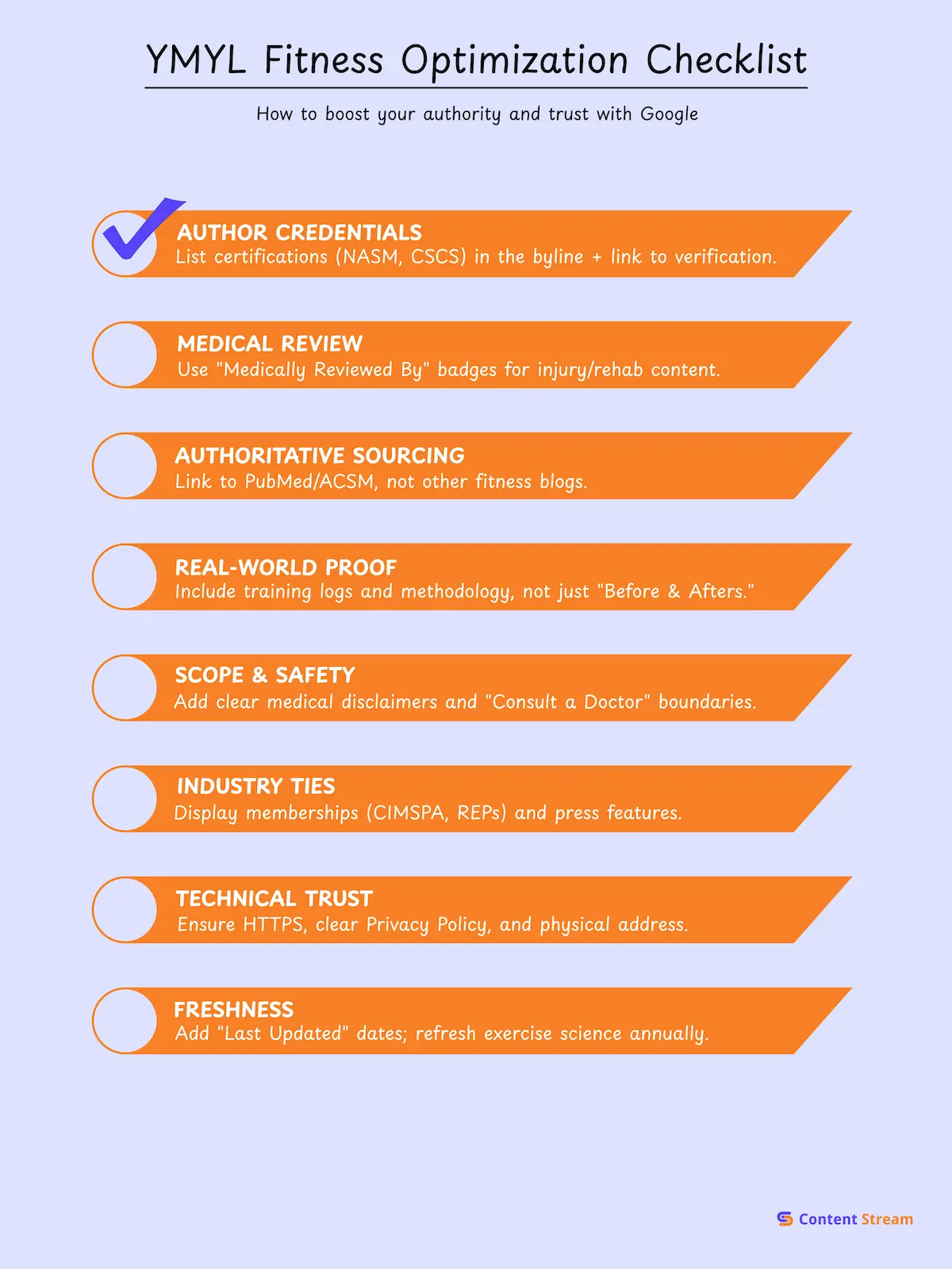
Let’s cover the essential elements Google’s systems looks for when deciding if your fitness content meets the standards for health-related advice.
We share tips that you can use immediately. We also have a comprehensive article on how to avoid YMYL penalties when creating your fitness content.
Display author qualifications prominently in article bylines and dedicated author bio pages. If your trainer has a NASM-CPT certification, don’t hide it in a footer, include “NASM-CPT” directly in the byline and link to the NASM certification verification page.
Create detailed author bios that list all relevant credentials (certifications, degrees, specializations) with the issuing organizations clearly identified. For example, “John Smith, CSCS, MS Exercise Science” with direct links to the NSCA certification directory validates expertise immediately.
For content addressing injury prevention, rehabilitation, or therapeutic exercise, implement a formal medical review layer. This could be as simple as having qualified professionals, physiotherapists, sports medicine doctors, or registered dietitians review and approve content before publication.
Display this clearly with badges like “Medically Reviewed by Dr. Sarah Johnson, DPT” with review dates. This is particularly critical for post-injury content, where incorrect advice could cause re-injury or delayed recovery.
Every exercise science or nutrition claim should link to peer-reviewed research or authoritative medical organizations. When recommending progressive overload for muscle growth, cite the specific study from the Journal of Strength and Conditioning Research or reference position stands from the American College of Sports Medicine.
Avoid citing other fitness blogs or unsupported claims. Link directly to the primary source, the actual study on PubMed, not a secondary article summarizing it.
Include documented case studies and client transformations that demonstrate you’ve implemented what you’re teaching. An article on strength programming should show actual client progress with methodology details, not just before/after photos.
It’s also helpful to include training logs, progression charts, or video documentation (with client permission) that prove real-world application of your methods.
Include clear disclaimers and honest boundaries about your scope of practice. State explicitly when someone should consult a doctor versus a personal trainer.
Acknowledge what you can’t claim. This transparency builds trust.
Establish organizational credibility beyond individual articles. Display memberships in professional bodies like CIMSPA or REPs on your site. Feature client testimonials with full names and verifiable details.
Include any press features, interviews, or guest contributions to established fitness publications like Men’s Health or ACE Fitness. These third-party validations signal to Google that you’re recognized within the fitness industry.
Implement basic technical trust elements that Google’s systems check automatically. Ensure your site uses HTTPS (the padlock icon in browsers). Create a comprehensive privacy policy that explains data collection practices.
Display clear contact information including a legitimate business address and phone number. Add terms of service that outline user responsibilities and content disclaimers. These may seem administrative, but missing elements significantly harm trustworthiness scores.
Date-stamp all articles with publication and last-updated dates displayed prominently. Review and refresh content annually to incorporate new research and remove outdated recommendations.
When exercise science evolves, update existing articles rather than letting them spread obsolete information. An article last updated three years ago signals potential inaccuracy to both readers and search algorithms.
The following resources represent the definitive sources for understanding and implementing YMYL standards. These are the documents and platforms Google references when evaluating fitness content quality.
The YMYL classification fundamentally changes how fitness content must be created and optimized. Google applies stricter evaluation standards to health-related advice because inaccurate information can cause real physical harm.
Meeting these standards requires more than traditional SEO. You need verifiable author credentials, medical review processes, citations to peer-reviewed research, and demonstrated real-world expertise. The E-E-A-T framework forms the backbone of YMYL evaluation, with each pillar requiring specific, actionable evidence.
Technical trust signals, transparent business practices, and regular content updates complete the picture. Fitness businesses that implement these standards don’t just rank better, they build genuine authority that compounds over time.
If you’re unsure whether your content meets YMYL requirements or want expert guidance on implementing these standards, request a free audit from our team. We can help point you in the right direction and provide a detailed roadmap for improvement.

I’m Matthew, a personal trainer turned SEO who’s worked with brands like Gymfluencers, Sailo, ClickCease, and Fraud Blocker. These days, I help small to medium sized companies grow their reach with smart, search-focused content.
