Fitness SaaS Content Strategy: 6 Tactics That Go Beyond the Blog
Many fitness SaaS companies follow the same content playbook: a blog, a keyword list, and a predictable publishing cadence. And there’s a reason for this; it works! (You should check out our Fitness SAAS keyword list btw. It’s really detailed!)
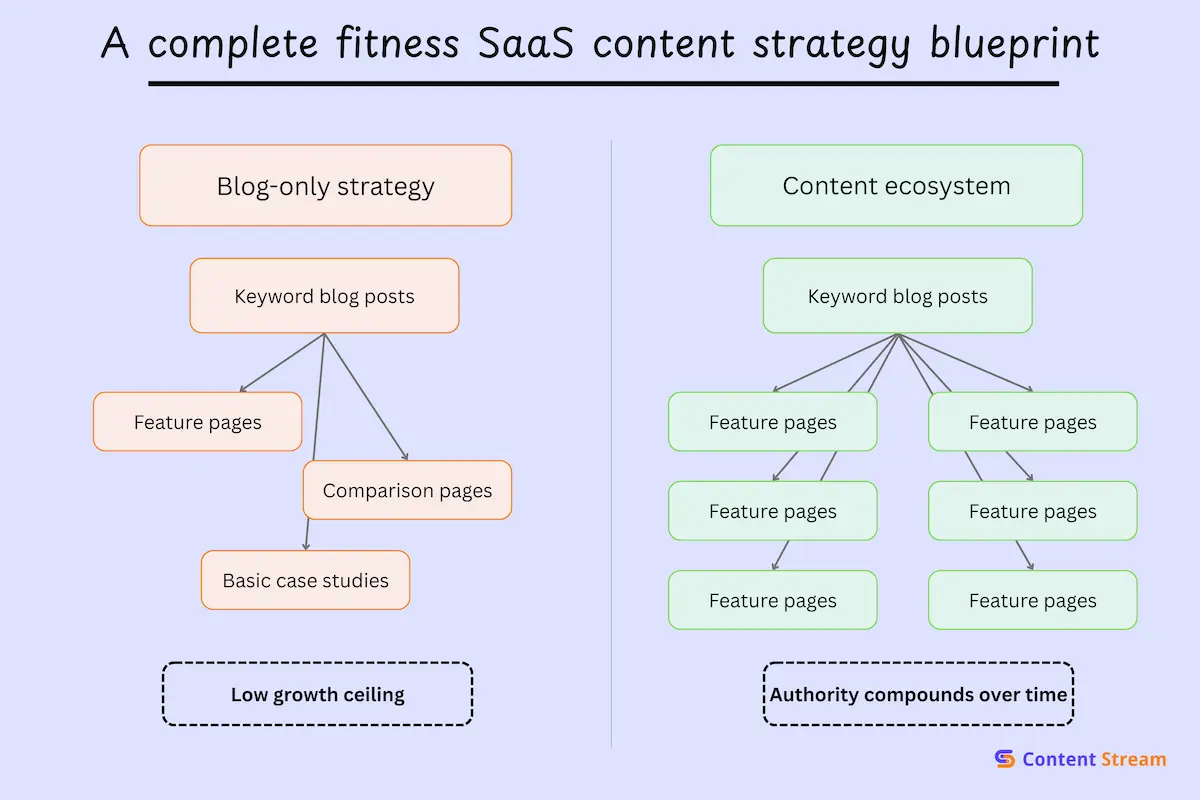
But, blog-driven strategies have a ceiling.
And in a niche where Google scrutinises health-adjacent content more heavily than most, that ceiling tends to arrive quickly.
An alternate strategy is to build content ecosystems: tools, calculators, structured data, video, and other formats that demonstrate real expertise. These wean your inbound off information queries alone, and can help you build genuine authority.
Let’s talk more about how to do that.
Before exploring ways to expand your content strategy, it’s worth examining the baseline strategies many companies already rely on. The cookie-cutter playbook looks something like:
These strategies represent the floor of SaaS SEO, not the ceiling.
Many of the best SaaS SEO strategies are open secrets. In fact, I’ve seen them deployed several times by SaaS companies to build authority and search visibility.
You just don’t see these strategies often in fitness SaaS because the current model works. You publish blogs, earn backlinks, and grow!
But if you want to outpace the competition (and survive the current traffic cannibalisation of AI searches), it’s time to explore these strategies.
One of the biggest advantages of running a SaaS platform is the amount of structured data your product naturally generates.
Instead of manually creating pages for every popular search query, or publishing endless hyper-specific articles and comparison pages, let programmatic SEO do the heavy lifting.
Programmatic SEO tools like Zapier help generate integration pages that connect one page to another–think [Tool A] + [Tool B] or comparison/alternative pages. Here are links to some examples.
Each tool targets a specific pairing while pulling from the same underlying product data.
Our industry has a version of this. Instead of integration pages, the pages focus on locations, business types, or coaching niches; essentially the verticals your software already serves.
For example, a gym management platform could generate pages like:
Higher search visibility isn’t the only benefit here.
These queries also carry minimal YMYL risk, because they focus on business operations rather than physiology. That means they fall outside the areas of fitness content that search engines scrutinise most heavily.
That said, ranking still requires effort. In my experience, the main hurdle here is avoiding low-quality programmatic SEO. That means you can’t simply swap a city name into a template. Each page needs genuine variation, drawing from local context, discipline-specific use cases, niche examples, or relevant customer stories.
Free tools and calculators have been a reliable SEO strategy for years, yet they remain surprisingly underused in the fitness and wellness SaaS space. We still see them (calorie counters, daily protein requirements, etc) but there’s a lot more potential.
And it’s important because these tools let you give searchers actual resources they need, instead of simply offering advice.
They’re surprisingly easy to create, too.
Platforms like Outgrow and Calconic let you create interactive calculators by defining input and logic, while simple Javascript tools can be embedded on your site if you want full ownership.
Many SaaS giants have built enormous authority through tools like these. For example, Hubspot uses its Website Grader, Email Signature Generator, and Marketing ROI tools to attract search traffic and earn backlinks.
Other Saas companies use the same strategy. Shopify offers tools like Business Name Generator and Profit Margin Calculator, while Ahrefs drives awareness through SEO tools like Keyword Generator and Backlink Checker.
Fitness SaaS companies have plenty of opportunities to build similar tools, especially around the business metrics gym owners and trainers already care about.
Here are some ideas:
Pro tip: Build your tool around your own platform data
When you can say “trainers using our platform average X clients per week” or “studios that automate booking see Y% fewer no-shows,” your calculator’s output becomes grounded in real user behavior.
In many SaaS verticals like cybersecurity, fintech, and martech, it’s common practice to build and publish large, searchable glossaries of industry terms that are fully indexable by Google.
These pages don’t always feel like traditional “content marketing,” but they quietly bring in a steady flow of informational searches while strengthening the company’s topical authority. The same principle applies to fitness and wellness SaaS.
But the opportunity isn’t necessarily the fitness terminology itself. That space is already saturated with content from major health publishers and training websites. The real gap is in the operational and business vocabulary that gym owners, studio operators, and personal trainers search for when trying to understand the metrics behind their businesses.
Think queries like:
By publishing clear, well-structured definitions around these kinds of terms, fitness SaaS companies can gradually become a reference point for curious trainers and gym owners.
Over the last decade, great video content has become almost synonymous with presence in the fitness industry. If you want to show up, you make videos. We’ve seen this cut across brands selling clothing, coaching, supplements, courses, or gym memberships.
Brands like Gymshark and Alphalete, for example, built massive audiences by partnering with gym influencers and creating video content with them.
Granted, there are fewer gym owners than there are hobbyist athletes or fitness enthusiasts, but there are also far fewer creators producing content specifically for fitness business operators.
That means there’s a massive gap you can fill.
We recommend publishing search-optimised videos around topics people are actively looking for help with. And obviously focusing on the intersection with your ideal audience. For example:
From a competitive standpoint, good optimization alone will often put you ahead of other SaaS brands in the space. But to truly stand out, it helps to focus on areas where you already have strong topical authority.
One brand that does this well is Trainerize.
Trainerize sells personal training software, and as a result, nearly every video they publish ties back to personal training in some way. Even a video like this on side hustles for trainers are examined through the lens of the trainer business ecosystem.
Depending on what kinds of businesses you serve, your brand likely has data points like booking patterns, session completion rates, client retention curves, and even season demand benchmarks. You can turn these into insightful reports for the industry to draw from (and to help your potential customers’ decision making.)
Original research is also some of the most linked to, cited, and E-E-A-T reinforcing content formats businesses can leverage.
Here are a few great examples of original research to inspire your own:
A lot of link-building in the fitness SaaS space revolves around guest posts and directory listing. Those tactics can help early on, but they have diminishing returns.
Digital PR is often a far more reliable path to earning the kinds of backlinks that genuinely improve domain authority.
By publishing original data, expert commentary, or timely research on fitness trade publications, business outlets, and coaching industry organisations, SaaS brands can earn editorial links that search engines increasingly reward.
Here are a few tactics that work particularly well in the fitness business space:
A common thread across all these strategies is that they play to the strengths of a fitness SaaS company: product data, operational expertise, a clearly defined audience, and a legitimate position inside the fitness business ecosystem.
Instead of competing for authority on workouts or nutrition (areas which are dominated by health publishers), your business can thrive by focusing on the operational side of the industry they serve.
Of course, none of this replaces foundational content like blogs, product pages, and case studies. But when combined with tools, programmatic pages, original research, and video, your content strategy shifts from chasing traffic to building authority over time.
Confused about where your website SEO stands? Book a consultation and let’s talk about it!

I’m Matthew, a personal trainer turned SEO who’s worked with brands like Gymfluencers, Sailo, ClickCease, and Fraud Blocker. These days, I help small to medium sized companies grow their reach with smart, search-focused content.
