Why Fitness SaaS Sites Struggle With Core Updates + What to Do
If you’re flagging a traffic drop and have traced it back to a Google algorithm update, you’re not alone. Fitness and wellness SaaS companies often get hit disproportionately hard by core updates, and the reasons aren’t always obvious, even to experienced SEOs.
It comes down to two things: the niche itself, and how SaaS content tends to get made. Fitness content sits inside YMYL territory, where Google holds websites to a stricter standard than almost anywhere else. And the content production habits that scale well in other verticals are precisely what Google’s classifiers have been built to detect.
Here’s why fitness SaaS sites are more exposed than most, and what to do if yours has already taken a hit.
The content marketing playbook for SaaS is fairly universal: identify high-volume keywords, build a content calendar, publish consistently, and let organic traffic compound. In most verticals, this works. In fitness, it carries higher risk because your content overlaps significantly with YMYL territory.
Google’s Quality Rater Guidelines classify content as YMYL when it could directly affect a person’s physical health and safety. That means rep ranges, overtraining signs, fat loss protocols, injury prevention. So while you’re publishing content to support your product, Google is assessing your site against the same standard it applies to medical publishers.
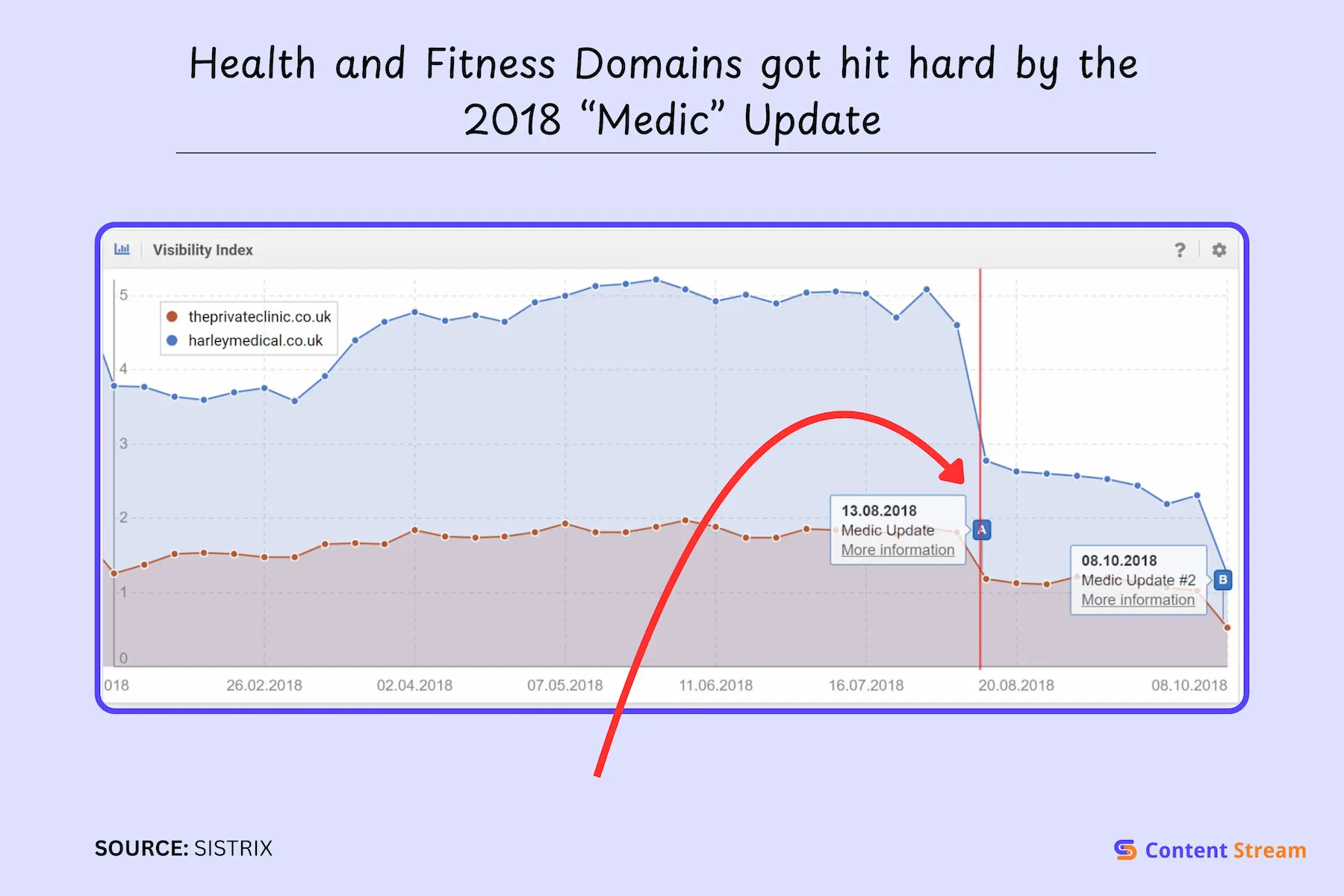
The first time we saw this take effect was the 2018 Medic Update, where 42% of affected sites were in the health, fitness, or wellness space.
E-E-A-T (Experience, Expertise, Authoritativeness, and Trustworthiness) is how Google assesses whether a site is a credible source. For most fitness businesses, closing that gap is straightforward: hire qualified coaches, get them writing or reviewing content, display their credentials.
For SaaS, it’s more complicated. The people who understand the product best are developers and product managers. The people producing content are marketers. The fitness expertise Google’s quality raters are looking for typically doesn’t exist in-house, and building it into your content process isn’t plug and play.
As Google’s John Mueller confirmed at the 2025 Search Central Live event:
“Sometimes SEOs come to us and mention that they’ve added E-E-A-T to their web pages. That’s not how it works. You can’t sprinkle some experience on your web pages.”
The typical SaaS response to an algorithm hit (updating meta descriptions, improving page structure, adding author bios) doesn’t address that underlying problem.
In SaaS, things move quickly, including the pressure to build topical authority and domain ranking, compete with established players, and justify content marketing budgets. This can lead to a production model that looks efficient on paper: keyword clusters mapped to templates, workflows optimised for consistency, high output at low marginal cost.
And in many cases I’ve seen, AI is even woven into the process, drafting, expanding, or publishing at scale.
The problem isn’t the use of templates or tooling. The problem is that Google’s classifiers are specifically tuned to detect what this produces.
In March 2024, Google introduced “scaled content abuse” as an explicit spam policy. It is defined as mass-producing content to manipulate search rankings, regardless of whether a human or AI generated it. Over 800 websites were de-indexed, losing a combined 20.7 million monthly organic visitors.
That’s why a fitness SaaS blog post about “how many rest days per week” that was generated from a template, lightly edited, and published alongside 200 similar articles is not going to survive scrutiny. Neither is one that was written by hand but follows the exact same structure as every competing article already ranking.
Here are two examples of websites that took a dip after a Google algorithm update. If your website has the same problem, you might recognize some of these patterns.
This was a fitness-niche site that had been building momentum through “best of” listicles — the classic “10 Best [product] for 2022” format. The site was picking up organic traffic steadily before the September 2022 Product Reviews Update rolled out, at which point it hit a year-long traffic low almost immediately.
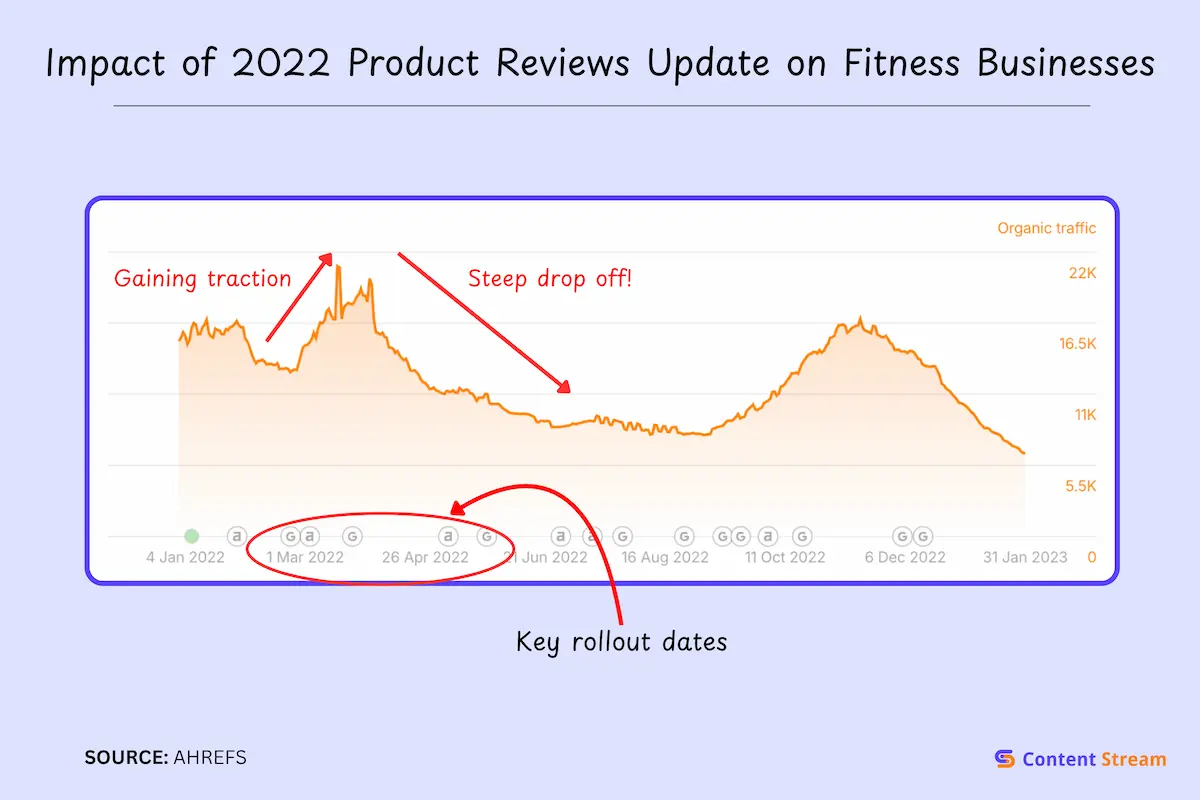
What were they doing wrong? Publishing templated roundup reviews that claimed to test products but didn’t. They didn’t share original photos, genuine comparative analysis, or author credentials. Google’s update specifically targeted this pattern, rewarding reviews backed by first-hand testing, evidence, and genuine expertise.
This one’s a sharper lesson. A site rapidly climbed in organic traffic by scaling AI-generated content. They published hundreds of articles built around trending fitness queries and supplement topics. The growth was enviable and fast, but it did not last.
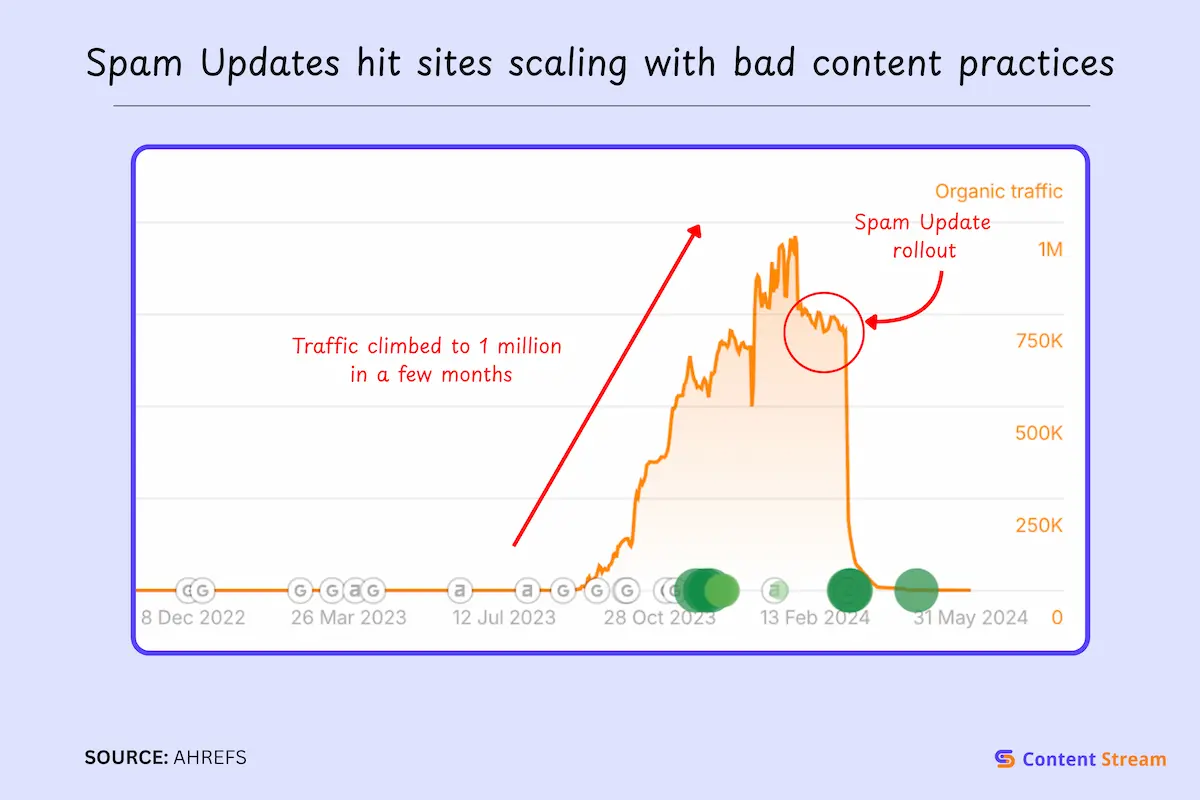
The site had no real brand presence, no community engagement, and no natural citations. Google’s March 2024 Spam Update introduced “scaled content abuse” as an explicit spam policy, and sites like this were exactly who it was designed to catch.
The March 2024 update alone saw 800+ websites de-indexed, losing a combined 20.7 million monthly organic visitors.
Both of these sites found out too late that their approach wasn’t built to last. The best strategy has always been to get ahead of the standards before an update forces your hand. A proactive SEO approach, built on genuine expertise, honest content, and solid technical foundations, is what keeps you visible through every update Google rolls out.
Algorithm penalties feel sudden, but the recovery process is methodical. Here’s how I’d approach it.
Before changing anything, verify that a Google update is actually responsible. Cross-reference your traffic drop date against known rollout dates using the Google Search Status Dashboard or Search Engine Roundtable. A drop that coincides with a core update rollout is a strong signal. One that doesn’t might be a technical issue like a broken page, an accidental noindex, or a crawl anomaly.
These will require a different fix.
Not all updates require the same response. A YMYL or E-E-A-T issue points to credential and content quality problems. A spam update points to manipulative patterns at scale. A page experience update points to technical performance.
Also, keep in mind that sometimes, Google may roll out an update that shouldn’t affect your niche but you still experience volatility. We saw this with the February 2026 discover update that affected sites that have never appeared in Google’s discover feed.
Misdiagnosing the type means your fixes won’t land, and you’ll be waiting for signs of success that never come.
Look at which pages dropped and what they have in common. Are they all thin? All written without credentialled authors?
Or is there a more complex problem like outdated examples and no search satisfaction?
The pattern across the pages usually tells you more than any individual page will.
Don’t just patch the reason this specific update caught you. Use it as a forcing function to raise your overall standard. That might mean tightening internal linking, publishing original research, refreshing stale content, or closing credential gaps on existing pages. The goal isn’t to get back to where you were but to build a site that survives the next update.
This is a second mistake I’ve personally made a few times before. The instinct is to recover the baseline quickly and stabilize organic traffic. But rapid growth rarely happens without shortcuts: mass-publishing, buying links, targeting low-difficulty keywords with no relevance to your product. Approaches like these contribute to algorithm penalties; they don’t fix them.
Once the fixes are in place, stop watching the dashboard and get back to work. Fold whatever changes you made that addressed the penalty into your standard workflow and move forward. The recovery will come, but it follows content worth rewarding, not the other way around.
We’ve seen sites bounceback and beat their pre-penalty traffic numbers. But they don’t usually wait for Google to recognise their fixes. Instead, the idea is to treat the penalty as a reset, raise content standards, and get back to satisfying real users.
If you’re not sure whether your fitness SaaS content is built to the standard Google expects, that’s worth finding out before the next core update does it for you.
Request a free audit and we’ll tell you exactly where you stand.

I’m Matthew, a personal trainer turned SEO who’s worked with brands like Gymfluencers, Sailo, ClickCease, and Fraud Blocker. These days, I help small to medium sized companies grow their reach with smart, search-focused content.
Get a free SEO audit and discover the exact keywords and strategies that will grow your fitness business. Or, jump straight into a consultation to discuss your goals.
No sales pitch. No obligations. Just a detailed analysis of your site's SEO performance or a strategic conversation about growing your business—with a clear roadmap to more traffic, leads, and revenue.
