Why Your Supplement Brand Isn’t Ranking: SEO Strategy Guide
If your supplement brand isn’t ranking, one of these is likely responsible:
Start here: Audit your existing content against these four areas. Identify your biggest gap, then prioritize fixing it before moving to the next.
The global dietary supplements market was valued at $192.65 billion in 2024, and competition for high value SEO keywords reflects this scale. As you can see in this graph plotted from Ahrefs keyword data, search volumes for keywords like “Lion’s Mane” and “Ashwagandha” have seen a steady rise since 2016.
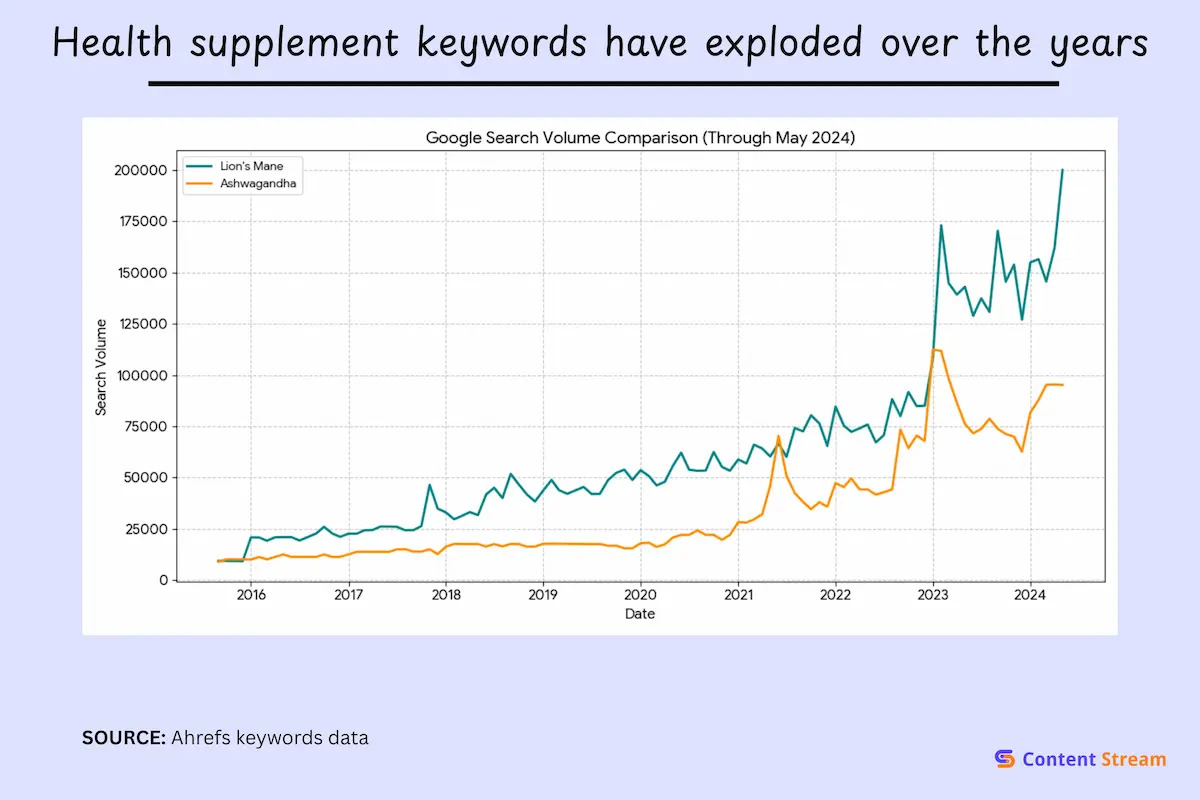
With volume comes competition, which is why it’s become very challenging for new supplement brands to rank. But fierce competition from established players and Amazon aggregators is only part of the problem.
The other is this: Google’s YMYL (Your Money or Your Life) standards scrutinise health content more heavily than almost any other industry.
That means that, even though white labeling makes entry into the industry fairly easy, ranking for “magnesium supplement” or “best protein powder” is a different story entirely.
If your brand’s website isn’t ranking, we can usually trace the problem back here. I’ve seen that the brands that break through don’t stop at optimising product pages. They go the extra mile and actually tailor their content strategy to the actual customer journey.
That’s not just experience talking, either. When we analysed 116 US supplement brand websites for our own Supplement SEO Report, we found the top 20 sites ranked for 8.7x more keywords than the rest of the sample, despite only 1.3x higher domain authority.
So let’s cover how you can do that, starting with understanding the supplement buyer’s journey and how they move from symptom to purchase. Then, you’ll be able to craft an SEO strategy for your supplement brand that captures potential customers at every stage.
If you’re looking for a quick list of why your website might be struggling organically, go to the “Sum Up: Why your website isn’t ranking” section.
The supplement customer journey follows 5 distinct stages:
One mistake that’s easy to make is targeting Bottom of Funnel (stage 5) keywords and ignoring the top of the funnel (stages 1-3), where actual buying decisions form.
The barrier to entry in supplements is remarkably low. Search any supplement category and you’ll find established brands competing with dozens of Amazon private label sellers. Bottom-funnel keywords like “buy [supplement name]” are intensely competitive and expensive, and by that point, customers have already decided what they’re buying.
The opportunity here is in stages 2-3, where customers are still researching problems and discovering solutions. We see the same pattern in our own report data: the top supplement brands rank for far more keywords than everyone else, 8.7x more, while their authority is only 1.3x higher. That gap comes almost entirely from covering more of these research and comparison stages, not from having a stronger domain.
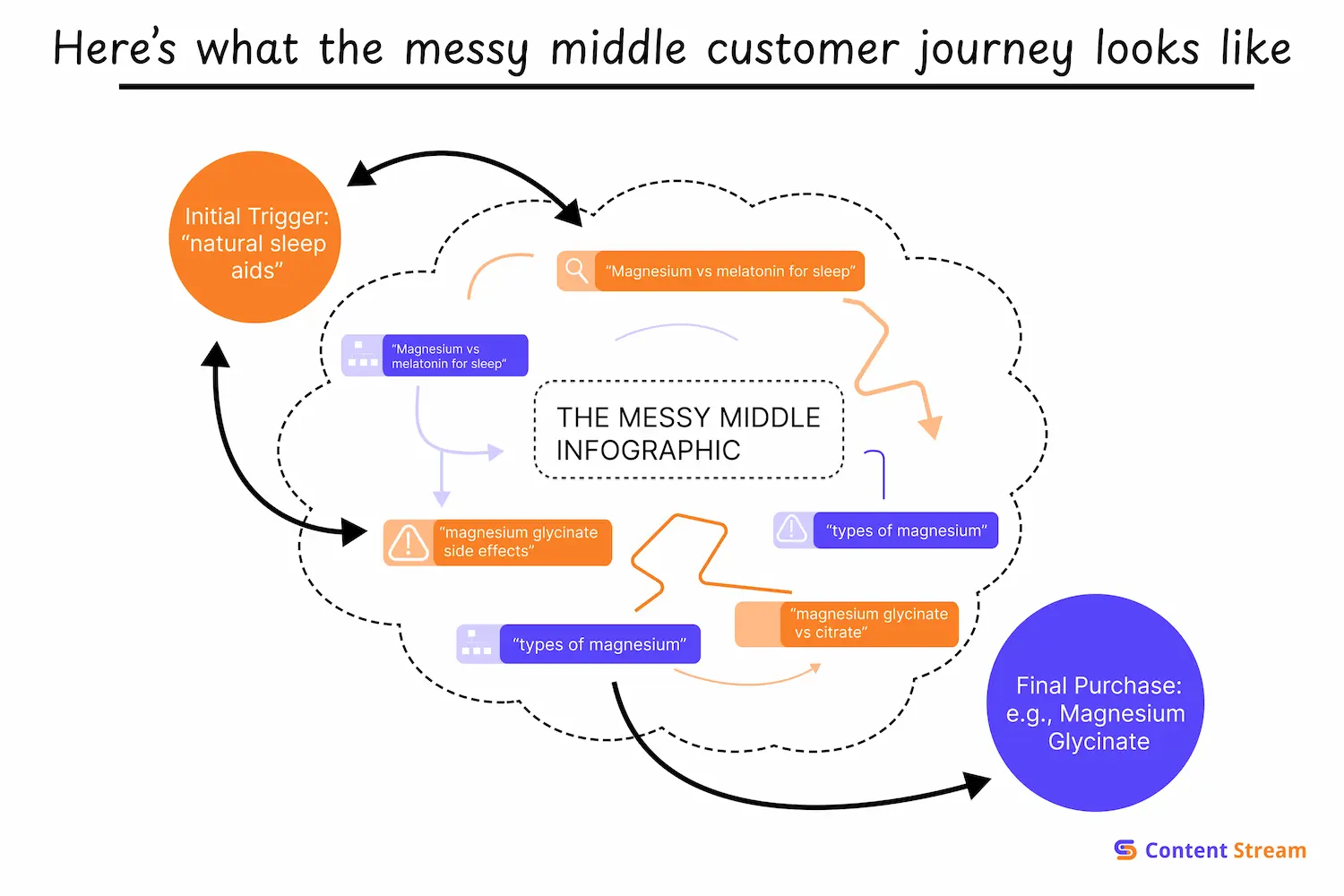
Google’s findings on the “Messy Middle” describes the process between initial trigger and final purchase, where customers loop between exploration and evaluation. This pattern is often long, non-linear, and very evident in the supplement industry.
Here’s what the messy middle might look like:
This loop can continue for days or even weeks before a purchase decision is made.
Each loop represents both a challenge and an opportunity. The challenge is that customers can exit at any point or choose a competitor.
The opportunity with the Messy Middle is that strategic content can break the loop and move customers toward a decision.
If someone is stuck comparing magnesium glycinate versus citrate, they need clarity to move forward. A comprehensive guide that explains the differences, use cases, and benefits of each form can be the piece of content that finally resolves their research paralysis.
Because the supplement landscape is so fragmented and the research journey so complex, we don’t look at the funnel as a single linear path. Instead, we view it as four distinct opportunities to build trust and provide value at different touchpoints in the customer’s decision-making process.
The messy middle we described above doesn’t just happen across Google tabs anymore. A growing share of it is happening inside ChatGPT, Gemini, and AI Overviews. Roughly 1 in 4 US adults have used an AI tool for health information or advice, and 8% now say AI is their first stop for health questions specifically, more than social media, closing in on traditional health websites.
For supplement brands specifically, this is already the norm rather than the exception. In our 116-site sample, 97% of supplement brands appeared in either Google AI Overviews or ChatGPT results, and higher organic traffic strongly predicted AI visibility.
The practical takeaway is that you don’t need a separate AI content strategy. The same comparison guides, dosage explainers, and evidence summaries that resolve a reader’s “magnesium glycinate vs citrate” confusion inside the messy middle are exactly what an AI Overview pulls from when it answers that same question. Strong consideration-stage content already does double duty, and the same principles apply whether that content sits on a supplement site or, as we’ve covered in our guide on optimising your wellness content for AI and LLM search.
Each stage of the supplement customer journey represents a different mindset, search behavior, and content need. Understanding these distinctions allows you to create targeted content that meets customers exactly where they are.
Here’s how the journey breaks down:
At the awareness stage, potential customers aren’t searching for supplements at all. They’re searching for answers to symptoms or health concerns they’re experiencing. These are informational queries with high search volume and relatively lower competition than product-focused keywords.
Content at this stage should educate without immediately selling. For example, an article titled “Why Do I Feel Tired After Lunch? 7 Common Causes” can introduce nutritional deficiencies as one potential factor, naturally leading to a discussion of relevant nutrients.
The goal is to build brand awareness and establish authority by providing genuinely helpful information.
Tips for awareness-stage content
Once customers identify a potential solution, they enter the consideration stage. Here, they’re researching specific ingredients, comparing options, and trying to determine which approach is right for their situation. These searches often include comparative terms or “best of” queries.
In my experience, this stage also represents the highest opportunity for most supplement brands. Why?
Well, the competition is more manageable than decision-stage keywords, and customers are actively looking for guidance on what to choose.
Content that comprehensively addresses these comparisons can become their go-to resource; the one that captures multiple users exploring the messy middle.
Effective consideration-stage content will include:
Our Supplement Brand’s Content Playbook breaks down exactly which content formats perform best at this stage, including ingredient comparisons and evidence summaries.
At the decision stage, customers know what ingredient or product type they want. Now they’re evaluating specific brands and products. They’re looking for trust signals: reviews, third-party testing, ingredient sourcing, and evidence of efficacy.
Product pages at this stage need to go beyond basic e-commerce optimization. Decision-stage optimisation needs to address the specific concerns that keep someone from clicking “add to cart.”
Answer questions like:
Critical elements for decision-stage content:
For most supplement users, the customer journey doesn’t end at purchase; they end up buying more tubs, or, maybe even switching to your competitor.
So, retention-stage content needs to serve existing customers by helping them get better results, which increases satisfaction, reduces returns, and, of course, encourages repeat purchases and subscriptions.
This content also serves an SEO function. Searches like “how to take [supplement] for best results” or “can I stack [supplement A] with [supplement B]” are often performed by people who’ve already purchased but want to optimise their protocol.
Keep in mind, most users will also search, “Cheaper alternatives to [supplement A],” giving competitors a chance to step in.
By ranking for these queries, you can capture customers who bought from competitors and potentially convert them.
Retention-stage content includes:
Google needs to trust your brand before customers ever get the chance to. Without that algorithmic trust, supplement brands find themselves spending heavily to drive traffic that vanishes the moment the budget runs out.
Like most supplement sites, you won’t get evaluated like typical e-commerce stores. Because health content falls under YMYL (Your Money or Your Life) guidelines, the algorithmic standards are significantly higher.
Here is how Google evaluates supplement sites differently:
If your supplement brand isn’t showing up in Google search results, the problem usually falls into one of these categories:
Based on my experience, I recommend starting by mapping your existing content to the four customer journey stages. Identify where you’re missing opportunities, particularly in awareness and consideration.
Next, build topic clusters that address the messy middle, and focus your content on guiding customers from symptom to solution without losing them to competitors.
I’d also keep in mind the huge factor of trust; without it, your brand will struggle to rank on Google.
Expert credentials, authoritative citations, transparent practices, and balanced information that includes both benefits and potential concerns are all crucial..
If you love getting into the weeds, I’d also scan Google’s Search Quality Rater Guidelines, using it as your reference.
If you’re unsure where your brand stands, request a free audit. Or, book a free consultation call to see if Content Stream is the right SEO partner for your supplement brand.
Let’s cast an experienced eye over your current content strategy and show you where strategic improvements will drive the most impact.

I’m Matthew, a personal trainer turned SEO who’s worked with brands like Gymfluencers, Sailo, ClickCease, and Fraud Blocker. These days, I help small to medium sized companies grow their reach with smart, search-focused content.
