
The State of SEO in Employee Assistance Program (EAP) platforms
The Employee Assistance Program sector provides mental health support, financial counselling, and crisis intervention to millions of workers around the globe. It is a sizeable, steadily growing market valued at $7.79 billion.
Unfortunately, most providers in this sector are largely invisible to new searchers. Our findings show that the majority of EAP platforms have minimal organic visibility and can’t be found by users looking for their specific solution. This is in spite of large keyword volume data and high EAP-related search queries.
In this report, we’ll share what we found about the state of SEO in Employee Assistance Programs in 2026, including the gap in organic visibility, our theories on why the space exists, and what providers can do to quickly take advantage of this opportunity.
This report analyses the SEO footprint of 51 EAP providers across the US, UK, Australia, Canada, and Ireland. We reviewed their organic traffic, keyword visibility, branded traffic dependency, AI search presence, and several other organic factors. This report is based on data pulled from Ahrefs in May 2026.
For clarity, we’ve divided the platforms in our study into three groups:
- Legacy providers: Established platforms with 20 or more years in market, typically operating a counsellor network model with broker-led distribution
- Modern platforms: Newer players built around digital or app-based delivery, positioning EAP as a technology product.
Read more on our methodology below.
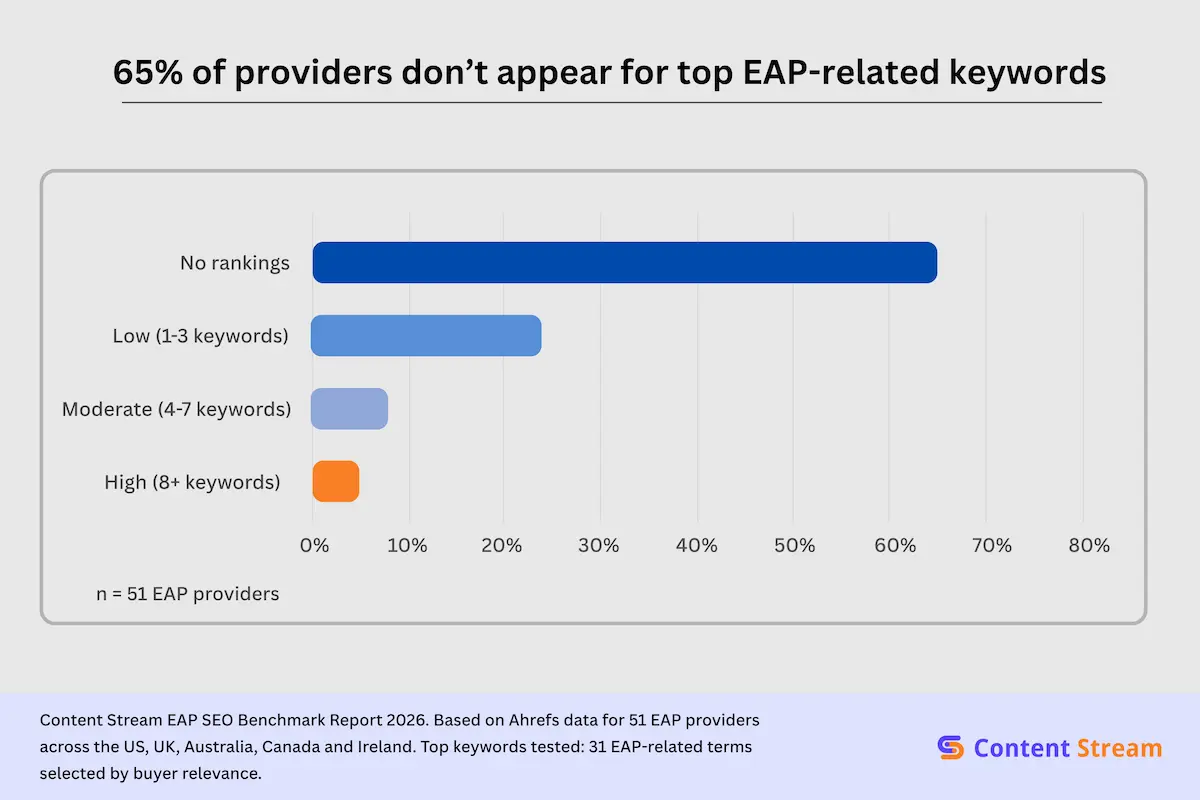
- 65% of EAP providers do not appear in the top 10 search results for any EAP-related keyword (US and UK), including terms like "EAP providers", "employee assistance program", and "workplace mental health support."
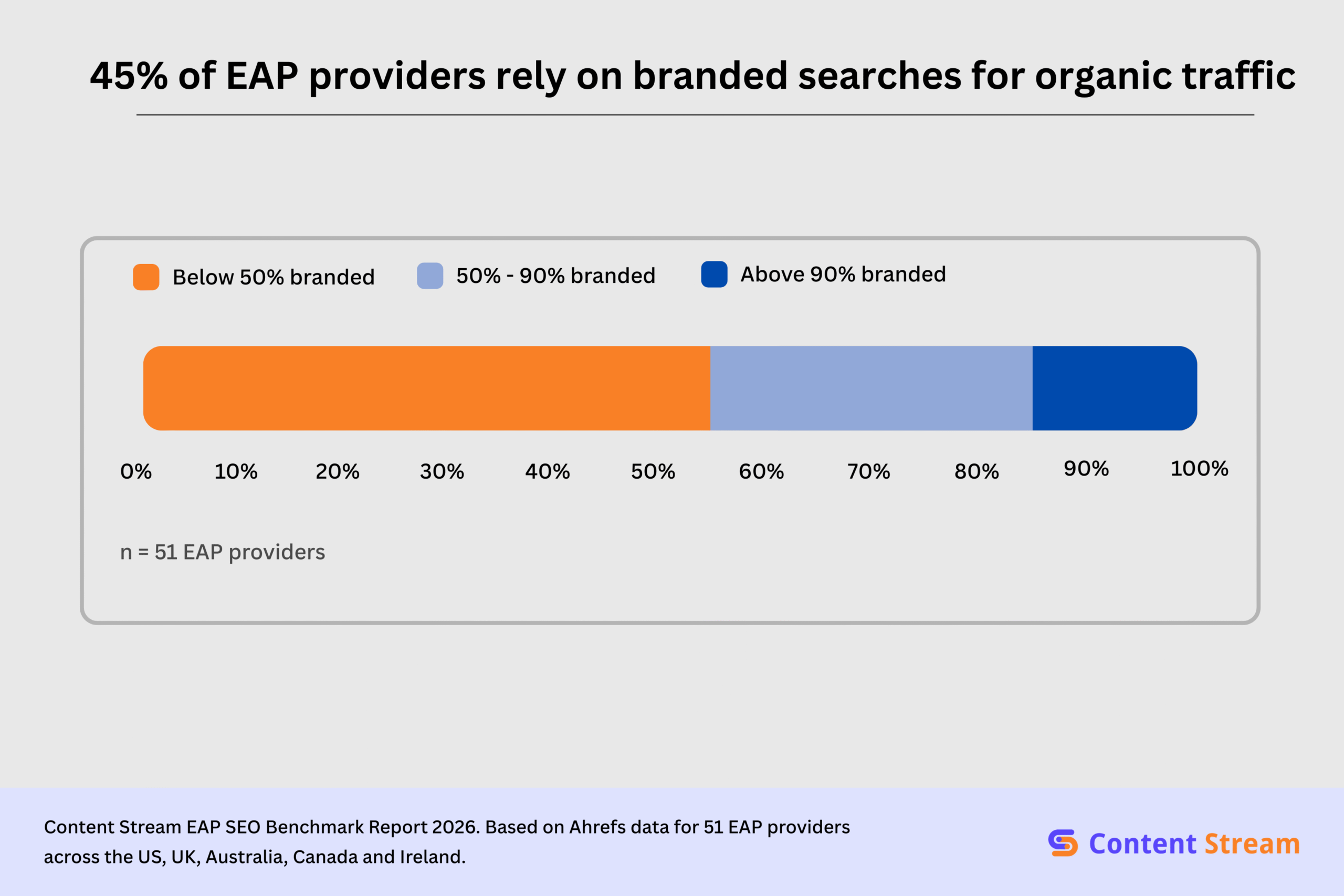
- 45% of EAP providers rely on branded searches for the majority of their organic traffic.
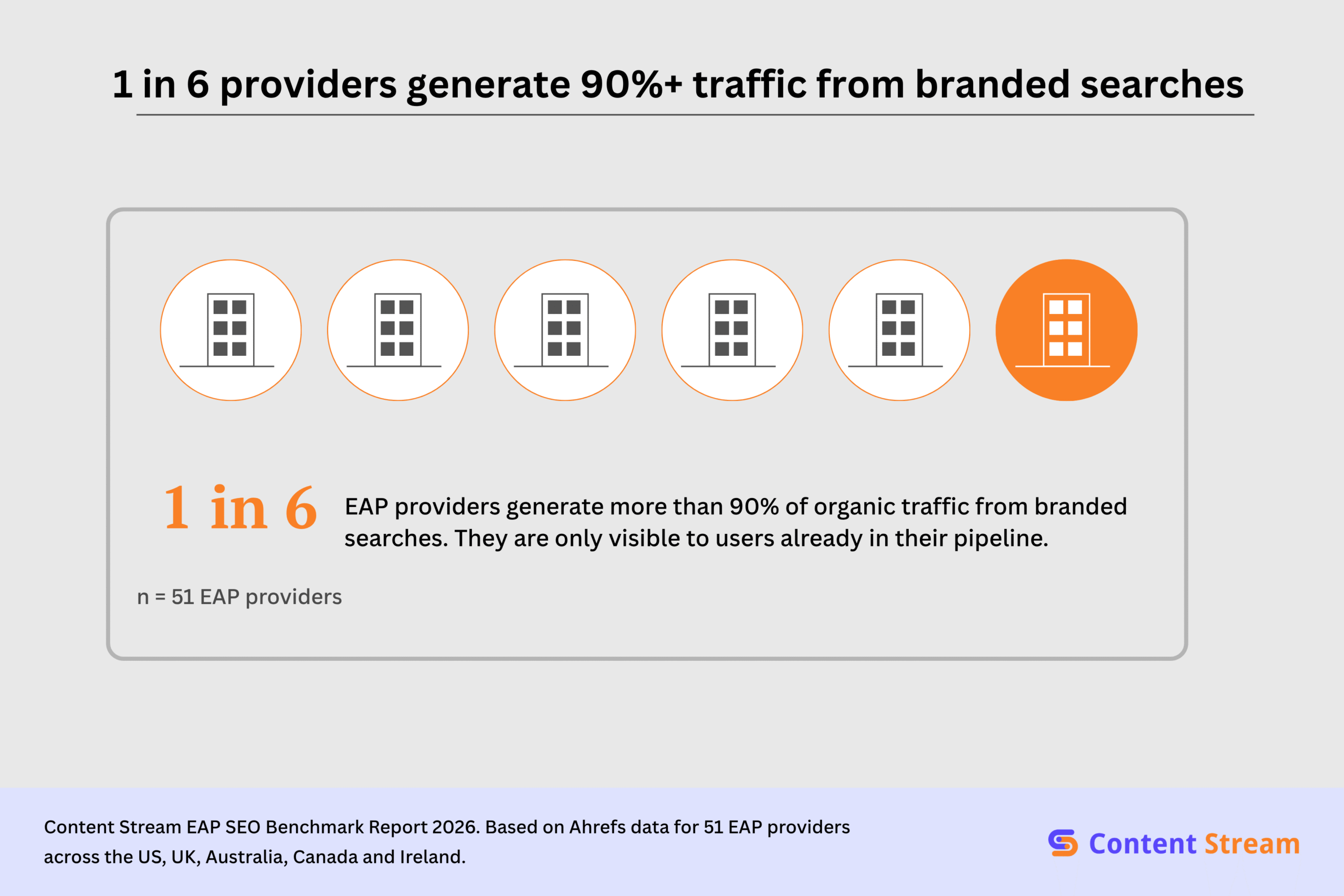
- 1 in 6 EAP providers generate more than 90% of their organic traffic from branded searches.
- Modern EAP platforms generate 32x more organic traffic than legacy providers, revealing a gap in how both groups approach content and SEO strategy
- The average EAP provider appears in just 13 AI Overview results and receives zero ChatGPT citations.
- Modern EAP platforms generate 42x more AI Overview appearances than legacy providers. This is identical the patterns we see in organic traffic
SEO benchmark data for EAP providers
Search demand exists for EAP services, but providers aren’t appearing for the top keywords in any intent. Commercial queries are occupied by HR tech comparison platforms and vendors. Informational terms are owned by government agencies, and educational content is being published largely by adjacent HR and wellness platforms.
The educational queries are particularly surprising. The SERPs are dominated by adjacent platforms with similar foundations, meaning that EAP providers can reasonably rank for these. But they don’t, and the findings below show why.
Organic traffic benchmarks
45% of EAP providers rely on branded searches for the majority of their organic traffic
A good number of websites in our dataset get their traffic from branded searches. These are queries from people who already know the brand and are trying to find the website. And for a smaller subset of providers, the traffic dependency is even higher.
Modern EAP platforms generate 32× more organic traffic than legacy providers
Our theory is that modern platforms invest more in SEO, as they don’t have the brand recognition, industry relationships, and broker partnerships that legacy providers have. So, they’ve built up a stronger backlink profile, more content, and greater non-dependent organic visibility.
However, this is based on looking at the SEO data alone. The reality may be much more nuanced and dependent on several business factors not visible in an organic traffic chart.
For 1 in 6 EAP providers, branded searches account for more than 90% of organic traffic
That means their website is effectively a directory listing, only visible to buyers already in the pipeline and invisible to everyone else.
Modern platforms have a lower branded traffic % than legacy providers (19% vs 43%)
This is consistent with other findings in this report: modern platforms have a more robust SEO footprint and thus are less dependent on their brand name alone.
We should note that the actual gap here is narrower than it looks, as we actually see branded dependency across both groups.
Keyword visibility benchmarks
2 out of 3 EAP providers don’t appear in top 10 searches for top EAP keywords
We tested 31 EAP-related keywords, and 65% of providers do not appear in the top 10 search results for them. These keywords were selected based on likelyhood of search by HR professionals and, and included commercial terms like “best EAP providers” and “EAP services”, informational terms like “what is an EAP,” and educational terms like “EAP mental health” and “EAP counselling.”
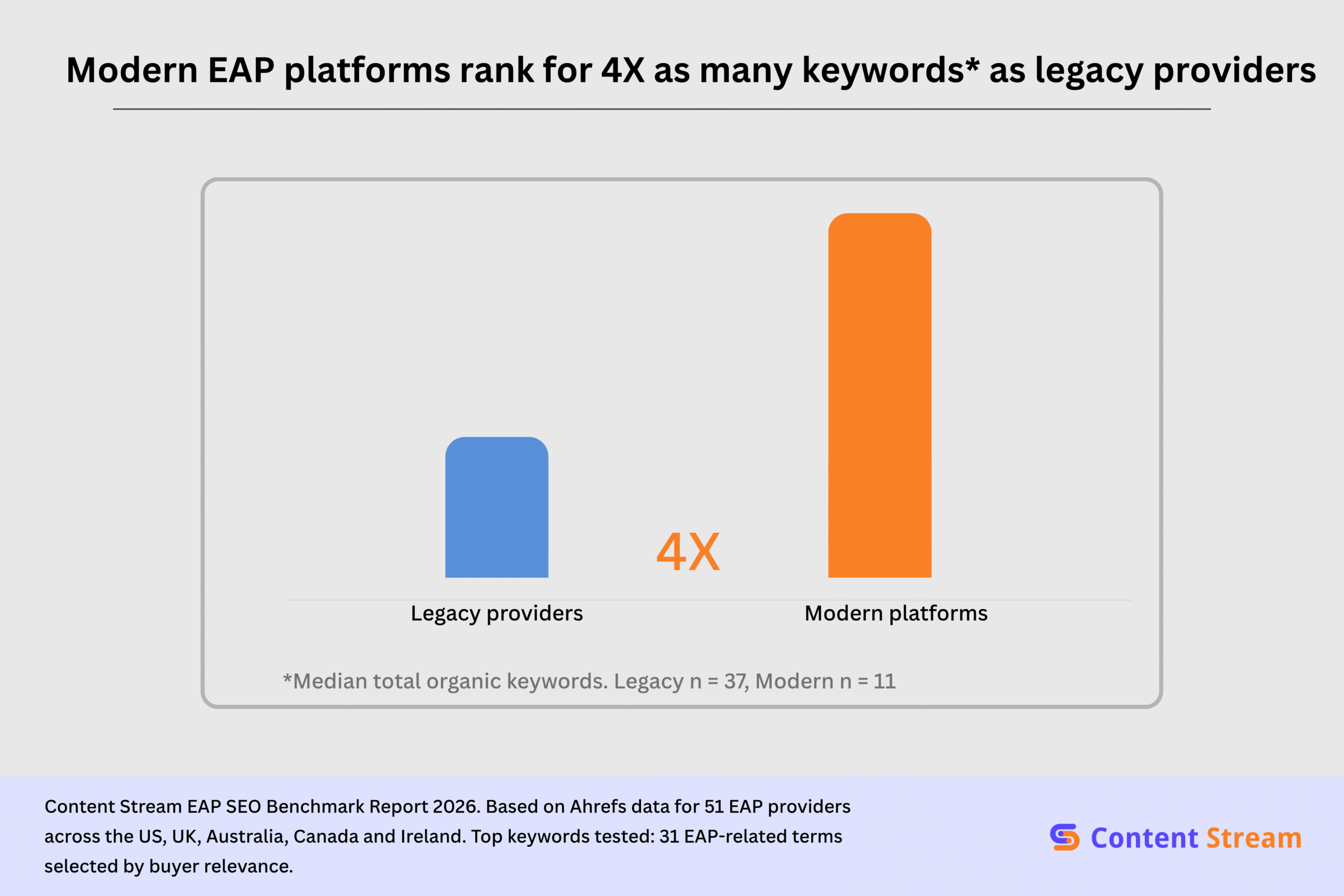
Modern EAP platforms rank for 4× as many keywords as legacy providers
Despite being relatively new, modern EAP platforms have a median DR of 56 (8 points higher than legacy providers) and rank for four times the number of keywords. In our dataset, legacy providers ranked for a median 113 keywords, while modern providers ranked for a median 437 keywords.
However, high domain authority does not guarantee organic traffic and a correlation here does not equal causality.
Only 12% of providers rank in the top 10 for four or more tested keywords
The remaining 88% of the sector has negligible industry keyword presence. Many terms with measurable search volume have no EAP providers in the top 10 at all, including “digital EAP” and “employee wellbeing programme.”
1 in 7 EAP providers with meaningful traffic don’t rank in the top 10 for EAP-related keywords
14% of providers in our list appear for none of the EAP-related keywords we tested, despite being in the top half of the sector by organic traffic. That means their website gets a healthy number of organic visits monthly, but none of those people are here for EAP-related queries.
On closer inspection, we found that the “healthy monthly visits” are built on content outside their core offerings, and those searchers may not convert. Some of the top ones include “causes of poverty” and “fun facts about summer”. These are high-traffic keywords but offer no business benefit.
Web presence
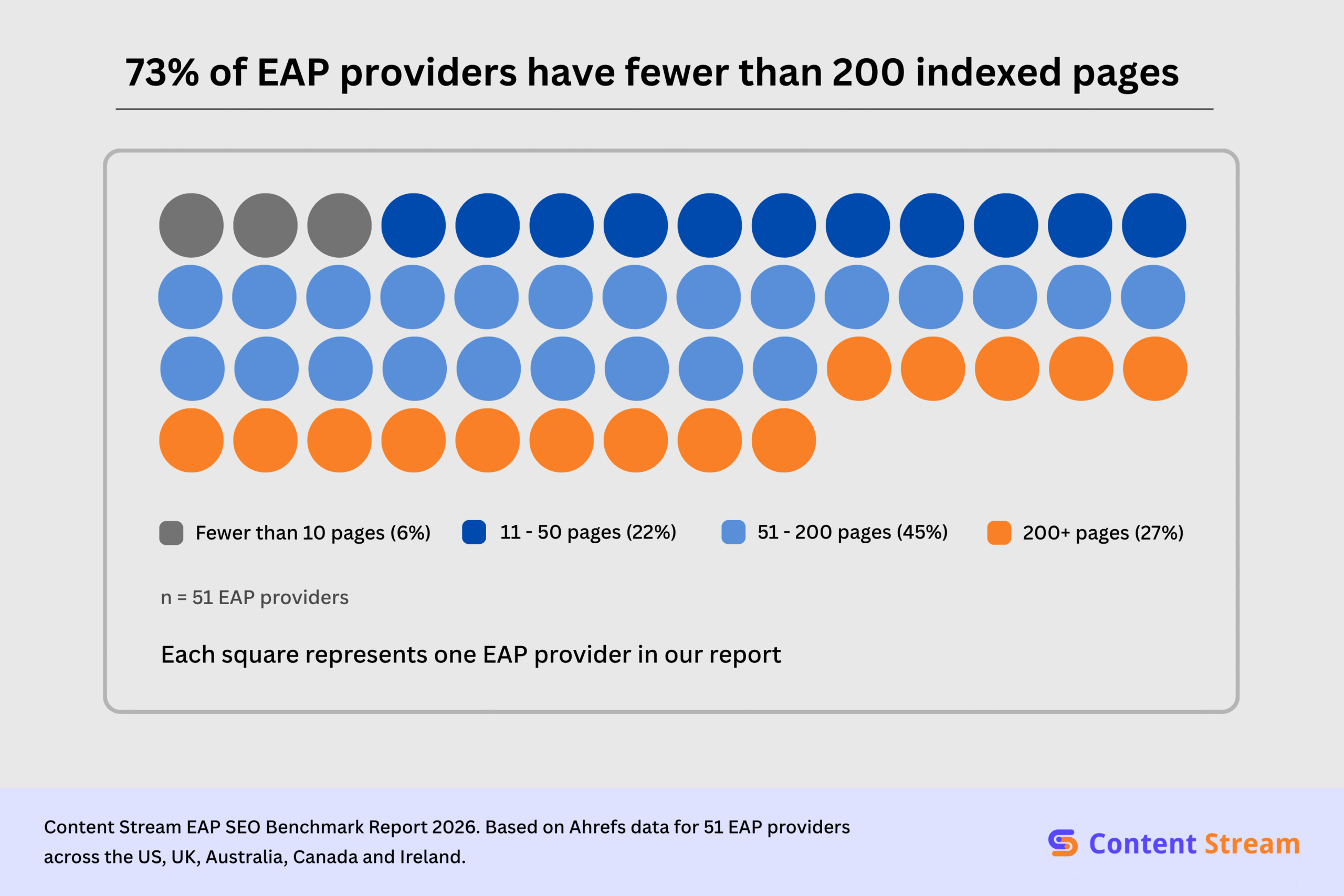
73% of EAP providers have fewer than 200 indexed pages
We believe this is due to the relatively small scale of the industry; there’s only so much business-relevant content you can create before deviating from your core offerings. Yet, we see that most providers — legacy and modern — have few indexed pages overall.
- 6% of providers have fewer than 10 indexed pages
- 22% have between 11 and 50 indexed pages
- 45% have between 51 and 200 indexed pages
- 27% have more than 200 indexed pages
AI search visibility
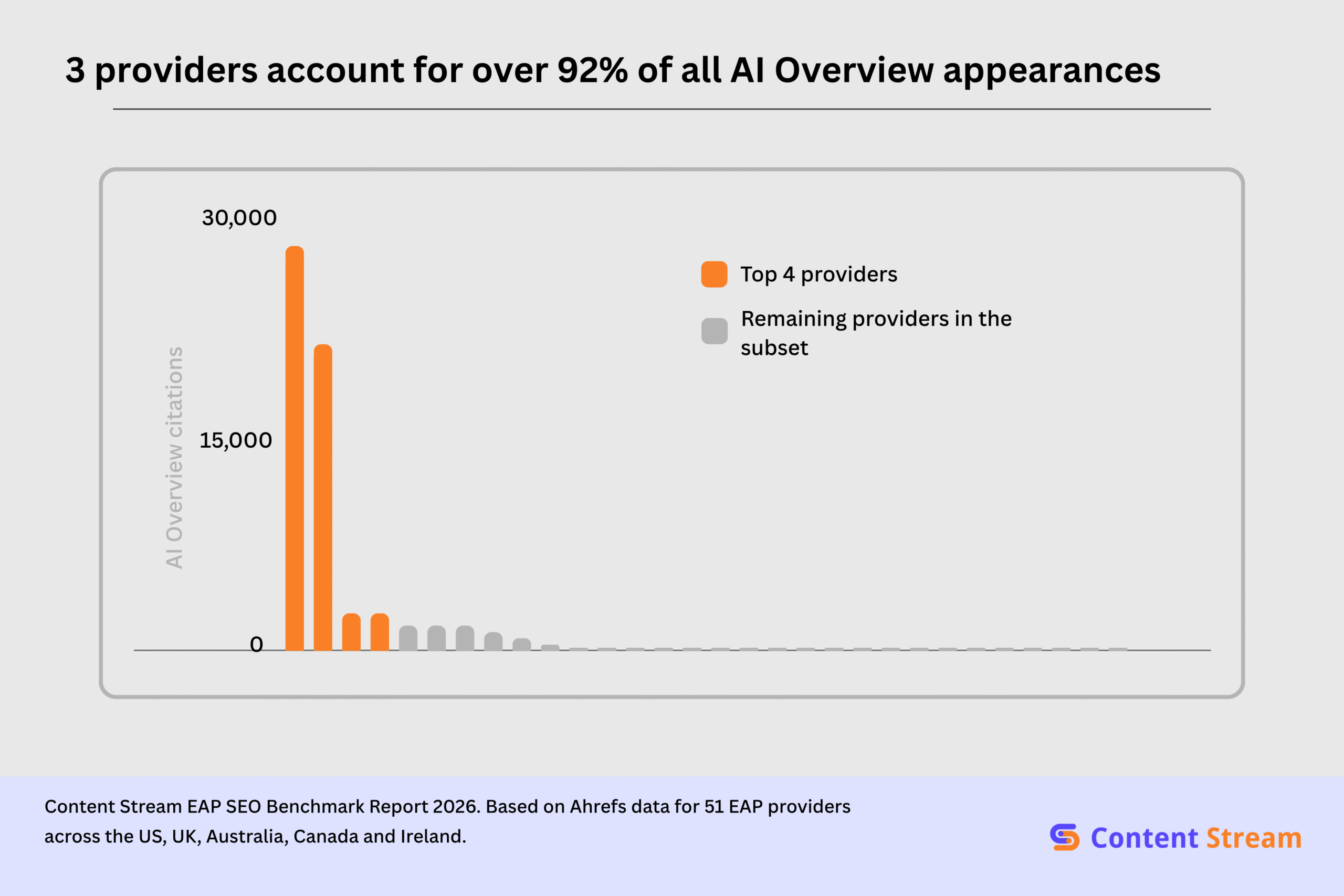
The average EAP provider appears in just 13 AI Overview results and receives zero ChatGPT citations
Of the 51 providers we analysed, 65% receive no ChatGPT citations whatsoever, and 16% have zero AI Overview appearances.
4 providers account for 92% of all AI Overview appearances
These providers are also in the top 10 sites with the most organic traffic in our dataset. This verifies the theory that AI visibility is an extension of content investment, and the better your organic performance, the higher the AI citations.
The opportunity for EAP providers
One thing the data makes immediately obvious: organic search in the EAP sector still has a lot of potential. A few providers with decent organic profiles are pulling ahead, while most websites haven’t invested much in SEO.
Modern and digital-first platforms in our dataset demonstrate this very well. They generate more traffic, rank for more keywords, and appear more frequently in AI search results because of their SEO investment.
But there’s still a lot of opportunity for growth in this industry, and we see it as being in two parts, one dependent on the other:
1. Winning the important keywords
65% of EAP providers don’t appear in the top 10 for keywords like "digital EAP," "Employee wellbeing programme," "EAP counselor," and "What does EAP stand for in insurance?"
But the results aren’t empty.
They are occupied by sites like government agencies, comparison platforms, and adjacent HR publishers that have higher domain authority than most EAP providers. It’s not a realistic goal to compete directly against opm.gov or a well-established vendor directory on generic informational EAP keywords.
But there's a good opportunity to win on the keywords that matter for providers and demonstrate genuine expertise in the sector.
These include:
- Benchmarks and outcomes data
- Workforce mental health research
- Authoritative guides built on real-world EAP delivery
- Implementation guides
In essence, content that only an EAP provider can credibly produce. We believe the path to organic visibility in EAP is not "What is an EAP?” It is "The state of EAP in [year]."
“What is an EAP?”
Generic. Owned by government agencies. Low commercial intent.
“The state of EAP”
Authoritative. Only EAP providers can produce it. High strategic value.
2. Optimising for AI visibility
The average provider appears in only 13 AI Overview results and receives zero ChatGPT citations. But our data shows clearly that only providers who have good organic visibility gain high AI visibility.
The recommendation here isn’t to create a separate AI visibility strategy but to merge it with an improved SEO content strategy. We recommend investing first in a strong SEO foundation and then optimising for LLM citations once organic visibility improves.
Be sure to explore our guide where we cover specific SEO stratgies for EAP providers here.
The path forward
The data we shared in this report points to one conclusion: search demand exists in the industry, and it’s growing. Our list of low-difficulty EAP keywords proves as much.
With an exception of a small number of providers, there’s massive growth in the industry for providers to step up and expand their organic search visibility.
But open does not mean easy.
Comparison platforms, government pages, and adjacent publishers are currently occupying EAP search results, with established content backlogs and high domain authority.
To win here, providers will need to first audit their current index pages and create a new SEO strategy around long-term visibility. This way, they don’t become part of the 14% who have good organic traffic but little EAP relevance.
This is where Content Stream can help. We focus on health and wellness brands, and can help with your EAP SEO strategy. Whether you’re building your organic footprint from the ground up or resuming your SEO efforts, we can help.
Click here to get in touch with our consultants and take advantage of this gap in the EAP industry.
About this report
The State of SEO in Employee Assistance Programs is a benchmark report produced by Content Stream Creative Limited, a UK-based SEO and content marketing agency specialising in health and wellness brands.
The report analyses the organic search footprint of 51 EAP providers across five English-speaking markets: the United States, the United Kingdom, Australia, Canada, and Ireland.
Keyword selection
The 31 keywords tested in this report were drawn from a master list of 175 EAP-related terms. The final selection was filtered by US and UK search volume and buyer relevance, prioritising terms that buyers and HR professionals are most likely to use when researching, evaluating or learning about EAP services.
The tested keywords are not an exhaustive list of EAP search demand. They are a representative sample of the most significant terms across the buyer journey. Providers not appearing in the top 10 for these terms may rank for other EAP-related keywords not included in this analysis.
How we built the dataset
Candidate domains were identified through a combination of industry directories, HR tech review platforms, and direct market research. Platforms were excluded based on the following criteria:
- EAP was not named as a standalone product
- They operated as a division of a larger insurer or HCM platform without a dedicated domain
- They showed no meaningful web presence
Data was collected via Ahrefs and covers six core metrics: Domain Rating, organic traffic, referring domains, total organic keywords, indexed pages, and branded traffic. Keyword visibility was assessed by checking each domain's presence in the top 10 search results for 31 EAP-related keywords spanning commercial, informational, and educational intent. AI visibility was measured via Google AI Overview appearances and ChatGPT citation counts per domain.
All figures reflect data collected in 2026. Organic traffic and keyword data were collected with a US country filter applied; a supplementary UK-filter pull was completed for UK-specific keyword terms to ensure accurate representation of UK-based providers.
Where individual providers are referenced, they are anonymised. No provider is named by name in this report.