SEO for Biohacking: Ranking for The Longevity Boom
As with most SEO strategies for YMYL businesses, the goal isn’t to game the algorithm, but to build something genuinely useful that also happens to rank. And as the space gets more saturated, that authenticity and trust building will be more important than ever. Two key strategies to stand out are:
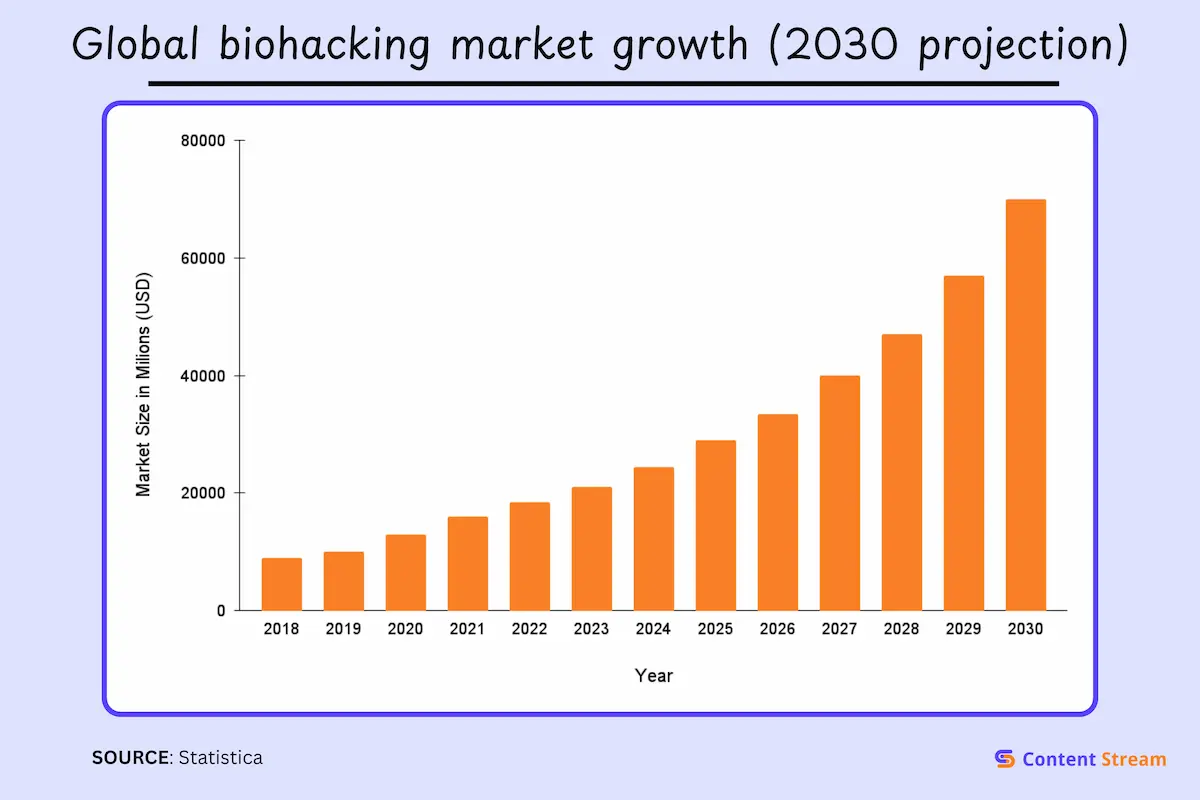
If you work in the longevity and biohacking space, you’ve likely noticed how fast demand — and competition — is accelerating. The global biohacking market alone is poised to grow from roughly $25 billion in 2024 to nearly $70 billion by 2030.
This shows rapidly growing consumer interest in self-optimization, diagnostics, and longevity interventions.
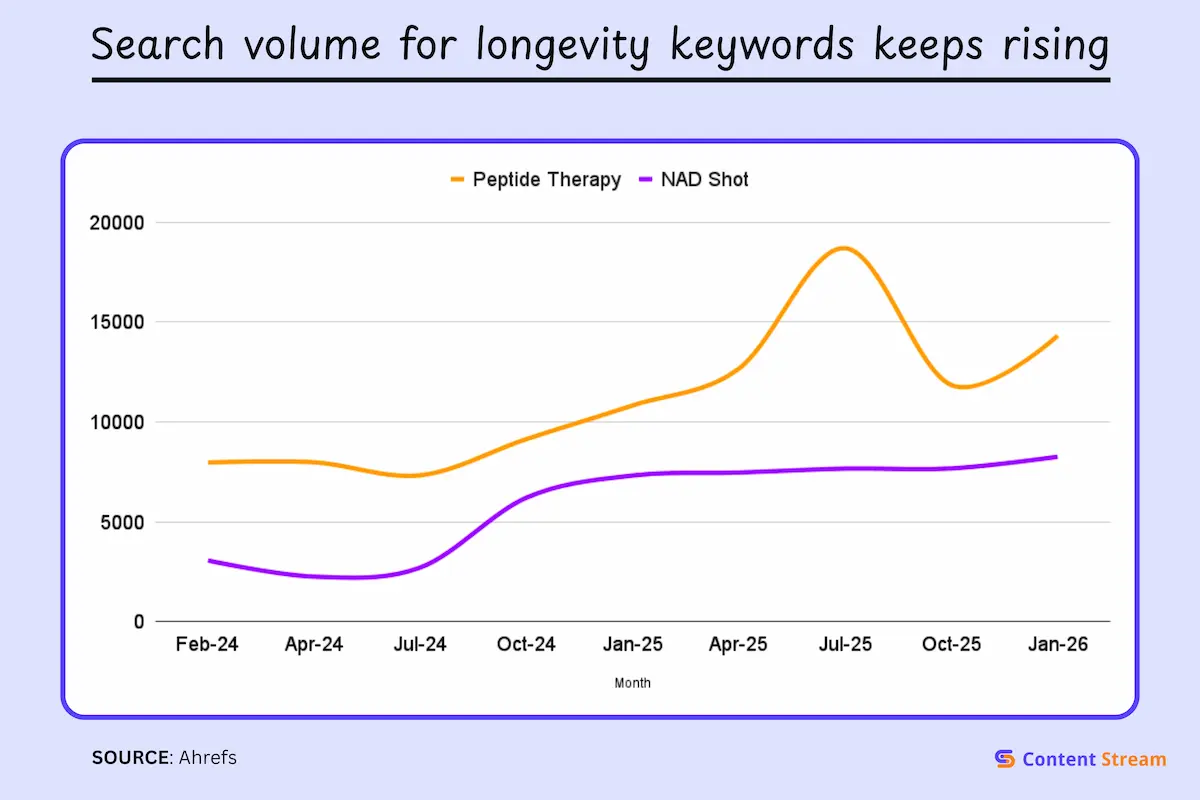
A lot of this growth is finding itself to search engine queries too; search volume for services like “peptide therapy” and “NAD shot” have steadily risen over the past few years. This is an increasing demand your business can capitalize on.
But there is a catch: ranking in search isn’t automatic, especially in a YMYL (Your Money or Your Life) category where Google applies stricter standards to health content.
Unless your site signals authority, clarity, and relevance, you’ll struggle to appear for the most valuable search queries.
So let’s talk about how to do that. In this guide, we’ll go beyond “write more blogs” or “get reviews” and show which content strategies can work for your clinic or biohacking center.
A note before we dive in
We’re SEO strategists, not longevity clinicians. The keyword examples and content strategies in this guide are drawn from our understanding of content strategy and how it works across the health and wellness niche. But, they haven’t been validated against your specific market, location, or audience.
Before building any content strategy around these terms, we’d strongly recommend running them through your own keyword research and SEO team to confirm search volume, competition, and commercial intent in your area.
The Longevity audience is result-driven, just like every other health and bio-hacking industry, and that means they listen to advice that works.
And some of the widest known and followed protocols or health stacks are those being talked about by industry leaders and influencers like David Sinclair, Andrew Huberman, and Peter Attia.
That means readers are more likely to respond to this. It’s a little like how “how Michael B Jordan got jacked” gets more visibility than “How to Get Jacked as a Beginner.”
The same content principle applies to your business. That could be something as simple as,
Then follow that up with the actual protocols your clinic offers, and educate readers.
Trustworthiness and search intent are key here. Writing celebrity articles on what your clinic doesn’t offer will rarely pay off in the long term. Neither will capitalizing on a celebrity protocol and then trying to steer readers to something different. I recommend only writing content that matches user intent.
We address this more comprehensively in our article on how to rank for GLP-1 keywords.
Ranking for longevity-related keywords can be a bit tricky for different age groups because they don’t use search engines the same way. A 30-year-old performance-driven client and a 70-year-old prevention-focused client might both want to slow their biological aging, but their keywords, motivations, and expectations vary dramatically.
The key to attracting both types of clients is creating content that reflects their priorities.
A user focused on optimization will search with a performer’s mindset, and their language is often proactive and enhancement-focused. They may use terms associated with the best longevity treatments, usually around
People focused on preserving, on the other hand, are more likely to focus on risk reduction, stability, mobility, and sustained function. They favor terms along the lines of
It’s important to use keywords that align with the demographic you’re looking to attract and create content accordingly. We have made a list of longevity-related keywords that could get you started.
In a YMYL category like longevity, authority signals are critical, and without them, your pages won’t even rank. Backlinks and citations from reputable professionals can help here, but to really stand out, you should consider structuring your evidence internally.
Here’s what that looks like.
Structure your blog page like a scientific publication website, complete with credentialed authors (with badges), and direct links to related posts talking about similar topics.
Then, add a bibliography at the end of each blog, citing study names, year of publication, scientists involved, and direct links to the full study.
From an SEO standpoint, the effort is well worth it since Google systems reward pages that interpret, and contextualize original research rather than recycle surface-level summaries.
Your resource library won’t be just another longevity clinic blog. It’ll be a source of information where users can access up-to-date information about current studies in longevity, with easily accessible links to the full publication for more details.
To summarize:
One underutilised source of high-intent traffic is helping people make sense of their test results. When patients receive bloodwork or biomarker data, their first instinct is to go to Google with highly specific, commercially aware questions..
They’re searching things like:
These are bottom-of-funnel queries from people who are already engaged with their health, already have data in hand, and are actively looking for guidance. That’s your audience.
Create content that interprets these biomarkers and explain what the research says, what optimal ranges look like, and why they matter for longevity. Doing this positions your clinic as the credible next step. Every piece of content becomes a natural entry point to book a consultation.
⚠️ A note on medical content
Biomarker content must be handled carefully. Publishing information about lab results without a face-to-face consultation can be misleading or harmful if readers treat it as personal medical advice. Every piece of content in this category should be grounded in peer-reviewed research, reviewed by a credentialed clinician, and accompanied by a clear statement directing readers to consult a qualified professional before drawing any conclusions about their own results.
Along the same vein, you can create dedicated, medically structured pages around individual biomarkers like Vitamin D (25-0H), Fasting Insulin, Glycan age, and DNA methylation clocks.
From an SEO and YMYL standpoint, each page should include the following.
Structuring your site around detailed, high-intent keywords makes it easier to compete in crowded health niches. They are precise, meaning low competition and naturally introduce relevant services. They also increase topical authority in Google’s knowledge graph around diagnostic and preventative medicine.
The longevity industry has been picking up steam for a while and we’re not seeing signs of slowing down. Search demand is climbing, consumer awareness is expanding, and high-ticket optimization programs are moving into the mainstream.
But with Google’s rising standards across all health-related industries, visibility is no longer a game of who can create the most blogs or make the biggest claims.
It needs to be earned by running an effective SEO strategy that centers around educating patients and providing genuine value, within the confines of the YMYL framework.
We recommend reading more about the YMYL framework to better understand how to position your content.

I’m Matthew, a personal trainer turned SEO who’s worked with brands like Gymfluencers, Sailo, ClickCease, and Fraud Blocker. These days, I help small to medium sized companies grow their reach with smart, search-focused content.
