How to Reduce Fitness SaaS Churn with Content Marketing
Unfortunately, churn is always going to be a part of building a SaaS product. But, I’ve seen that not all users who churn have to go. Some can be sold on the product value, and one way to do that is with content. The strategies that help:
Churn in SaaS products isn’t news; some estimates put 30-day user retention at just 39%, and that number drops to 30% by the 90-day mark.
The problem and potential solutions for SaaS churn are also well documented, and you’ll find many Reddit conversations on the issue. One point that stands out is user education. Users who seek a feature will churn if they don’t think your product offers it. Here, content marketing can help a lot.
But there are many other reasons why users churn as well. I’ve worked with a number of SaaS products, inside and outside the health and wellness space, and I often see opportunities to reduce churn that businesses just aren’t using.
So in this article, I’ll be sharing some of the most effective strategies I’ve seen for reducing churn in fitness SaaS, and, the best way for you to start implementing them.
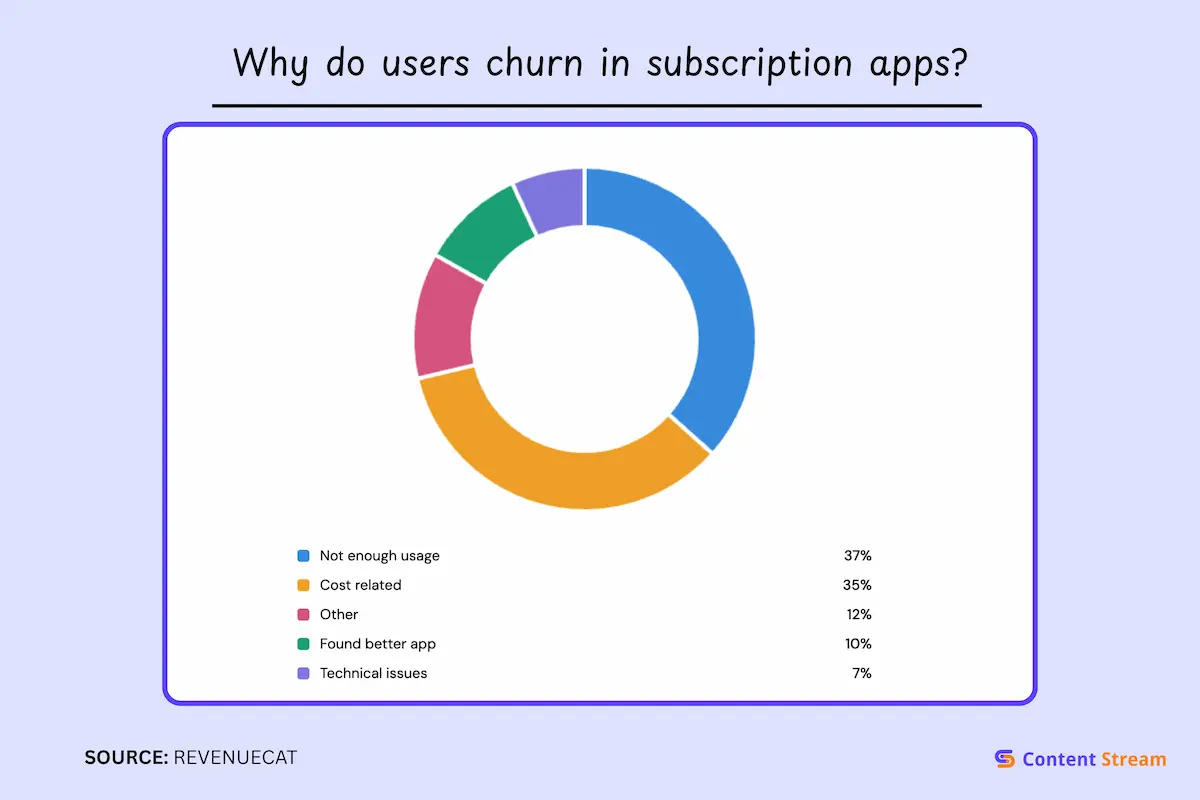
37% of users cite insufficient usage as their reason for churning. The other four are cost concerns, billing issues, finding a better app, and technical issues.
With two of these, content marketing can’t help at all. Billing failures and technical problems will require operational fixes. But content can contribute to fixing the remaining three.
These three reasons share something in common: users who were confused, under-supported, or never quite understood what your platform could do for them. And we can use content marketing to close this gap.
The stat that 37% of users churn because of insufficient usage shows that they aren’t necessarily leaving because the product is bad. But because users never quite figure out how to make it work for them. The onboarding process is a great opportunity to get ahead of this problem and potentially retain some of that 37% of users.
It’s unreasonable to walk users through every feature. But, you can get them to one meaningful moment as quickly as possible: a logged meal, a completed workout, a progress chart that actually means something to them.
Here’s a few ways to go about it:
Customers introduced to community features like forums and events show 13–24% higher long-term retention. That seems like an easy-win opportunity to me!
Content is a relatively low-effort way to do this. And it’s not necessarily about publishing more, but by creating touchpoints that make users feel like they’re part of something.
That might look like encouraging users to share progress screenshots or streak milestones to help show other users what’s possible, and also create accountability.
You could also run a 30-day challenge where the shared goal becomes part of people’s routines. Or, simply recognising a user who hit a meaningful milestone.
These are small things, but they shift the relationship from transactional to something closer to membership.
The content doesn’t have to be elaborate. It just has to be consistent and pointed at the right moments — the ones where a user might otherwise go quiet.
We discuss several of these strategies in our article on marketing ideas for fitness businesses.
SaaS apps collect a lot of data as part of operations. Use it to power your retention by showing users what their data says about their progress.
Here’s an example of why that matters: A user who tracks their macros religiously but doesn’t understand how that data connects to their actual goals will eventually wonder what the point is. And that’s a churn risk that has nothing to do with your product’s functionality.
Content can close that gap. Short guides that explain the relationship between, say, protein intake and recovery or between training load and plateau prevention can give users a reason to keep logging. When the data starts to feel meaningful rather than administrative, engagement tends to follow.
Real user stories help too. Not polished case studies, but honest examples of someone who noticed a pattern in their data and changed their behaviour because of it.
“We miss you” emails sent when a user goes quiet have been around for a while. But they aren’t particularly effective. What I’ve seen work better is content that removes the friction of coming back. It’s important to give the user something they can act on immediately, without having to backtrack or remember where they left off.
A few formats that work well here:
The email benchmarks for health and fitness re-engagement are modest: Open rates around 19% and CTR around 1.2%. But at low cost and high frequency, the payoff can stack quickly. The key is that each send feels like it was written for that user, not broadcast to a list. Read more on email marketing strategies you can adopt for your business.
You may have noticed this pattern shows up in user engagement: a user starts strong, logs several high-intensity sessions in a row, and then goes silent. It’s easy to read that as low commitment. But often it’s just burnout or the early signs of an injury they didn’t know how to manage.
The interesting thing is that your platform probably already has the data to spot this. If someone logs three max-effort sessions back to back and then activity drops off sharply, that’s a pretty good signal.
You can use content to respond to this signal in a genuinely helpful way for the user:
If users understand that consistency beats intensity, they tend to stick around longer. That’s what your content should be aiming for.
Most businesses see SEO and organic visibility as an acquisition lever. You use it to attract your target audience and that’s it. But your organic presence can be critical for retention, too, especially when users start searching for answers outside your app.
When a user has a question mid-session:
They likely won’t search inside your app. Instead, they open Google, and wherever they land next shapes how they feel about your platform.
If that answer comes from your blog or help centre, you’ve reinforced the relationship. If it shows how your specific solution solves that problem, even better!
But, if they find the answer on a competitor’s page, they could have a reason to try the new solution.
Here’s a few points to consider here:
Clear headings, intent-matched answers, semantic structure make sure Google matches your pages to the results users seek. If someone types “how to track progressive overload” into Google, your content should have a shot at showing up.
Users rarely search broad terms. They search for exactly what’s confusing them right now. Content built around those specific moments of friction tends to perform well and serves a genuine need.
Retention isn’t only a beginner problem; experienced users who’ve exhausted the obvious use cases can disengage if there’s nothing left to discover. Deep-dive content around advanced tracking, performance optimisation, or nuanced feature use gives power users a reason to keep exploring.
The through-line is the same across all three: when users can find answers inside your ecosystem, they’re less likely to drift out of it.
Content marketing is powerful, and as someone with skin in the game myself, I’d like to big it up as much as possible. But, there are things your content won’t do, regardless of how optimized it is.
Here are things content marketing can’t do for your business:
This isn’t to encourage the deprioritization of content. But it’s important to set realistic goals as you invest in content marketing specifically to tackle a high churn rate. We want to focus in on the users who leave because they were confused, under-supported, or never quite understood what your platform could do for them.
If you’re not sure where to start, the first 30 to 90 days of your user journey is usually the most revealing place to look. Map where engagement drops off and see how you can use content to plug the gap.
From there, next step is to build things in the right order. I’d recommend onboarding education before re-engagement, and laying the SEO infrastructure before creating advanced content.
That’s the kind of work we do at Content Stream. If you’d like a second pair of eyes on where your biggest opportunities are, we offer a free audit. Request your free audit →

I’m Matthew, a personal trainer turned SEO who’s worked with brands like Gymfluencers, Sailo, ClickCease, and Fraud Blocker. These days, I help small to medium sized companies grow their reach with smart, search-focused content.
