AEO and GEO for Fitness SaaS: How to Win in AI Citations

A gym owner opens ChatGPT and types “best software to manage my studio.” Mindbody gets named. Your product doesn’t.
This is a problem that SEOs have been tackling since LLM use became widespread. The problem is that when someone asks an AI tool for recommendations, it makes multiple searches at once and weights certain results differently from others. If your brand lacks certain brand mentions, backlinks, and general authority, the model has no reason to recommend you.
Answer Engine Optimization (AEO) and Generative Engine Optimization (GEO are about getting your brand mentioned and cited by LLMs. Whether that’s a backlink, or as is becoming more common, a mention.
Many gym owners now start their software research with AI tools, not search engines. Yet we still see many fitness SaaS companies publishing content designed only to rank on Google.
This article looks at what actually moves the needle towards GEO, while still optimizing your organic visibility.
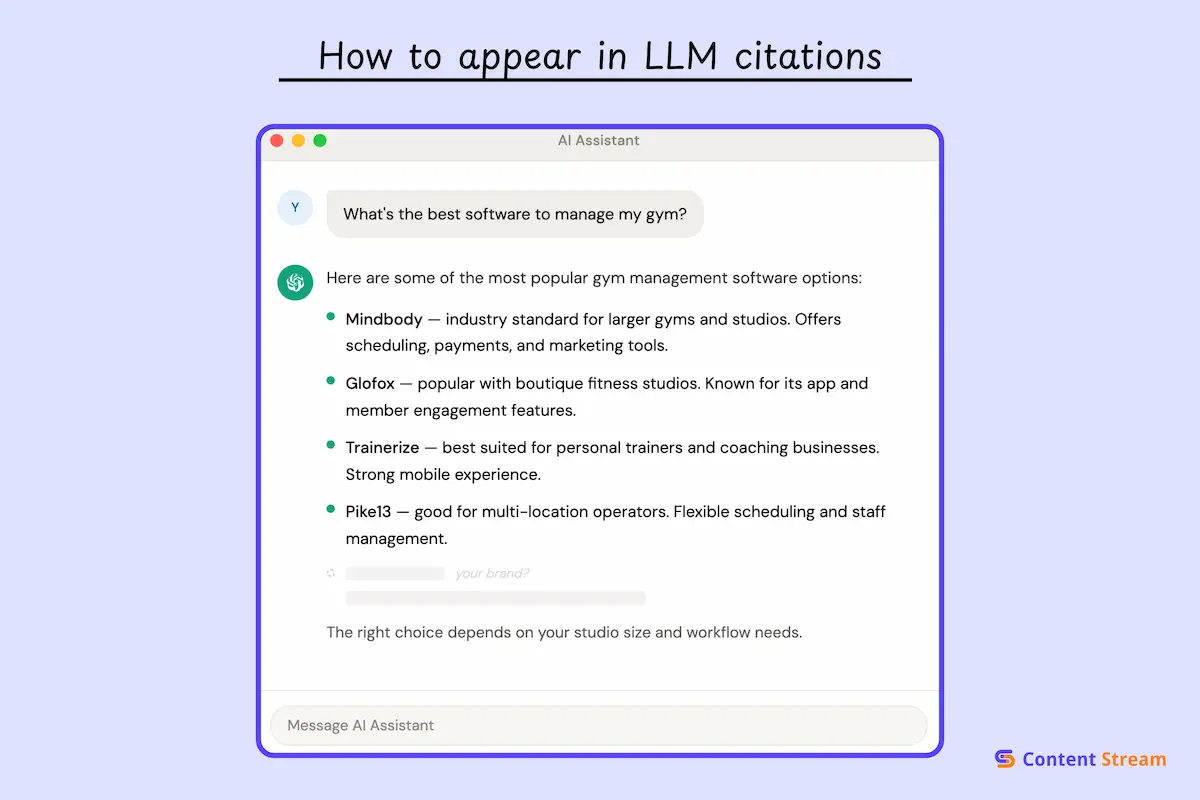
If you run a newer fitness SaaS company, the challenge is that you’re competing with years of existing mentions that AI systems have already absorbed in their training data. That creates a kind of citation debt that newer brands have to work harder to overcome.
Brands like Mindbody, Trainerize, and Glofox have been mentioned across the internet for years. Gym owners discuss them in forums. Review sites compare them. Over time, those mentions accumulate.
According to research, 82.9% of AI citations come from third-party sources i.e., news articles, review sites, and industry blogs rather than the brand’s website.
AI models learn from large volumes of publicly available text. When the same brands appear repeatedly across trusted sources, they become familiar entities in that training data.
For your company, the challenge is not just ranking higher in search. You need enough credible mentions across the web for AI systems to recognize your brand as part of the same conversation.
Many fitness SaaS companies structure their content around product features. You will often see posts about CRM integrations, reporting dashboards, booking systems, or API capabilities.
These are great, and very useful for keeping people in the loop about what you’re doing.
But when people use AI tools, they usually ask outcome-focused questions. Someone might ask, “What software helps reduce member cancellations?” or “What is the best software for managing a small fitness studio?” Very few people ask for a “gym CRM with API integration.”
This pattern appears across AI chatbot users in general. People describe the problem they want solved, not the feature they need. If your content focuses only on features, you risk missing the queries where real buying intent appears.
So, what kind of content actually helps your company show up in AI answers?
The answer isn’t as simple as “publish more blogs.” It’s not even fill the content gap. Volume alone will not change how often your brand appears in AI-generated responses.
But these three will.
For many SaaS brands, comparison pages are the highest-leverage content you can publish.
Buyers frequently ask AI tools questions like “Mindbody alternatives for small gyms” or “Trainerize vs other gym software.” When those prompts appear, AI systems often pull from comparison content because it already frames the evaluation.
Create one page for each major competitor. Mindbody. Trainerize. Glofox. Pike13.
The key is to be factual and specific. Statements like “no per-location fee” or “built for studios with fewer than 500 members” are clear claims that AI systems can repeat.
Besides hosting these on your website, make sure your brand is included in off-site lists as well. Check out our comprehensive link building guide if you need pointers on getting started with these.
AI systems frequently cite original data because it gives them something unique to reference. Readers love this as well because it gives a picture of the space
You’re likely already sitting on valuable insight hidden in your user data. Anonymizing and sharing this data, that no one else has, get your brand mentioned and cited.
For example, you might report the average churn rate for boutique fitness studios or how much gyms actually spend on management software each month. You can also publish content on the most common reasons members cancel.
Once that information is published, it becomes a reference point. Other writers may cite it, and AI tools can surface it when someone asks about industry benchmarks.
A modular answer block is a short section of content designed to stand on its own. It usually focuses on a single claim or explanation, succinctly packaging the entire idea in one “piece.”
Someone should be able to read that block in isolation and still understand the point. LLMs certainly want to.
Here’s what that might look like in practice:
A section titled “How gym software reduces member churn” should directly answer that question in one clear explanation.
This approach makes it easier for AI tools to lift the passage and include it in an answer. If a section cannot stand on its own or requires several paragraphs of context, it is far less likely to be cited.
If you need more insight into how to create content effectively for your brand, we address that in our article on Content Strategies for Fitness SaaS brands.
Two pieces of recent research add useful context to what we’ve covered above.
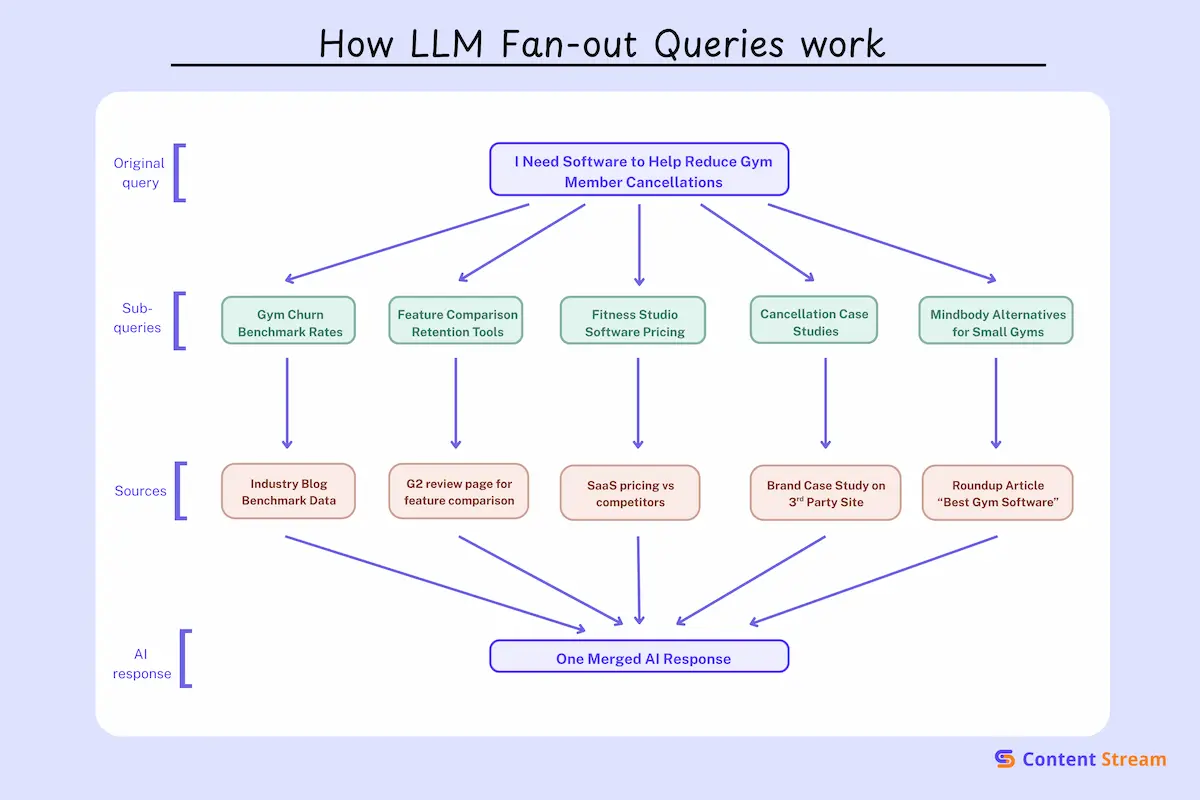
The first, from SimilarWeb, explains the mechanics behind how AI tools actually process a query. When someone types a question into ChatGPT or Perplexity, the AI doesn’t treat that query as a final instruction. Instead, it breaks that query it into multiple smaller, related sub-queries and merges the retrieved information together.
SimilarWeb calls this query fan-out, and it has a direct implication for fitness SaaS brands: you’re actually competing for multiple small queries, instead of one big one.
A gym owner asking “what software helps reduce member cancellations?” may trigger sub-queries about churn benchmarks, feature comparisons, and pricing. Each one will pull from a different source.
The lesson here is that your content should address multiple angles related to the fan out query. Read more about FAN out queries on Similar Web.
The second is an analysis published on Search Engine Land, and it reviewed hundreds of AI prompts, categorizing where the resulting links actually pointed. Only 9% of links pointed to the brand’s official domain. The remaining majority went to third-party domains, specifically, third-party domains that mentioned the brand name in their text.
That finding reframes the entire goal of off-site content. A review on G2, a mention in a “best gym software” roundup, or a quote in an industry publication are critical for surfacing your brand, not just on those platforms, but in LLM citations as well. Read the full piece on Search Engine Land.
Once you start publishing this kind of content, the next question is simple. How do you know if it’s actually working?
The easiest way is to track where your brand gets cited.
Tools like Ahrefs offer an LLM citation tracking tool, but you don’t have to pay $100 a month to track your visibility.
Start with a weekly practice of running a few queries that a potential customer might realistically ask. Think about the questions a gym owner would type when they are researching software.
For example:
Then look at the responses.
Does your brand appear? Does your content get referenced? Or do the same competitors show up every time?
Over time, you can track how often your company surfaces in these answers. That becomes your citation rate. It is one of the clearest indicators that your AEO and GEO efforts are starting to work.
You don’t need a full strategy overhaul to start. Look at the answers and note which brands keep getting mentioned. The gaps you see there often reveal the exact content your company should be publishing next.
If you want help identifying those gaps, this is exactly what we do at Content Stream. We analyze your website, your competitors, and what you should be doing but aren’t. Book a website audit and let’s review the opportunities together.

I’m Matthew, a personal trainer turned SEO who’s worked with brands like Gymfluencers, Sailo, ClickCease, and Fraud Blocker. These days, I help small to medium sized companies grow their reach with smart, search-focused content.
