EAP SEO: How to Build Organic Visibility From Scratch (For Employee Assistance Program Businesses)
Content Stream’s recent SEO report on the EAP industry found that 65% of providers don’t appear in the top 10 results for a single EAP-related keyword. And 45% rely on branded searches for most of their traffic, meaning their website only gets found by people who already know them.
These numbers show that many Employee Assistance Program (EAP) platforms are invisible in organic search. That’s not because the demand isn’t there, but because they don’t have the SEO foundations to appear for relevant keywords.
In this guide, we break down the six elements that drive organic visibility for health and wellness brands like EAP providers. We cover recent developments in SEO and AEO, showing what new and existing brands can do to increase their visibility today.
Note: These tips aren’t necessarily in order, and your SEO team will likely do them in tandem. So, there’s no need to complete one before moving to the next.
The conversation of technical SEO isn’t just about whether Google’s crawler can access your site anymore. Even though that’s still important, we now also need to consider if AI systems can read, understand, and use your content when presenting answers.
LLMs like ChatGPT and Gemini pull from structured, clearly formatted content. If your site is slow, poorly structured, or buried behind unnecessary JavaScript, you lose the chance to be cited in AI-generated answers. Our data shows the average EAP provider appears in just 13 AI Overview results and receives zero ChatGPT citations.
We’ve found that a weak technical foundation contributes to that lack of visibility.
We have a longer guide on technical SEO for health and wellness businesses. But here are specific tips to keep in mind:
When LLMs parse content, they scan for signals like clear headings, direct answers, and straightforward advice.
These are content writing best practices, and if you write with humans in mind anyway, it shouldn’t be news to you. But it’s more important now than ever to make key points as clear as possible. Here’s what that looks like in practice:
Read more: Every Google update that affected fitness businesses.
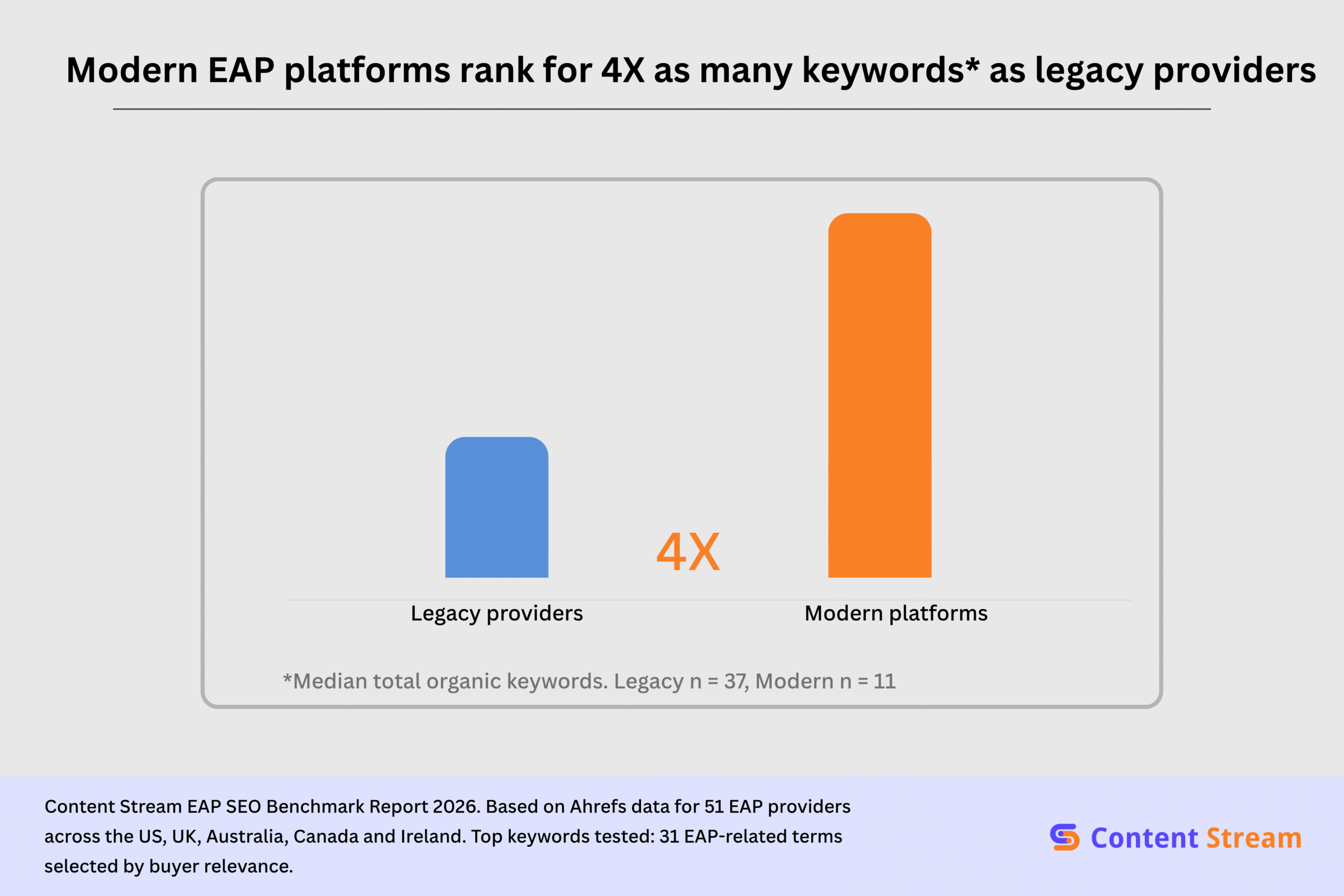
Our report found that modern EAP platforms rank for four times as many keywords as legacy providers. A big part of that comes down to content investment (both volume and authority.)
Brands can’t simply create generic content any more and expect to rank. Aggregator websites, government agencies, and high DR brands already occupy that space, and search engines are unlikely to recommend your content above theirs.
The report backs this up too: EAP providers don’t appear in the top 10 for generic informational queries like “What is an EAP?” and “How does an EAP work?” These spots are hard to win.
But content that comes from running an EAP brand is something only your business can publish. These include:
No one else can produce these easily.
Think about the questions your buyers (HR leaders, people teams, and procurement leads) are actually trying to answer before they ever speak to a provider. Questions like:
Those are questions your brand can answer with real authority.
When people search your brand name, Google needs to decide if the user is interested in a word, a misspelling, or your business. Having your business as an established entity is what makes that distinction.
The good news is entity establishment is largely a one-time infrastructure task. Once the groundwork is done, your content and online presence build on it.
Here’s what it involves:
This schema tells search engines about your business. They can read your brand name, logo, founding date, contact details, and social profiles. It’s one of the first signs that your business exists. Read more about schema for wellness businesses.
Your brand name, address, and contact details should be identical across your website, Google Business Profile, LinkedIn, and any directory listings. That’s how search engines can establish that you’re one brand as opposed to several similarly named ones.
It’s also important for your founders, clinical leads, and senior team members to have an active online presence – LinkedIn profiles, bylines on published content, and off-page mentions. Having these identifiable, credible people tied to your brand will strengthen your association.
A Wikipedia presence is one of the strongest entity signals you can have. It’s not feasible for every brand (smaller businesses may struggle to get it), but it’s one of the strongest entity signals you can have.
Entity establishment won’t immediately boost your organic visibility. But it will improve the payoff on everything else you do, from content and backlinks to PR.
Domain authority isn’t everything in SEO, but it’s a reliable indicator of how well your brand ranks in search engines and how trustworthy it is. In the EAP sector, we see a clear gap between different groups of providers.
Our report found that modern EAP platforms have a median Domain Rating of 56, compared to 48 for legacy providers. We also found that modern platforms rank for four times as many keywords despite being newer to the market.
These are by no means causal. But there’s a strong relationship between authority and organic visibility. If you want to give your brand better visibility, you need to improve your authority.
So how do you build it?
This is the path with the longest-term viability. In the EAP space, that means HR publications, occupational health journals, workforce mental health organisations, and business media covering employee wellbeing.
Directory listings are also important. Getting a spot on lower authority but reputable lists will also boost your visibility. We recommend prioritising publications first and directory listings second.
The keywords that high-traffic EAP brands are ranking for aren’t generic or informational queries. They are unique information worth linking to: original research, outcomes data, and benchmark reports. These tend to attract citations from journalists, academics, and adjacent publishers who need a credible source to reference.
Digital PR is the other lever worth pulling. Reactive commentary on workforce mental health stories and thought leadership placed in the right publications can all build authority signals that compound over time.
One practical note:
Domain authority is a long game. For newer EAP providers, we recommend a focus on building a consistent track record of earning genuine, relevant clicks instead of trying to inflate your DR as quickly as possible.
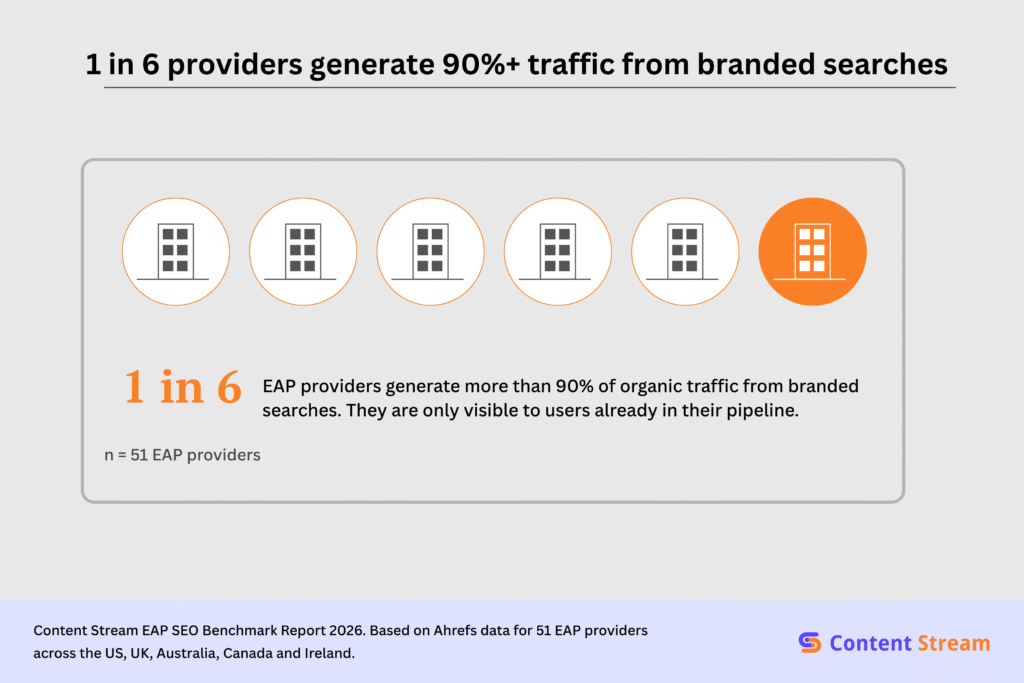
45% of EAP providers rely on branded searches for the majority of their organic traffic. And for 1 in 6 providers, that figure rises above 90%. That’s a problem for these businesses because they aren’t getting discovered by new users. Every visitor already knows the business by name.
But branded visibility is still crucial because even the healthiest websites have a good portion of branded searches. It’s important to build these for your website (without creating a dependence).
LLM citations are becoming a greater part of organic visibility. And based on Google’s recent announcement of AI-only search, it’ll likely be an even bigger part in the future.
That means users will no longer just type two or three words into Google. We’re moving towards queries where users ask AI tools detailed, specific questions and get highly tailored answers based on past conversations, account information, etc.
Data from airops supports this, where they found that users use ten or more words in their searches. They also found that 32.9% of pages cited in AI answers were found through narrower follow-up searches rather than the original query.
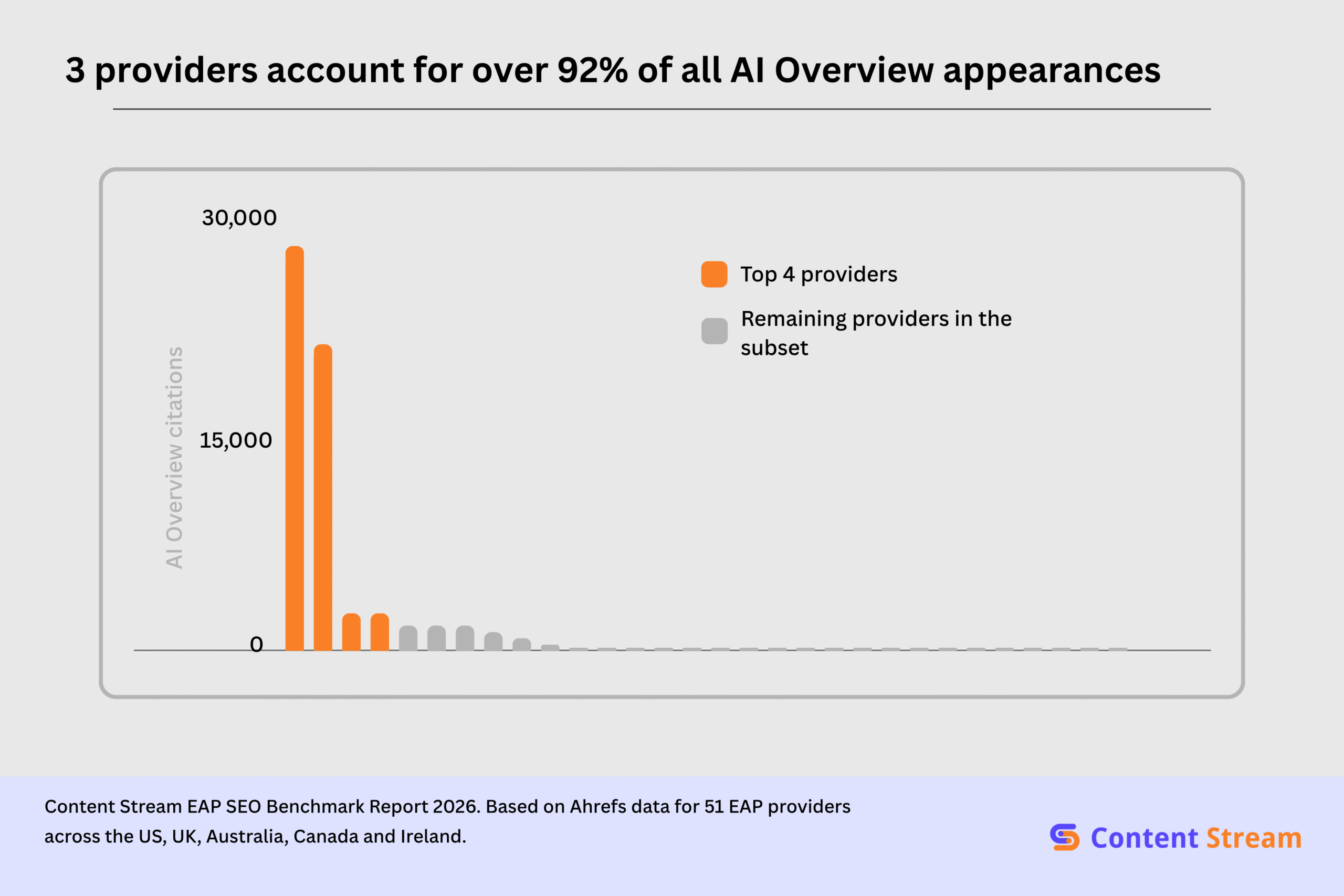
Our own report found that the average EAP provider appears in just 13 AI Overview results and receives zero ChatGPT citations. Additionally, four providers account for 92% of all AI Overview appearances, and these are the same providers with the strongest content investment.
Build content around the specific questions your buyers are actually asking at each stage of their research. Not just “what is an EAP” but “how do we measure EAP ROI”, “what does EAP implementation look like for a remote workforce”, and “how often should employees use their EAP?”
You can also use the AI platforms themselves to identify the questions and long-tail queries your audience is asking.
Many EAP providers and adjacent platforms have built their business through relationships like broker partnerships, employer referrals, industry events, and podcast appearances.
These activities can be very valuable for compounding all your online visibility efforts.
Here’s an example based on our case study: One of our clients, a UK fitness media brand, was growing its online presence while simultaneously sponsoring fitness events, forming product collaborations, and appearing on industry podcasts. Over six months, referring domains grew from 42 to 83, organic traffic grew by 800%, and the site went from zero top-10 rankings to over 100. We did a lot of foundational SEO work, but it was clear that the offline activity compounded the results.
A broker partnership that earns you a mention on a high-traffic HR platform is a backlink. Likewise, a speaking slot at an HR conference can lead to a citation in an industry publication.
As you invest in SEO, it’s important to help your teams understand the link to offline efforts.
65% of providers don’t rank for any top EAP-related keyword; there’s a real visibility gap in the industry. That could be good news for your brand, and it all starts with implementing the strategies we’ve shared in this guide.
We work with health and wellness brands to do exactly what this guide describes, from technical foundations to content that earns citations. If you want to know where your EAP SEO stands right now, start with a free audit.

I’m Matthew, a personal trainer turned SEO who’s worked with brands like Gymfluencers, Sailo, ClickCease, and Fraud Blocker. These days, I help small to medium sized companies grow their reach with smart, search-focused content.
