Content Strategy for Wellness Clinics: What to Publish and Why
Creating content for a wellness clinic asks more of you than picking a topic and hitting publish.
Start with the evidence behind your services. A strong body of clinical research supports some treatments, while others rely on a smaller body of evidence. Your content should accurately reflect that difference, presenting claims in a way that’s both useful to patients and supported by the available evidence.
There’s also the regulatory landscape to consider. Wellness marketing sits close to FDA and FTC guidance on health claims, so the language you use needs to be specific, evidence-based, and careful not to overstate what a treatment can do.
Search adds another layer of complexity. Many wellness searches have local intent, making local SEO an important part of your strategy. At the same time, broader informational searches are often dominated by major health publishers, creating a much more competitive environment for educational content.
Add multiple services, multiple locations, and the need to guide patients from their first question through to booking an appointment, and it’s clear that publishing the occasional blog post isn’t a content strategy.
In this guide, we’ll look at how to build a content strategy that supports your service pages, demonstrates expertise, and helps prospective patients move naturally from their first search to becoming a patient.
The first step in creating new pages is to assess the current ones. The structure of your website should determine your content strategy.
Start with what keywords/queries your pages rank for. Services pages, location pages and blogs can compete with one another if they’re all optimised for the same search intent.
In many cases, blog pages and service pages can rank for the same keywords, e.g., “IV therapy”, but you can differentiate them with intent. The blog can focus on “What is IV therapy?” to satisfy curious searchers, while the service page optimises for conversion by including the following:
Below is a table with more examples on how you can optimise blogs and service pages for similar but distinct searcher intent.
| Layer | Target | Focus | Intent |
|---|---|---|---|
| Acupuncture for Anxiety | |||
| Blog | "acupuncture for anxiety" | How it works, research citations, expected timeline | Top-of-funnel, not booking-ready |
| Service | "acupuncture for anxiety [city]" / "anxiety treatment" | Practitioner credentials, structure of session, insurance requirements | Bottom-of-funnel, ready to book |
| Chiropractic Adjustment | |||
| Blog | "chiropractic adjustment" | What happens, sensations to expect, assurance of safety, busting myths | Feeds internal links to service pages |
| Service | "chiropractic adjustment [city]" / "same-day chiropractic adjustment" | Scheduling, location, availability | Searchers are booking-ready |
| Functional Medicine Doctor | |||
| Blog | "what is functional medicine" / "functional medicine vs conventional" | Comparison-style content, evidence for/against presented | For people still evaluating the approach |
| Service | "functional medicine doctor [city]" | Provider bios, approach breakdown, conditions that can be treated | Direct intent, ready to convert |
| Hangover IV Therapy | |||
| Blog | "does hangover IV therapy actually work" | Addresses the evidence gap directly, satisfying sceptical readers | Builds trust before the ask |
| Service | Exact commercial phrase | Ingredients list, pricing info, book-now button | Converts already-convinced searchers |
Read more: How to rank for GLP-1 Related Terms
Next, audit your articles and make sure they link to, or serve, important service pages
Auditing existing service pages is a great starting point to identify where additional information is needed for patients before they can book in. Those gaps are filled by learning opportunities that complement your core services to them.
If you provide hormone treatment, for example, your service page should describe the therapy and motivate enquiries. Then, there are questions that people may have before starting treatment which can be answered by supporting articles. In this case, the supporting article could describe how hormones affect energy or what to expect during therapy.
Every article should, of course, include a link back to the corresponding service page, which will allow your patient to continue navigating your site and help reinforce your site’s topical authority.
If you’re still refining your website structure, our guide to Wellness Clinic SEO explains how to organise service pages, location pages, and content hubs to support long-term organic growth.
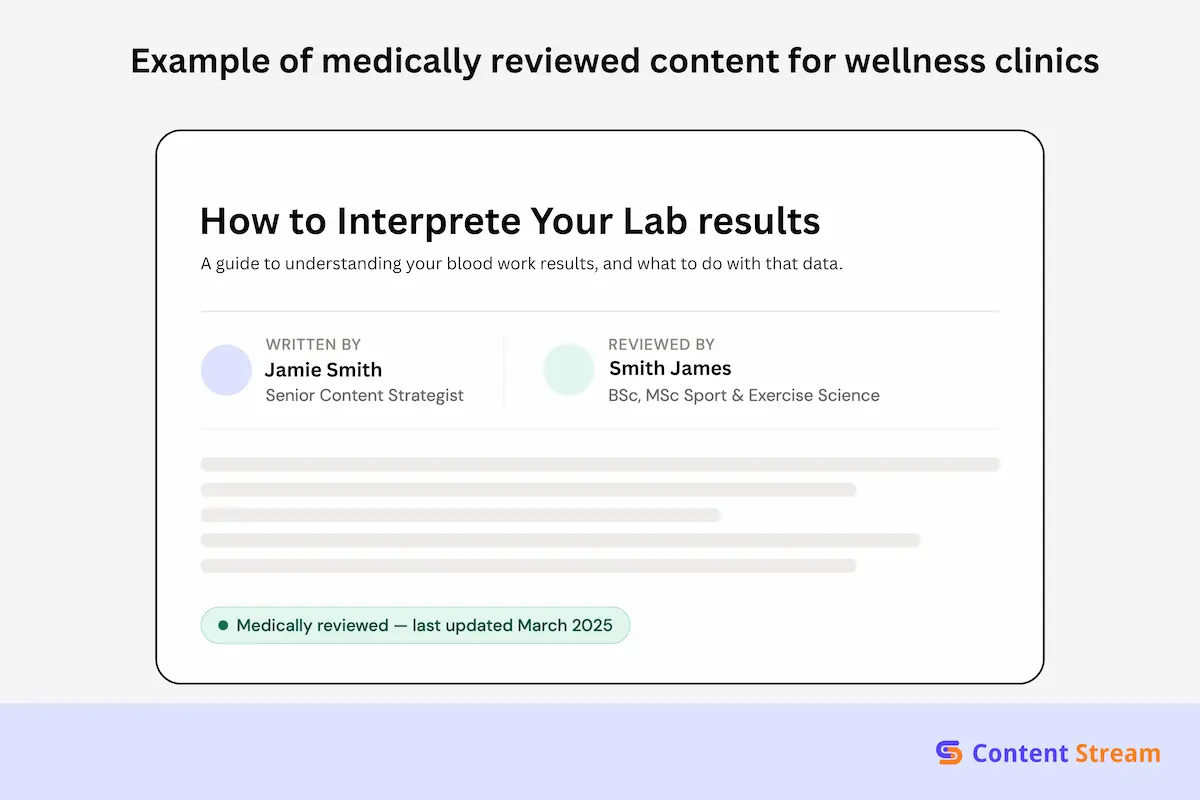
Health content carries a higher level of responsibility than most other industries. While a consistent publishing schedule is important, it’s also very important to have a process that ensures every article is accurate, up to date, and appropriate for your audience.
Google’s guidance on creating helpful, reliable, people-first content places particular emphasis on expertise and trust for health-related topics. One of the most effective ways to demonstrate those qualities is by building content governance into your editorial workflow from the start, rather than treating it as a final check before publishing.
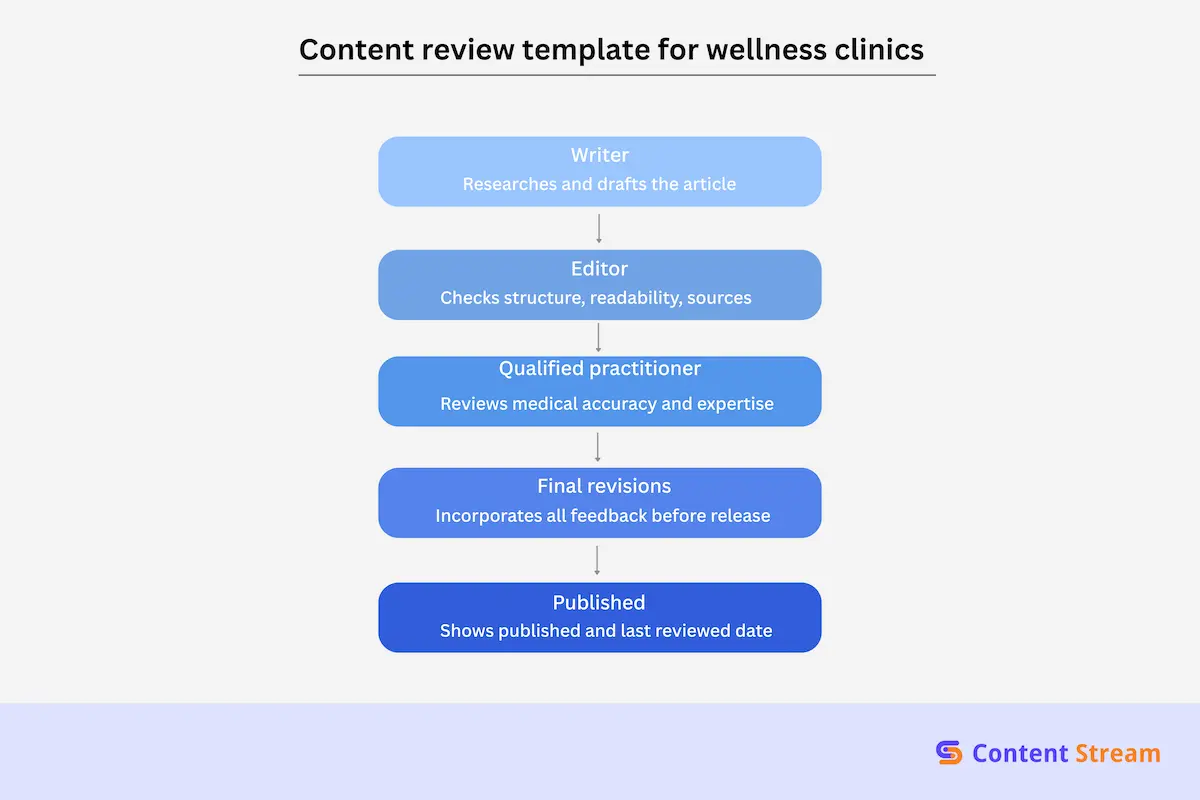
A simple governance process might look like this:
Alongside this workflow, every health-related page should clearly identify the author or reviewing practitioner where appropriate and include visible publication and review dates. Together, these signals help demonstrate that your content is actively maintained rather than published once and forgotten.
One of the simplest ways to plan content is to map it to the patient journey. Different types of content serve different purposes, from answering early questions to helping prospective patients compare treatments and, eventually, book an appointment.
A well-rounded content strategy supports patients at each stage of that journey. Here’s a breakdown
At the awareness stage, people are looking for information rather than a specific service. They might be anxious to learn about a symptom, to find further information about a health objective, or about ways to enhance wellbeing, such as
The opportunity here is to respond to general educational enquiries and to present yourself as an expert to any patients who may be looking for details. It makes sense that these articles would naturally lead to the corresponding service page, which is where readers can find out more about treatment options.
At this stage, people are evaluating different approaches and deciding whether a particular treatment may be right for them. Potential patients in this stage may search queries like:
Content mapped to this stage enables potential patients to learn about the various choices available and what to anticipate. It should also guide readers towards the service pages most relevant to their needs.
Decision-stage content is designed for people who are ready to take action. They know what they’re looking for and are evaluating providers. Examples include:
In most cases, this content belongs on service pages and location pages rather than in the blog. The emphasis needs to be on setting out the service, establishing trust and ensuring that prospective patients are able to contact you easily.
| Patient stage | Content type | Example | Links to |
|---|---|---|---|
| Awareness | Educational guide | How hormone levels affect energy | Hormone therapy page |
| Consideration | Comparison article | IV therapy vs oral supplements | IV therapy page |
| Decision | Service or location page | IV therapy clinic in Bristol | Booking page |
See more about this kind of strategy in our blog, SEO for Biohacking
Google’s guidance for website owners remains the same, except for the fact that search experiences are now powered by AI. The same practices that help content perform well in traditional search also help it appear in AI-powered experiences, including AI Overviews.
Rather than creating content specifically for AI, focus on the same fundamentals that have always mattered: accurate, well-organised, genuinely helpful resources. Google’s own guidance on succeeding in its AI search experiences confirms this directly. The strategies that are effective for a page to rank in conventional search apply to its performance in AI Overviews and AI Mode as well.
There’s really no separate playbook to learn. Clinics that already have a solid foundation in SEO best practices, provide useful content, have a clear site structure, and have a clear and honest knowledge base would be the most suited to gain from this.
Health-related topics are judged more strictly as they could have a significant impact on decisions. Google’s advice keeps focusing on experience, expertise, authoritativeness and trust (E-E-A-T), so it’s crucial to ensure your content is created by someone who has the right expertise.
When appropriate, cite the author and/or reviewing practitioner, cite credible sources, and provide a balanced, evidence-based explanation of treatments. These signals help to create trust not only with the person who is considering becoming a patient, but with the search engines as well.
Publishing more content doesn’t necessarily help. Google’s guidance on generative AI content is clear that AI-generated content can add value when it’s used well, but producing large volumes of low-quality pages simply to target keywords is unlikely to help your visibility. A small collection of quality, informative content that is kept up-to-date will almost always surpass dozens of opinionated articles.
Good content is only part of the equation. Search engines, and the AI systems built on top of them, also need to understand how your pages relate to one another.
Organising content around clear service pages, supporting educational articles, and logical internal linking makes it easier for both users and search engines to navigate your website. Structured data should also accurately reflect the visible content on each page, helping Google understand your clinic and its services.
Wellness information evolves with new information. It’s important to regularly audit and update health-related content to ensure that patients receive accurate information and that your website is actively managed.
This is especially significant for treatment pages and educational resources about the treatment, which can be important to access before making an appointment. Inclusion of review dates and adherence to the governance process described above ensures that information is up to date.
Google has been explicit that having a separate AI search strategy isn’t necessary for any website. The ones that benefit more from this are the clinics which already have a solid foundation in terms of helpful content, site structure, and expertise on all the services they provide.
Not every piece of content serves the same purpose. Some articles introduce prospective patients to your clinic, while others help them compare treatments or build confidence before booking an appointment. A balanced content strategy should support each of these goals.
Your practice will have different priorities depending on its services and audience, but here’s a simple starting framework we recommend at Content Stream:
Treat these percentages as a planning framework, not a fixed target. As you see which topics attract qualified traffic, generate enquiries, and support your service pages, adjust your priorities to fit your practice’s goals.
If you’re building or refining your clinic’s content strategy, start with these priorities:
A strong content strategy helps prospective patients find the right information at the right time while supporting the services your clinic offers. When your content is built around your website structure, reviewed for accuracy, and aligned with patient intent, it becomes a long-term asset for both your practice and your SEO.
Creating health content takes more than good writing. It takes an editorial process that balances SEO best practices with medical accuracy. At Content Stream, we work with health and wellness brands to produce content that’s built for both search visibility and patient trust. If you’d like a strategy tailored to your clinic’s services and goals, book a free consultation.