How to Build Topic Clusters for Your Health and Wellness SaaS Brand
For many brands, the standard SEO content strategy looks something like this:
Publish SEO content targeting low difficulty keywords, pick up some traction, rely on simple SEO strategies to deliver traffic, rinse and repeat.
But health tech brands can’t do that alone and win.
You operate in a space where trust, clarity, and credibility matter from the first touchpoint. Because you’re not just selling software; you’re selling fitness trackers, and sometimes, clinical, operational, or behaviour-change products that have a major impact on people’s health.
That raises the standards of what searchers expect, and the scrutiny Google puts on your project.
In this article, we’ll share exactly why you can’t rely on boiler-plate strategies, and what an effective SEO plan looks like for a health tech brand.
Health and wellness SaaS is a crowded, high competition space where your organic content is competing with direct competitors, publishers, review sites, healthcare institutions, wellness blogs, and even large platforms with years of topical authority. We talk more on this in our article on Why Health Tech Needs a Unique Content Strategy.
That means following the standard content playbook isn’t going to cut it.
If you want organic search to become a real growth channel, you need content strategy beyond the blog. It needs to be structured, commercially relevant, and built around how your audience actually searches. That is where topic clusters come in.
A topic cluster, sometimes called a content cluster, is a group of related pages organised around one central theme. The main page, often called the pillar page, covers the broader topic. Supporting pages go deeper into specific questions, subtopics, and use cases. These pages are linked together strategically so search engines can understand the relationship between them and readers can move naturally from one stage of research to the next.
For health and wellness SaaS brands, this approach is especially useful because trust matters so much if you intend to rank highly on Google. You are creating content in a space where quality, accuracy, and credibility influence both rankings and conversions. We cover that in more depth in our guide on the YMYL framework, and our E-E-A-T guide for health and wellness brands.
This article is focused on the practical side. We share a blueprint for planning and building topic clusters that can support visibility, authority, and pipeline.
The core value of a good topic cluster is helping you organize your blog content. But it does so much more than that.
Topic clusters can:
In practice, a strong topic cluster should do five things well:
That is the framework to work from.
Traffic going up looks great in reports, but revenue is the real success metric. And that’s where we start building a pillar from.
In execution, your pillar topic should sit where product relevance, search demand, and audience need overlap. If it is too broad, you will struggle to rank and attract a lot of irrelevant traffic. If it is too narrow, you may not have enough room to build a meaningful cluster around it.
A common mistake is choosing a topic that sounds large and impressive but is too far removed from your actual product.
For example, if your product is a patient engagement platform, building a pillar around “digital health” is far too broad. Even “patient communication” may still be too loose depending on the content landscape.
A stronger pillar might be “patient appointment reminders” or “how to reduce no-shows in clinics.”
Those topics are much closer to a real operational pain point. They also give you room to build supporting content around workflows, systems, software considerations, and outcomes.
Here’s a simple question to test if you pillar topic is ideal:
If this page ranked well, would the people landing on it be realistic buyers and strong-fit future leads? If not, the topic probably needs refining.
For health and wellness SaaS, the best pillar topics are usually tied to one of the following:
Once the pillar is clear, the next step is mapping the cluster around how your audience actually thinks and searches.
Build around intent rather than just keywords.
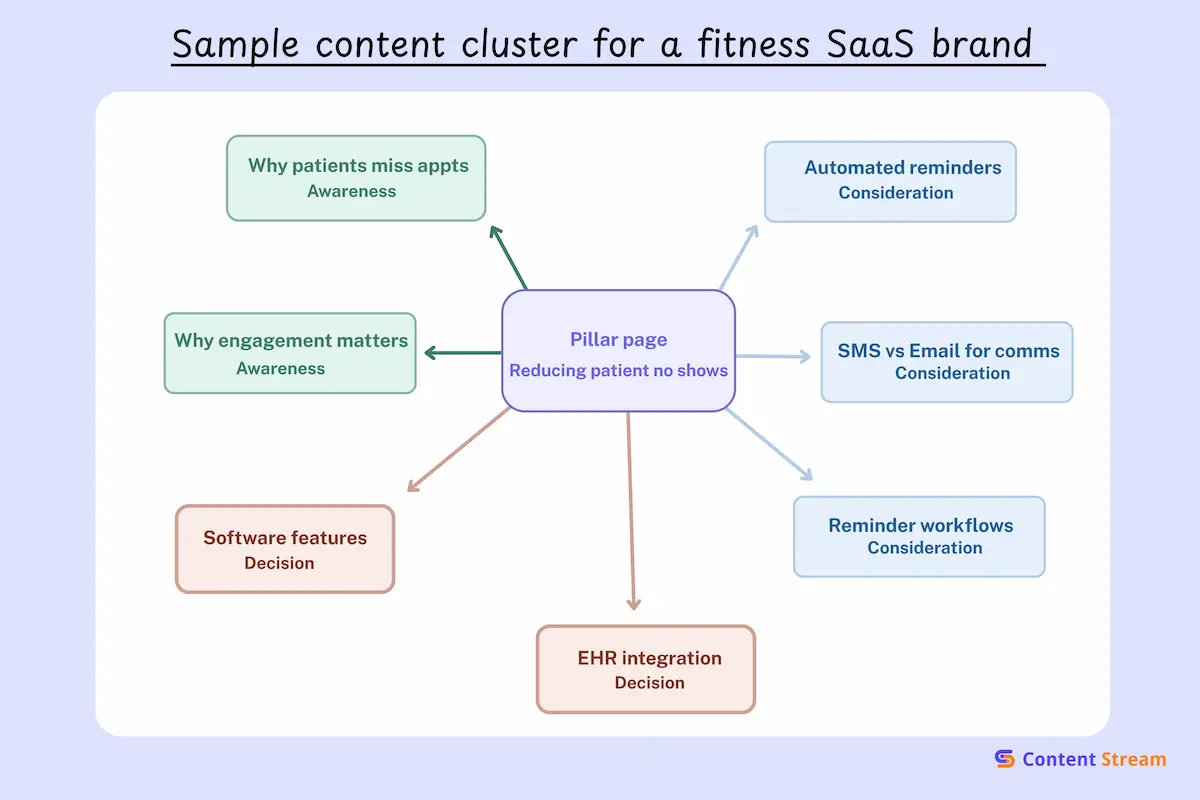
Most strong SaaS topic clusters include content for awareness, consideration, and decision. That matters because buyers usually start with questions, problems, comparisons, and internal research, not product pages.
Take the patient engagement angle from Step 1.
At the awareness stage, your audience may be searching for things like:
These searches are problem-led. The reader is trying to understand what is happening and why it matters.
At the consideration stage, the same audience may be looking for
These searches are solution-led. The reader understands the issue and is now exploring approaches.
At the decision stage, the queries become more specific. They may search for:
These searches are closer to evaluation and purchase.
That is what a useful cluster should reflect. It should be focused on supporting the full decision journey rather than just targeting related phrases.
For a topic cluster to work, each page needs its own distinct function.
Each article should target one clear question or intent and offer real value, not just keyword placement. It’s also important that each page presents the next logical step to the user.
That means your content needs to be useful in a practical way. It should explain clearly, bring in examples where relevant, and reflect real understanding of the buyer’s world. In health and wellness SaaS, that may mean referencing operational pressures, clinical workflows, patient behaviour, compliance considerations, or implementation realities depending on the product.
Rule of thumb for building content clusters
Every page in the cluster should be able to stand on its own, but it should also feel like part of a bigger system.
Without internal linking, cluster pages are just a collection of related articles.
Here’s the recommended way to interlink your content clusters:
This structure helps search engines understand the hierarchy of your content. It also helps users move naturally from one question to the next, which improves engagement and increases the chances of them reaching a commercially relevant page later in the journey.
Let’s say your pillar page is about reducing patient no-shows. That page might link to supporting pages on why patients miss appointments, reminder channel comparisons, patient communication workflows, reminder software features, and implementation considerations. Those supporting pages should also link back to the main pillar using clear, descriptive anchor text.
It’s also critical that anchor texts give context. Phrases like “patient reminder workflows,” “reducing clinic no-shows,” or “appointment reminder software features” are much more useful than “read more here,” and “this guide.”
A topic cluster should be measured like a business asset, not a publishing exercise.
Traffic matters, but traffic alone is not enough. Especially in SaaS, the real question is whether the cluster is improving visibility for the right keywords, attracting the right audience, and contributing to the pipeline.
Start by tracking keyword movement across the pillar and supporting pages. Then look at engagement. Are users moving between pages? Are they staying long enough to indicate relevance? Are they progressing toward decision-stage content?
After that, look at assisted conversions and lead quality. Often, content does not get credit on the final click even though it played a clear role in the buying journey. Someone may first discover you through an awareness article, return via a comparison page, and only convert later through a product page or demo request. That is still strong content performance.
Topic clusters bring structure to content that would otherwise sit in isolation.
When doing SEO for health and wellness SaaS brands, that structure can do a lot of heavy lifting. It can improve how search engines understand your expertise. It can help readers move from first question to serious evaluation. And it can turn content from a brand-awareness exercise into something that supports growth.
The key is to stay close to the product, close to the buyer, and close to search intent.
Choose a pillar topic that matters. Build supporting pages around real questions. Make each page genuinely useful. Link everything properly. Then measure performance based on rankings, engagement, and qualified lead impact.

I’m Matthew, a personal trainer turned SEO who’s worked with brands like Gymfluencers, Sailo, ClickCease, and Fraud Blocker. These days, I help small to medium sized companies grow their reach with smart, search-focused content.
