SEO for Nutritionists: How to Get Found Online
If you search for nutrition-relevant keywords on gut health or allergies, you’ll see most of the top results are Healthline, WebMD, and Medical News Today, not other nutrition practices.
Granted, these large websites have greater authority and, theoretically, more resources to put out accurate and reliable information. But they are still taking up valuable search real estate that can get your business in front of the right people.
One key learning here is that your business can’t realistically rank for every broad keyword related to nutrition. And chasing keywords shouldn’t be the entire SEO strategy either. We’ve already published a guide to low-difficulty nutrition keywords that can help you identify realistic opportunities. But choosing the right keywords is only one part of the equation.
Your site also needs to demonstrate expertise, target the right search intent, and give Google clear signals that your content is trustworthy.
In this guide, we’ll walk you through what it actually takes beyond keyword targeting: the structure, credentials, and trust signals that let a real nutrition practice compete and win.
“Registered dietitian” (RD or RDN) is a credential protected by law in the vast majority of states. To use it, you need an accredited degree, supervised practice hours, and a passing score on a national exam.
“Nutritionist” works differently and less consistently. Regulation varies significantly by state: some require licensure or certification even for non-RDN nutritionists, while roughly as many place no requirements on the title at all. In a state with no requirements, someone can call themselves a nutritionist regardless of training.
From an SEO perspective, your website should make your professional background easy to understand. Clearly explain your qualifications, the services you offer, and the expertise behind your advice so prospective clients can quickly establish trust.
RDs are legally permitted to offer medical nutrition therapy, so your content can lean into specific health conditions without receiving a penalty from Google. But nutritionists without the RD credential usually can’t provide medical nutrition therapy, so we recommend that your content stay in general wellness and lifestyle territory, both to remain compliant and credible.
Here’s a table showing how to write content and share information online, depending on your credentials.
| RD can say | Wellness nutritionist can say |
|---|---|
| Meal plans for managing type 2 diabetes | Foods that support steady energy levels |
| Medical nutrition therapy for a diagnosed condition | Lifestyle guidance for general wellbeing |
| Specific dietary protocols tied to a clinical diagnosis | General nutrition education, not tied to any diagnosis |
Local SEO for practice-based nutritionists If you run a nutrition practice with a physical clinic, the fundamentals of local SEO still apply. You need a complete Google Business Profile, consistent business details across directories, and accurate citations that reinforce your location. These are the baseline signals Google uses to understand and rank local businesses. For a detailed step-by-step guide, see our Google Business Profile guide.
Here are the most important bits:
We recommend auditing your business listings regularly as your practice grows. And if you move locations, you shouldn’t create a new profile. Instead, Google’s own guidance recommends updating the existing one. Similarly, there’s no need to create a new Google Business Profile for each service you offer at the same address.
The goal is to keep your profile consolidated, and the more accurate the information you share, the easier it is for Google and potential clients to find the right information.
Here are the other essentials to keep in mind:
You want to keep your profile accurate, complete, and easy for both Google and potential clients to trust.
If you work fully online with clients anywhere, local SEO matters less. You’ll get more value from the content strategy covered in the next sections, where your expertise can reach a much wider audience than trying to rank in one area.
Keyword research is still worthwhile, but Google surfaces content differently now. AI Overviews and large language models are better at understanding topics and intent, so a page doesn’t need the exact keyword phrasing to rank.
Rather than chasing individual keywords, we recommend focusing on matching your content to what people are actually trying to accomplish. See our nutrition SEO keyword list for more ideas.
One useful way to do this is to sort keywords into 3 groups:
Articles on healthy eating or meal planning can drive traffic, but they won’t convert readers into clients unless they’re part of a broader strategy.
Instead, build content around the actual journey someone takes from researching a problem to booking an appointment. Start broad and educational: recipes, meal planning ideas, general nutrition tips. Move into more targeted content for readers with a specific concern.
This is where your professional scope matters: RDs can lean into evidence-based content on specific health conditions or medical nutrition therapy, while wellness nutritionists should stay focused on lifestyle and general wellbeing topics within their scope. Finish with content that signals someone is ready to act: “nutritionist near me,” “sports dietitian in [city],” or your core service pages themselves.
A strategy built this way does more than rank. It puts the right content in front of the right person at the right stage, and it keeps you visibly building authority on the topics that matter most to your practice.
Want a content strategy built around your specific scope and goals? We can help you build one.
For your practice, trust isn’t built on an About page alone. It needs to be visible wherever you’re making a health-related claim.
If you’re an RD or RDN, display the credential clearly and explain in plain terms what it means. Most potential clients won’t know the difference unless you spell it out. If you’re a nutritionist without that credential, lean harder on other signals: qualifications, training, and real work experience. Case studies and patient quotes help too, but label them clearly as patient experiences, not clinical evidence or a promise of results.
Back up any specific nutrition claim with a named, reputable source. Citing trusted organisations and peer-reviewed research gives your content authority and lets readers see exactly where the information comes from.
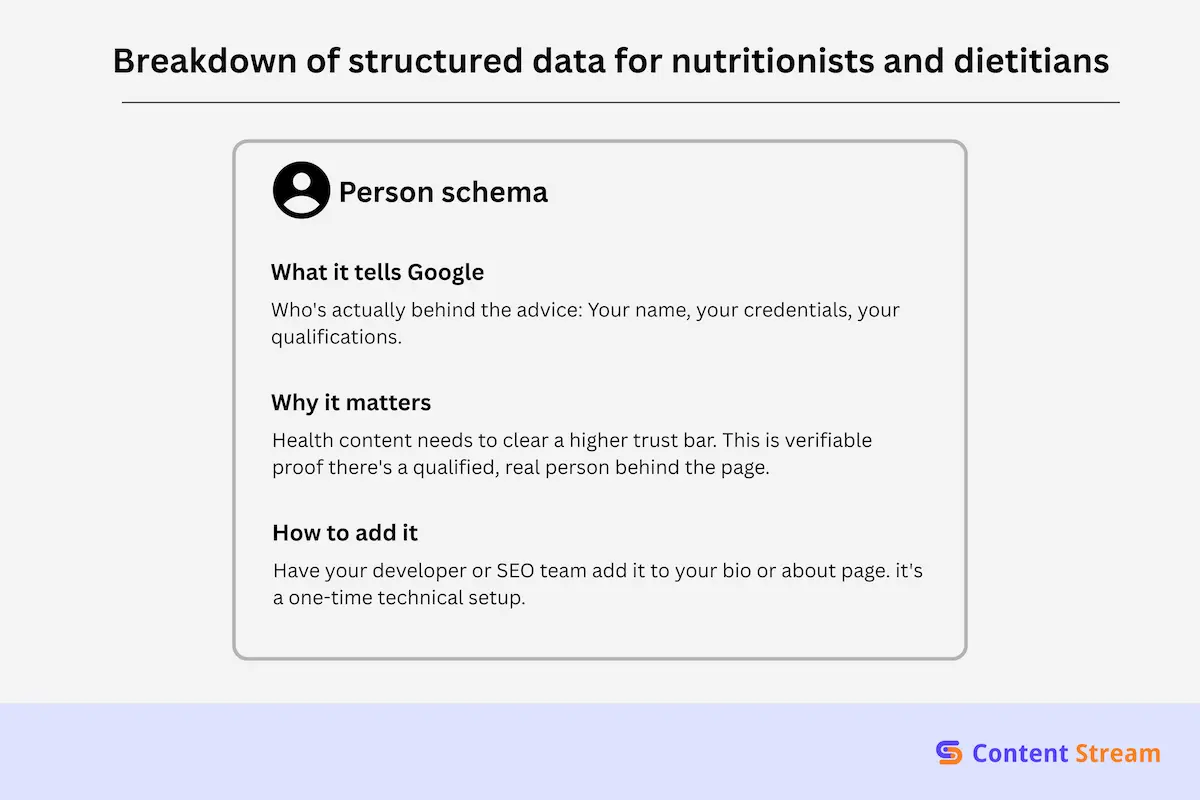
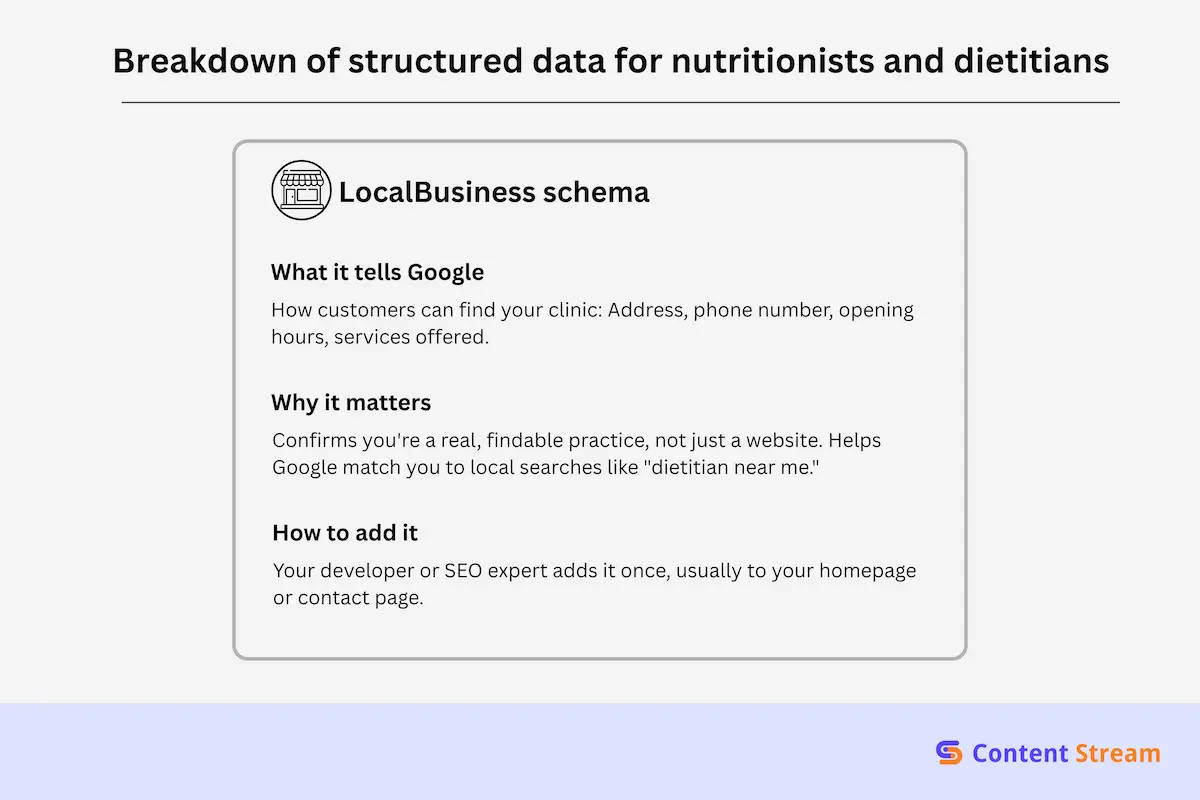
On the technical side, structured data reinforces these signals. Use Person schema for the practitioner behind the content, and LocalBusiness schema if you operate a physical clinic. You can also check out our guide on schema types.
Trust signals won’t rescue weak content, but they reinforce good content. Since your practice sits in YMYL territory, making your qualifications, evidence, and expertise clearly visible tells both potential clients and Google that your content deserves to be trusted.
The best backlinks for your practice come from sites genuinely relevant to your field. Guest content for complementary health practitioners, physiotherapists, GPs, personal trainers, gyms, builds authoritative links and puts your expertise in front of the right audience. These partnerships tend to carry more value than links from unrelated sites, since they build topical relevance.
Professional associations and trusted directories work well too. For RDs especially, being listed with a recognised organisation gives you a trusted citation and a quality backlink at once.
Avoid shortcuts like bulk guest-post services or reciprocal link exchanges with unrelated sites. They can add link volume without adding authority in Google’s eyes. A handful of links from credible health and wellness sites will always outperform a large batch of low-quality ones.
Technical SEO won’t make your practice stand out on its own, but poor technical performance holds a strong site back. Keep your site mobile-friendly, fast-loading, and easy for both users and search engines to navigate, especially since health-related sites carry a higher baseline expectation for a fast, reliable experience.
If you’re unsure where to start, our guide on technical SEO for fitness websites covers the fundamentals, and they apply just as directly to a nutrition practice.
Whether you’re a registered dietitian or a wellness nutritionist, effective SEO starts with understanding your professional scope. The content you create, the keywords you target, and the trust signals you display should all reflect the services you’re actually qualified to provide.
If you’re not sure where to begin, here’s a list that might help:
A successful nutrition SEO strategy is built on credible expertise, well-organised content, and a clear understanding of what prospective clients are searching for at each stage of their journey.
If you’d like help building an SEO strategy tailored to your practice, get in touch with our team for a free consultation. We’ll identify your biggest opportunities and build a plan designed to support sustainable, long-term growth.