How to Optimise Your Health & Wellness Content for AI Search (ChatGPT, Gemini, Claude)
Page 1 rankings used to be the content strategy goal for many health and wellness businesses in the past. Appear on the first page and you automatically get traffic to your site. Now, the landscape has changed and appearing for LLM citations and AI appearances is just as important.
Similarweb data shows that average monthly visits across AI platforms, including ChatGPT, Gemini and Claude, have grown 70% year-on-year, reaching 9.5 billion visits between June 2025 and May 2026.
Before you go ahead to create a separate AI content strategy, especially if your content isn’t being surfaced by AI systems, know that your existing SEO work is still the foundation. In this guide, we’ll share:
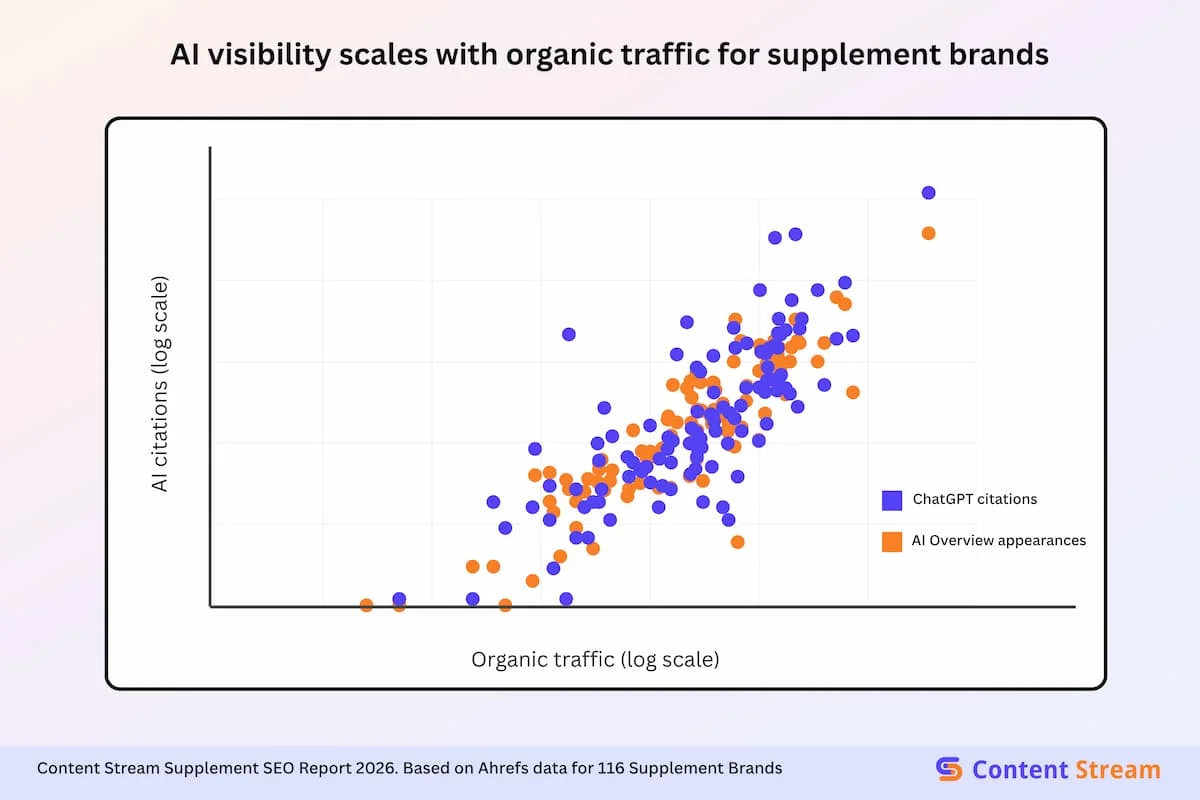
According to findings from our recent study, businesses that perform well in organic search also tend to appear in AI citations. Our report sampled 116 supplement brands in August 2026 and discovered that, for health and wellness businesses in this category, organic strategy translates very well to AI search strategy.
Although this doesn’t mean ranking well automatically gets you cited by an AI chatbot. However, it does suggest that AI visibility isn’t happening in a completely separate part of the search ecosystem.
In the same vein, Ahrefs analysed 75,000 brands and found that off-site signals were strongly associated with AI Overview visibility. According to the study, brand mentions correlated roughly three times more strongly than backlinks, giving brands another reason to think beyond their own website when building visibility.
SEO guidance according to Google still remains relevant to AI Overviews and AI Mode. So if you’re already working on technical SEO, content quality, internal linking, and authority, keep going.
When someone asks AI systems such as ChatGPT, Gemini or Claude a health question, they aren’t looking to dig through several pages for the answer. They want the answer to their question with zero stress.
This goes to show the importance of content structure. Clear headings, concise explanations, and logically organised information help AI systems identify which parts of a page are relevant to a particular query. They also make the same content easier for people to scan.
Here’s how to structure your content.
If you’re writing health and wellness content, include a short answer or summary at the start of the particular part. Use the remainder of the section to explain the reasoning, evidence and practical context for it.
For instance, the information about the “How long does vitamin D take to work?” section may begin with a brief, straightforward statement. You can then follow it up with information about factors that might influence the length of time required and when a person should contact a healthcare professional.
This not only gives search engines a more defined way to answer the query directly but also saves the potential customer time trying to read through the entire article for the answer.
Long paragraphs can hide useful information. Make the relationship between ideas clear by breaking important points into formats.
Use:
It’s not about adding formatting to achieve SEO. When a person can skim a page and get the information they need, the AI system also has an easier structure to work with.
Keyword targeting still matters, but conversational search gives you another way to think about your content.
A page specifically for “Vitamin D benefits” may cover the topic in depth, but someone using an AI assistant might ask:
Those are not simply variations of the same keyword. They represent different questions and potentially different stages of the user’s research.
Instead of forcing target keywords into every section, centre your content around real user questions. To keep things clean and readable, use the layout framework from our Content Strategy for Wellness Clinics guide.
Even the best-written health content might struggle for visibility if search engines can’t reliably access, interpret, or connect with it. Make sure the website itself isn’t getting in the way before you add more to your content calendar.
For health and wellness businesses, that means looking beyond the copy. Your structured data, site architecture, internal links and technical setup all help search engines understand what your pages are about and how they relate to one another.
Structured data gives search engines additional information about the content and entities on a page. It isn’t a shortcut to AI visibility, and adding schema doesn’t guarantee that a page will appear in a particular search feature. But using the appropriate markup can help search engines interpret your content more consistently.
Depending on your business and the page, this could include:
Read more about how to use different types of structured data for wellness businesses.
AI visibility doesn’t start and end with individual articles. Your website should make it easy to understand how your pages connect.
For example, your wellness clinic might have a broader guide to a condition, supporting articles covering individual symptoms and treatments, and service pages explaining how the clinic can help. Internal links connect those pages and give search engines a clearer picture of the site’s topical coverage.
Use:
This also helps distribute the authority your site earns. A useful article shouldn’t become a dead end. Link it to the relevant service, product or category pages where those links genuinely help the reader.
Read more about technical optimisations for businesses in the health and wellness industry.
A technically complicated website isn’t the goal. A website search engines can access and understand reliably is.
Check that important pages are:
If you’re unsure whether technical issues are limiting your organic visibility, see our request for a free website audit for a clearer picture.
Health and wellness content doesn’t get much room for unsupported claims. If you’re writing about supplements, symptoms, treatments or ingredients, readers need to know where that information comes from and why they should believe it.
Start with the basics:
None of that guarantees ChatGPT, Gemini or Claude will pull your content into an answer. But what it does is give both readers and AI systems a solid basis for judging your credibility.
In our August 2026 supplement SEO study, we saw something similar. The bigger, more established sites did tend to have stronger E-E-A-T signals, author bios and citations.
Once we accounted for the authority those sites already had, the difference narrowed to just 7%, not enough to call credentials a meaningful growth driver on their own..
So for your health and wellness brand, E-E-A-T should be treated as hygiene rather than a growth lever. Get it right because it’s the baseline, then put your energy into the things that actually make your content worth finding and citing.
In July last year, Semrush analysed over 10 million keywords to track evolving search behaviours. AI Overviews appeared for 6.49% of queries in January 2025, peaked at 24.61% in July, and stood at 15.69% by November.
The intent behind triggering searches shifted significantly as well: commercial queries grew from 8.15% to 18.57%, while transactional queries increased from 1.98% to 13.94%.
For your health and wellness business, look beyond where your pages rank. Instead, ask where they appear in AI-generated answers.
To measure your success,
AI visibility is not something you can bolt onto a website by adding a few FAQs or rewriting every heading. If your content attracts organic traffic, the better starting point is to identify where you have existing authority and user demand, then make those pages easier for AI systems to understand and reference.
Over the next 30 days, focus on a small group of pages rather than trying to overhaul your entire site.
Original research attracts links naturally, whether that’s statistics you noticed in your business, collated feedback, or even a roundup of relevant stats in your industry.
But you don’t have to launch extensive research to publish data-driven content. Run surveys, track trends, and analyze results. Other sites will reference your findings and link back without any extra effort on your part.
| Week | Focus | What to do |
|---|---|---|
| Week 1 | Find the opportunities. | Start with content that is already getting some traffic or rankings. Look for pages that answer questions people commonly ask about their health. Then identify where the answer could be clearer, more useful, or easier to find. |
| Week 2 | Make answers easier to find. | Rewrite the important sections so readers can quickly find what they need. Put the answer upfront, use clear headings, and turn complicated information into lists or tables where they make sense. Also, add related questions your readers are likely to ask. |
| Week 3 | Strengthen trust and connections. | Check who wrote and reviewed each piece. Add sources for important health claims, update outdated information, improve internal links, and add relevant structured data. |
| Week 4 | Measure what changes | Look at what changed after your updates. Check your organic traffic and rankings, and where the data is available, look at AI Overviews and traffic coming from AI platforms. Use those results to decide which pages and approaches to improve next. |
If you want to show up when someone asks ChatGPT, Gemini, Claude or Google a question, the work starts long before the answer is generated. You have to give those systems something worth finding and referencing.
That will include content that answers the questions your customers actually ask and health claims backed by credible evidence. You also need expertise that’s easy to verify and a website that’s technically easy to access.
A practical starting point:
If you’re unsure whether your current content is giving your brand the visibility it deserves, get in touch with us. We can review your existing content, identify the gaps affecting your search and AI visibility, and help you build a content strategy around the questions your customers are actually asking.

I’m Raechelle, a content writer and editor specializing in SEO and health content. With over six years of experience, I help brands turn complex health topics into clear, well-optimized content that ranks.
