The Supplement Brand’s Content Playbook: What’s Driving Traffic in 2026?
Top-performing brands cover 8.73x more keywords than the rest, despite domain authority only 1.3x higher. Coverage, not authority, is what separates the winners from everyone else.
Informational content dominates keyword footprints, but leaning too hard on it backfires. Brands with the heaviest informational skew saw 2.7x less traffic per keyword than brands with a balanced mix of informational, commercial, and transactional coverage.
The best brands pull less traffic from their own name. Branded searches make up just 20% of traffic for the top 20 brands, compared to 54% for the bottom 20, showing that strong organic content drives visibility more than brand recognition alone.
E-E-A-T signals matter, but they act as a baseline, not a growth lever. Among high-authority sites, credentialed brands saw only a 7% traffic edge over non-credentialed ones once overall authority was accounted for.
AI Overview visibility tracks traditional rankings closely. Brands that rank well organically are largely the same ones showing up in AI-generated answers, so the fundamentals of people-first content, original expertise, clear structure, and accurate information still decide who wins.
Planning content for a supplement brand comes down to a few real decisions: which topics deserve attention first, where your biggest opportunities sit, and what will contribute to long-term organic growth.
To find real answers, we analysed 116 supplement websites and identified patterns shared by the strongest performers. Some confirmed common SEO advice, like high DR = real growth. Others challenged assumptions that get repeated across the industry, like the influence of SEO on paid campaigns.
In this guide, we break down those findings and extract strategy from them. You’ll find out what the winning brands in 2026 are doing in terms of SEO and organic content, and walk away with a list of what to prioritise first.
You can read the full report here: The State of Organic Visibility in the Supplement Industry, 2026.
Every supplement brand already has a natural starting point for content planning in its product catalogue. Our research found that nearly every keyword a supplement brand ranks for has informational intent. Only 23% is transactional. That means most people are researching supplements well before they’re ready to buy. More importantly, it means even transactional keywords still show up in informational search.
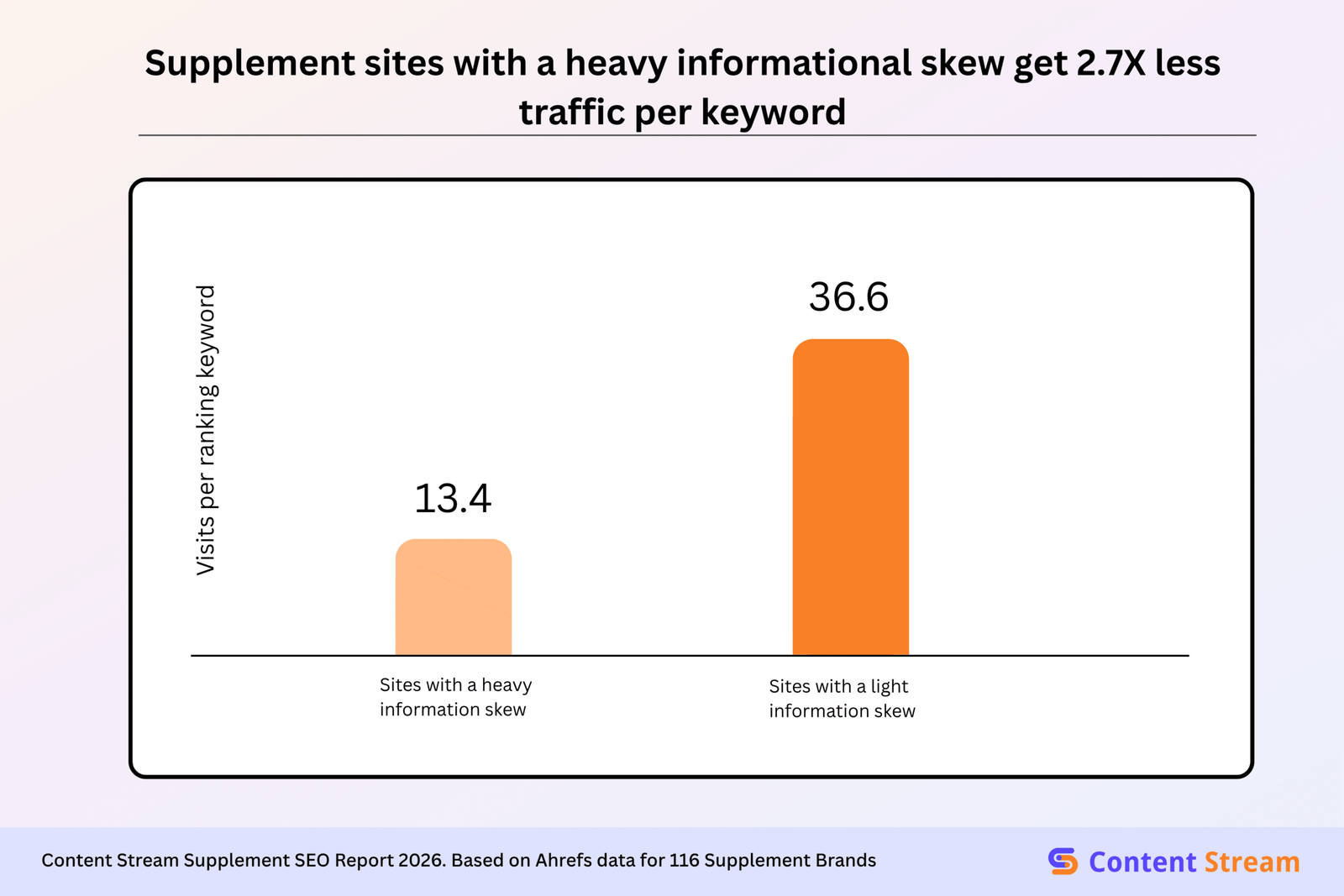
That said, the data comes with an important caveat: brands with the heaviest informational skew in their keyword footprint actually saw 2.7x less traffic per keyword than brands with a lighter, more balanced intent mix. Informational content still matters, since it’s where the volume of search demand sits, but it works best as part of a mix alongside commercial and transactional coverage, not as the sole focus of your strategy.
A strong content strategy should help answer the burning questions first, then guide readers towards the products that meet their needs. Start by identifying the products or product categories that matter most to your business, then build a cluster of supporting content around each one.
| Content format | What it covers |
|---|---|
| Evidence summaries | What current research actually says, and where the evidence is still limited |
| Ingredient comparisons | E.g. magnesium glycinate vs citrate, whey isolate vs concentrate |
| Product-specific FAQs | Built from the questions your customer support team hears most often |
| Dosage and safety guidance | Referencing reputable clinical sources where appropriate |
| Buying guides | Helping customers choose between similar products based on their goals |
This approach naturally expands your keyword coverage while strengthening the commercial pages that generate revenue.
One of the clearest findings from our research was the size of the keyword coverage gap between top-performing brands and the rest of the pack. The top-performing supplement websites ranked for 8.73x more keywords, despite having domain authority only 1.3 times higher.
That gap shows where the opportunity lies: broadening the range of topics you cover.
Start by finding the questions your customers have that your site doesn’t yet answer. These gaps tend to fall along the lines of your current products and ingredient categories, so filling them is really an extension of the strategy you already have.
Expanding your coverage means answering more of the real questions your audience is already asking. Each new topic you cover adds another way for new customers to find your brand in search.
Keep this in mind when auditing your supplement brand’s content.
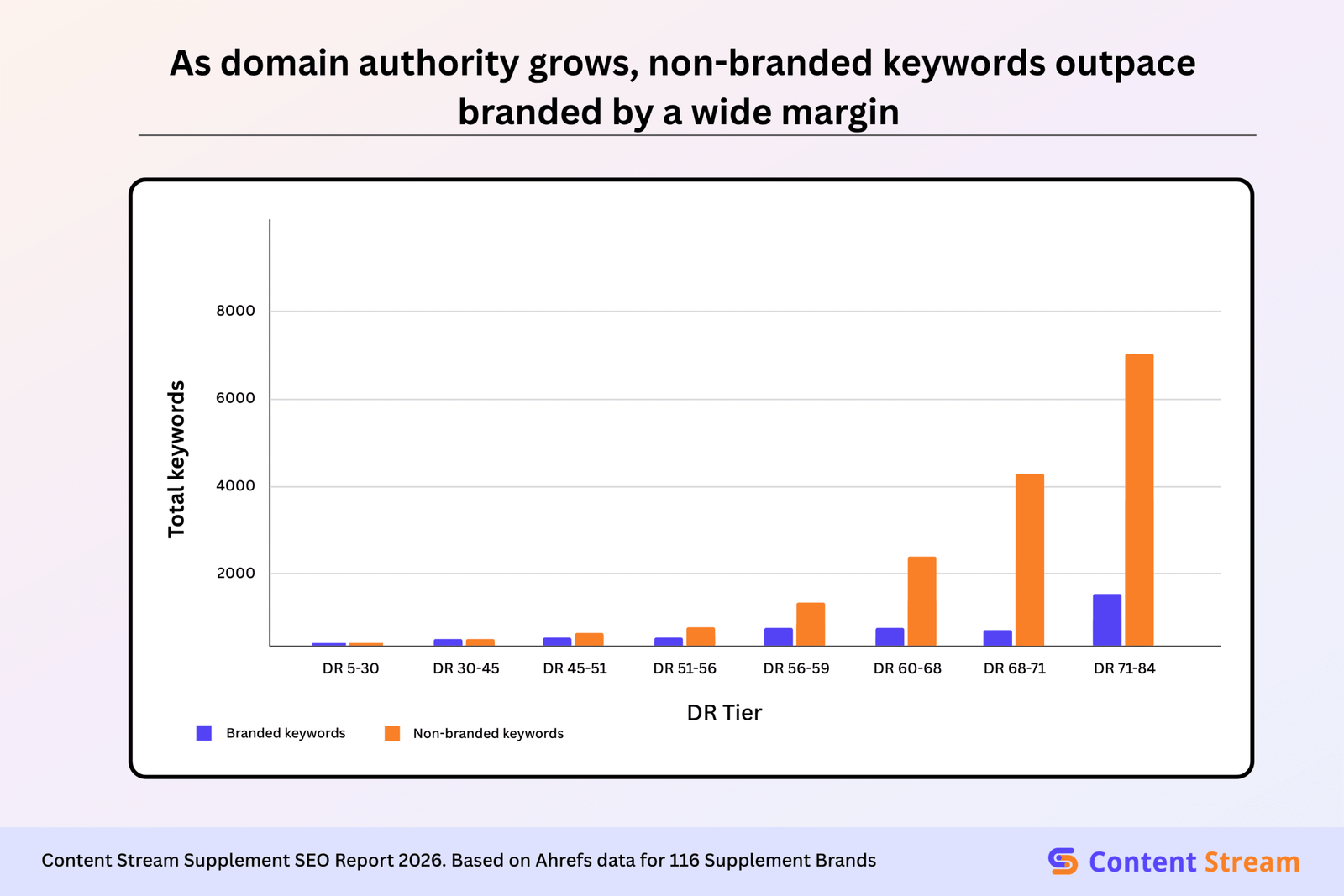
Our research found that brands with high authority lean less on branded searches than those with lesser authority. They still have a large portion of their traffic coming into branded pages (20% for the top 20 brands vs 54% for the bottom 20), but there’s a lot less dependence.
In other words, the best supplement brands get more of their organic traffic from people who aren’t searching for their brand directly.
Worth noting: a high branded traffic share isn’t automatically a problem. It’s only a concern when it comes from weak organic content performance. A handful of brands in our sample carry high branded traffic coming from strong offsite presence, social following, influencer partnerships, and founder-led recognition. In situations like this, these need to be taken as a signal of strength.
Non-branded content introduces your brand to people who are still researching a health goal, ingredient, or product category. They tend to look for content around the following:
Branded content, product news, company updates, and brand-specific resources still earn their place, especially as your brand grows. But if your goal is to attract new visitors through organic search, prioritise publishing non-branded topics.
Some supplement topics are covered by almost every brand: Ingredient benefits, dosage guidance, and product comparisons. These are all important, but unfortunately, they are also highly competitive.
The content that’s much harder to replicate is the kind only your business has access to. It draws on your products, processes, and expertise, giving readers information they won’t find on dozens of other supplement websites.
| Content idea | Why it stands out |
|---|---|
| How your products are formulated | Explains the thinking behind ingredient selection and product development |
| Why specific ingredients were chosen | Shows why one ingredient or dosage was selected over another |
| Third-party testing | Demonstrates your approach to quality assurance and product verification |
| Certificates of Analysis (COAs) | Gives customers greater transparency about product quality and testing |
| Manufacturing process | Helps customers understand how your products are produced and controlled |
| Sourcing decisions | Explains where ingredients come from and the standards used to select suppliers |
| Customer FAQs | Answers real questions collected by your customer support team |
| Practitioner interviews | Shares insight from nutritionists, pharmacists, or other experts involved with your brand |
| Product development stories | Gives customers a behind-the-scenes look at how products evolve from idea to launch |
Content like this shows customers the difference between your product and everyone else’s, and it builds assets competitors can’t easily copy or rewrite.
Combine it with your other product-focused content to strengthen your overall library for both search visibility and trust.
Read more about optimising supplement sites for AI visibility.
Our research found that on-page E-E-A-T signals, author bios, credentials, and citations show only a modest independent relationship with organic performance once you account for overall site authority.
Among high-authority sites, credentialed brands saw just a 7% traffic edge over non-credentialed ones.
That doesn’t make them any less important. But it doesn’t mean that linkbuilding for supplement brands and authority boosting can substitute E-E-A-T signals.
The takeaway is that treating them as a baseline expectation should be the goal, rather than a growth strategy on their own.
For your brand, trust should be built into every stage of content production. Readers need confidence that the information they’re relying on is accurate, balanced, and up to date.
These practices help readers evaluate your content and support the credibility of your brand.
Educational content is valuable on its own, but its job doesn’t end once it answers a reader’s question. Every article should help move traffic towards the pages that generate enquiries and sales.
That typically means connecting informational content to product pages, category pages, buying guides, or ingredient collections. Someone reading about the benefits of omega-3 should be able to continue naturally to a page comparing your omega-3 products or explaining how to choose the right formulation.
Internal links also help search engines understand how your content fits together. When several articles link to the same commercial page, they pass authority from those articles to the page that needs it most.
As you review your content, ask where someone should go next. If the answer isn’t obvious, that’s either a gap in your content strategy or, you have room to improve your internal links.
For a more detailed look at structuring ecommerce websites for search visibility, see our ecommerce SEO guide.
Attributing content success to actual business outcomes can be challenging. Unless organic visitors click through to your blog page > product page > and complete a purchase, it’s hard to say what’s working definitively.
Here’s a framework that can help.
These are the most traceable metrics.
Most of the data won’t be completely clean, but track these as a start. It’s the kind of metrics that can be presented to even the CFO.
These are the metrics that show content leading to a purchase decision without directly closing it. They include things like:
The biggest advantage of content and SEO is the compound interest. Every blog published adds to your overall authority and search equity over time.
Here are the metrics you can use to measure these:
One critical takeaway from our analysis of 116 supplement brands is this: the strongest performers ranked for a wider range of relevant topics, attracted a greater percentage of non-branded traffic, and built content that served both their customers and their commercial pages.
If you’re reviewing your own strategy, that’s the template to build with.
Need help with your strategy? Our team can help you map keyword gaps against the patterns we found in our study, and build you a proven content roadmap.

I’m Raechelle, a content writer and editor specializing in SEO and health content. With over six years of experience, I help brands turn complex health topics into clear, well-optimized content that ranks.
