Supplement SEO Statistics: 2026 Visibility Numbers For Brands
Ranking on Google’s first page is nice to have as a supplement brand, but in 2026, it shouldn’t be the sole focus. For supplement brands, the competition is concentrated in AI visibility, brand authority, total number of keywords, and even branded search; search visibility is just the start.
So how are businesses in the industry doing? That’s what this list of stats answers. Every number here is a clue to how customers actually make supplement purchase decisions online. We also discuss what separates brands winning that attention from those struggling for visibility.
The core data in this article comes from our analysis of 116 US supplement brand websites, as well as external research on how supplement shoppers search, buy, and research.
In online shopping, supplements are the clear leader within consumer health, and by a wide margin. But here’s the surprising part: most supplement spending still happens in physical stores, not online.
So one key takeaway for supplement brands is this: there’s still a lot of room for that spending to shift online. The real question is who will capture it when it does.
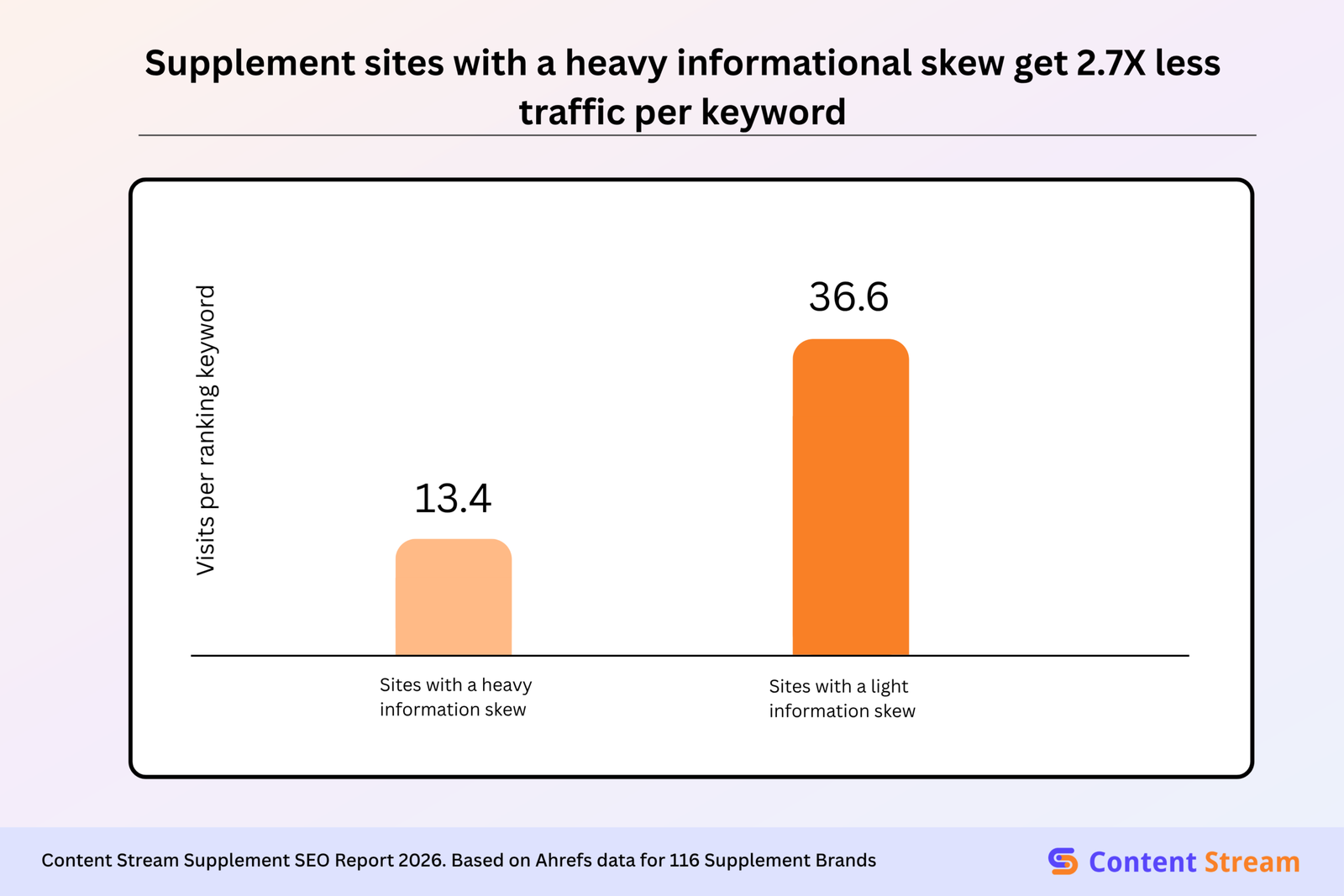
These figures show that supplement shoppers are clearly researching before they buy. Although informational searches dominate the keyword landscape, the data suggests that brands perform better when informational content is part of a broader search strategy.
This doesn’t equal producing less informational content. What it suggests is educational content working alongside commercial and transactional pages. That way, consumers can move from researching a health concern or ingredient to comparing products and ultimately making a purchase.
Most consumers already treat supplements as part of their everyday health routine rather than an occasional purchase, which means the demand for this kind of content is only going to hold steady or grow.
This shows how top-heavy the supplement market really is. It’s a massive, still-growing industry, and yet a handful of players are capturing most of the visibility. If the market leaders are ranking for that many more keywords, the real opportunity is spreading your own footprint out rather than trying to out-rank them on the same handful of terms.
Smaller brands don’t need to out-pace the market leaders on authority to compete with them. Building out the long tail around your own products is the more realistic path. We break down this approach in our Supplement Brand’s Content Playbook.
For more tips on how to optimise your website, see our technical optimisation guide
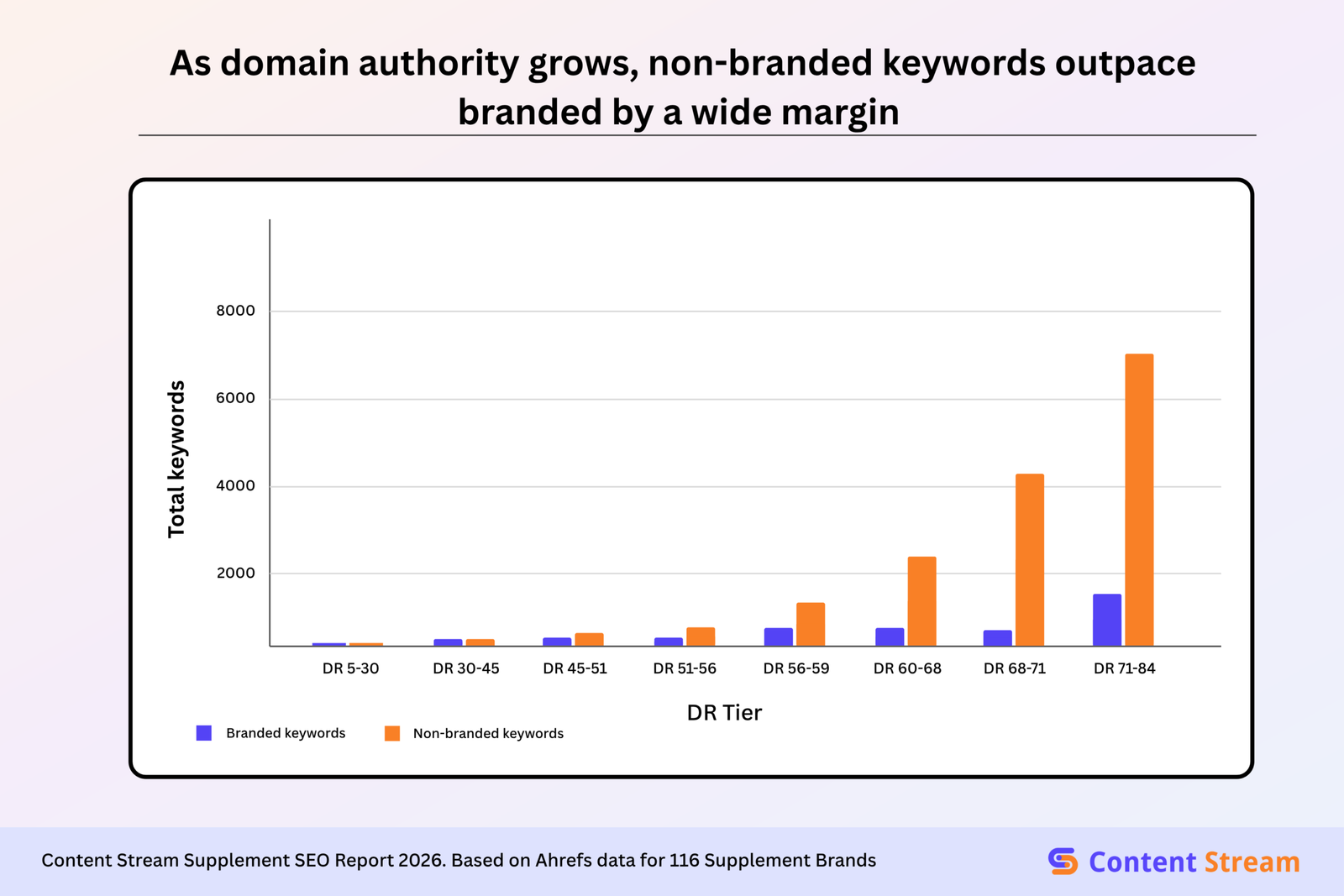
The data shows that organic growth comes from customers who know nothing about your site. The gap between the top and bottom performers is proof that visits from someone searching for an ingredient or query is not always your brand name at all. However, the weakest sites are living off people who already knew to look for them.
The real benchmark to track isn’t, “how much traffic are we getting,” but “how much traffic is coming from people who found us organically?” To win new customers through organic search, the data shows that branded traffic shouldn’t do most of the heavy lifting on your site.
These stats show how trust ties into supplement SEO and organic visibility.
Certifications have always been a big factor in determining which brands people choose, and we see that they still are. It’s not uncommon for users to search “Organic x supplement” during the research process. Brands that have the certification and include it in their content will reap the benefits.
Attribution is also a big part of trust, but, according to the numbers, has a smaller part to pay in overall performance.
Once domain rating is controlled for, credentialed and non-credentialed sites in the high-DR group aren’t that much different. This means that credentials are not necessarily a ranking lever on their own.
Certifications and credentials matter because supplement buyers are cautious, evidence-seeking shoppers. Plus, the latter is a real ranking signal for Google, and that alone makes them worth the effort.
But neither is a lever you pull to move your organic traffic, at least not on its own.
Our SEO audit checklist goes further into where E-E-A-T actually sits in your priority list.
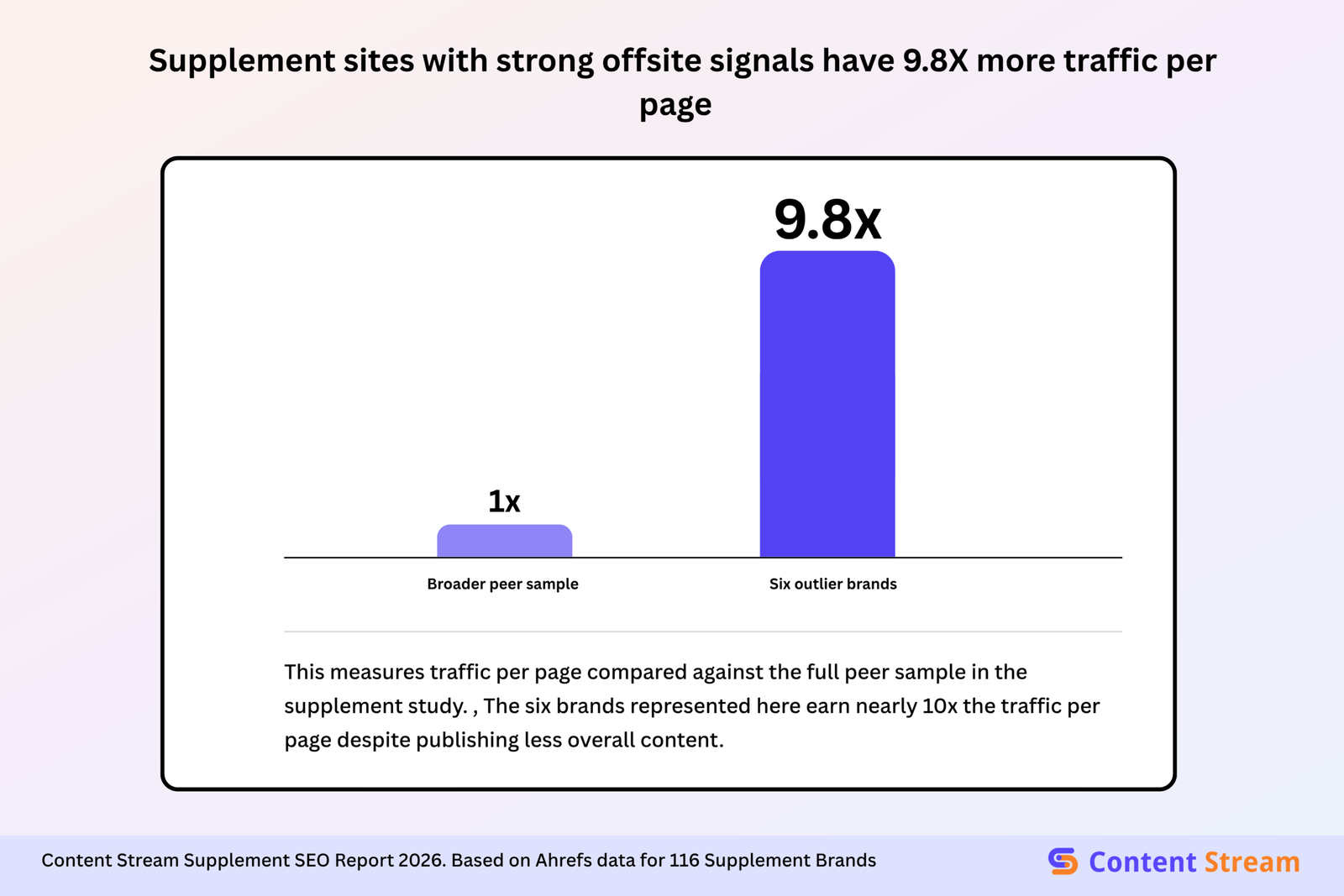
Content Stream’s 2026 supplement SEO report found that brands with a strong off-site presence generated up to 9.8x more traffic per page than their peers, and up to 34x more than brands publishing similar content volumes [3].
In the SEO report, nothing in high-performing sites’ content or backlink profile explains a 34x difference in traffic.
It can only be explained by strong off-site, social presence.
None of these will show up in a brand’s site audit. But, they are key performance indicators that can transform your organic performance.
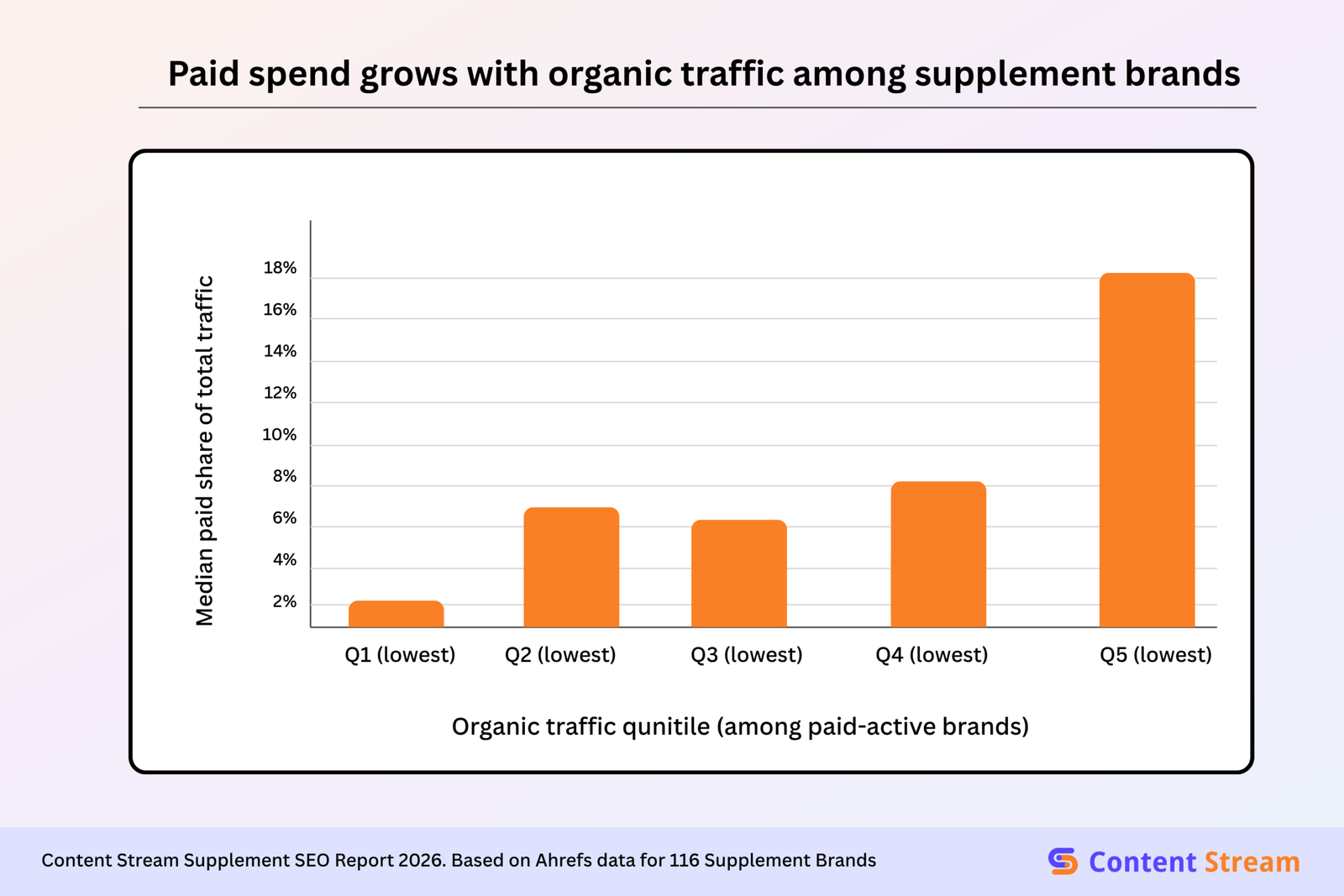
Ahrefs’ paid figures from our report are modelled estimates, not verified ad spend. Now, even with that caveat, the pattern is opposite of what you’d expect. The top brands are spending more on paid, despite winning in organic performance.
That paints a picture of what to expect for most brands as their organic performance grows: paid needs to be an ongoing effort. This runs contrary to conventional wisdom that organic traffic can substitute paid performance.
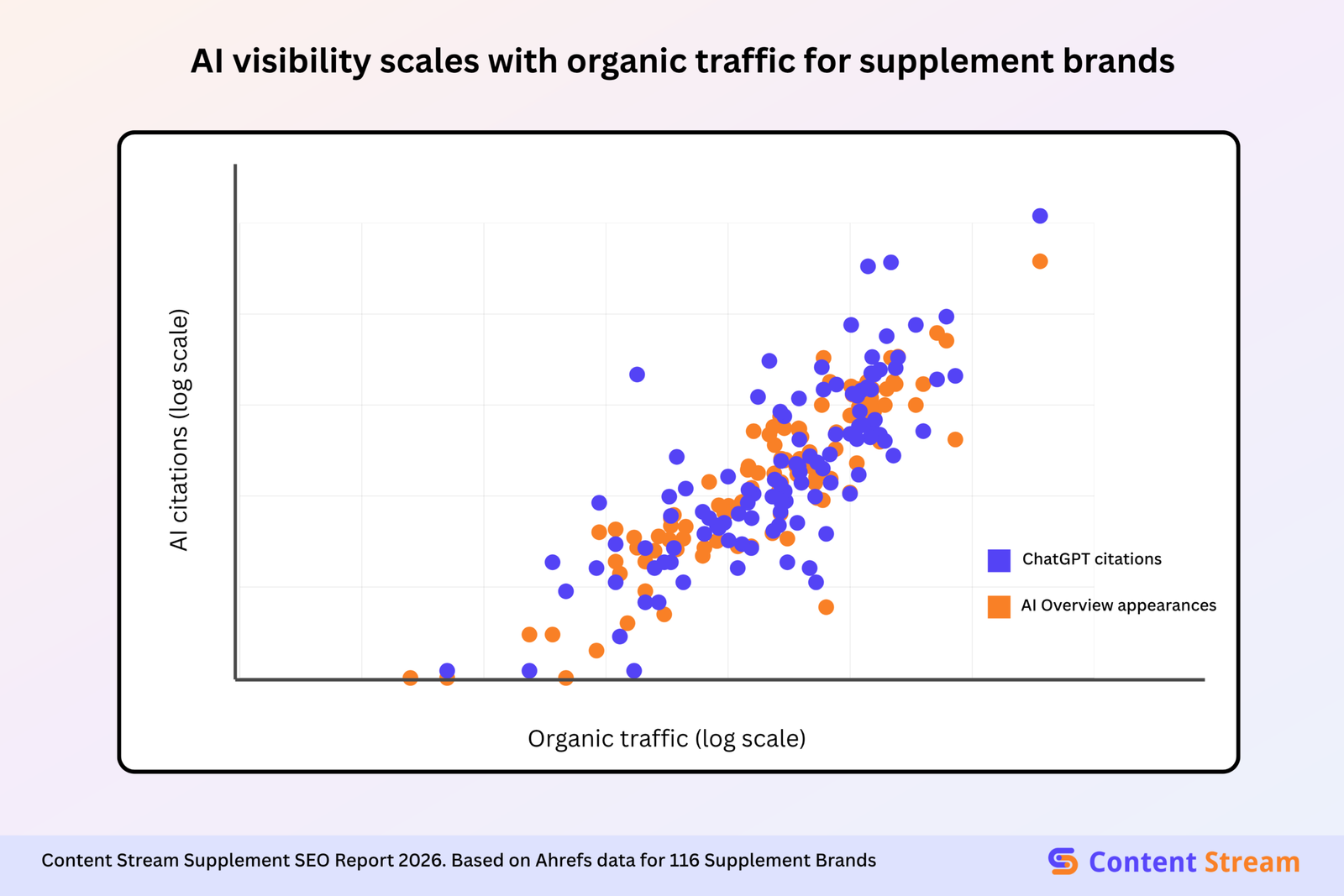
AI is no longer just a niche behaviour in health search. A quarter of US adults have used it for health information at some point, and a small but growing number now reach for it before anything else.
For supplement brands specifically, all but 3 of the 116 sites in our sample show up in AI Overviews or ChatGPT results. And the brands showing up most in those results are, unsurprisingly, the same ones already winning organically. This is a pattern we’ve also seen play out in how AI and LLM search are changing wellness content.
Online discovery is already a major part of how consumers research and buy supplements. For your supplement brand, growth stems from being visible across several relevant searches other than simply relying on high-volume terms.
You don’t need to chase a new SEO tactic to help you show up on AI systems. Rather, focus on expanding the topics your site can credibly cover. In 2026, there are more opportunities for building visibility beyond your website. The opportunity is making sure your brand is there when people start looking.
Looking for an SEO partner for your supplement brand? Book a Free Consultation

I’m Raechelle, a content writer and editor specializing in SEO and health content. With over six years of experience, I help brands turn complex health topics into clear, well-optimized content that ranks.
