How to Create Health Content for Fitness SaaS Without YMYL Penalties
If you run a health-adjacent product (gym management software, workout app, calorie tracker, or even a wellness companion), you need to create content that attracts your idea audience. Invariably, that means you will have to touch on health and wellness topics important to the reader.
But if care isn’t taken, your content may wander into YMYL territory where Google applies a lot of scrutiny.
This blog talks about how to create positioning content that attracts the right health-conscious audience, without getting penalized for Google.
| YMYL Trigger | What it looks like in practice | Why it's a problem |
|---|---|---|
Health-focused outcome language |
"Improve your recovery" | Claims a health outcome without evidence. Google expects cited studies or qualified authorship to back it up. |
| "Boost your metabolism" | ||
| "Optimise your sleep" | ||
| "Accelerate fat loss" | ||
| "Balance your hormones naturally" | ||
| "Reduce inflammation with consistent training" | ||
Aggregated third-party research |
"Studies show that tracking macros improves performance" | Interpreting external data signals expertise. Without credentials on the site or author, the algorithm treats it as an unqualified claim. |
| "Research suggests better recovery with consistent logging" | ||
| "Evidence points to higher retention among users who log daily" | ||
| "According to sports science, periodisation improves results" | ||
| "Data shows meal timing affects metabolic rate" | ||
| "Experts agree that progressive overload is the most effective method" | ||
Borrowed authority |
"Used by certified personal trainers" | Association doesn't transfer authority. The content still can't make claims a certified professional would make. |
| "Integrated with hospital-grade wearables" | ||
| "Trusted by 500 gyms" | ||
| "Recommended by physiotherapists" | ||
| "Built to meet clinical standards" | ||
| "Partnered with leading sports nutritionists" |
The YMYL framework is all about content that can affect critical aspects of people’s lives. In this case, we are focused on health-sensitive advice.
And you can create fitness saas content without actually triggering these filters. For example, you create a guide on how users can track workouts using your app. If you’re a B2B platform selling studio management software, for example, your content has even more of a leeway.
But, other types of content will trigger the framework. Like a blog on how macros recorded can affect rest, recovery, etc.
The scrutiny is even higher when you start talking about topics like fat burning, metabolic rates, building muscle, etc.
Let’s dive deeper
Regardless of where it appears, language around health outcomes is right in YMYL territory. It either needs to be reframed, or written by a qualified professional. (more on this later)
That’s why “Improve your recovery” in a product description will read differently to Google’s filters.
If your content is claiming recovery improvement, it needs to show studies that prove this. Otherwise, it can be interpreted as an unfounded and potentially misleading claim.
The penalty for this may come immediately (the page not ranking) or it may show up later where your entire SaaS site struggles with core updates. The latter is more likely if you have a lot of content with the same poor YMYL practices.
Making a health claim is one level. But citing it is another. And while this isn’t quite as bad, it can still get your site dinged. Here’s why:
Google’s algorithm doesn’t fact check content; it checks the writer. So unless your site, and the author of the content, is a known source of medical information, the algorithm has to assume you’re making claims without expertise to back it up.
When you aggregate information, you’re interpreting the data basically. And you need to be qualified and have expertise to do that.
A strong and reliable way to signal authority is by association. But they don’t automatically transfer authority.
So phrases like:
These statements may be entirely true, but they don’t transfer authority to your content.
As a result, your content can’t make claims that a certified and practising personal trainer would make without attracting scrutiny.
That’s why E-E-A-T signals are so important.
E-E-A-T (Experience, Expertise, Authoritativeness, and Trustworthiness) is Google’s framework for evaluating whether a piece of content deserves to rank. Among other things it assesses whether the author and source are qualified to speak on the subject.
That’s why the fixes we’re about to cover are so important. They show how your site can send the right signals to Google, without trying to game the system.
The safest approach with YMYL-related content is simply sticking to what your product does, and what your website has authority around. It may be tempting to chase all the low difficulty fitness SaaS keywords you can find. But that will erode your authority.
If your platform tracks workouts, write about workout tracking. If it logs macros, write about macro logging.
Doubling down this way signals that you are talking about what you know, and that’s information users actually need to see.
I also recommend doubling down on your product’s expertise and sharing your data.
Publish your findings and package that information as trends, benchmarks, usage patterns, and even informational strategies for new users. When the numbers come from your own user base, you’re not interpreting someone else’s research, and you’re not citing a medical study that requires specialized expertise.
Content signals like this are great for more than just helping you avoid YMYL filters. It can also establish you as an authority and source of truth in your industry.
You can even add a bit of digital PR to spread the word about your findings and reports.
When sharing product data, it’s important to clarify what it is and isn’t, especially if its interpretation has health consequences.
For example, if you’re sharing why recent frequent high intensity training sessions can affect sleep, it’s very important to add caveats.
Phrases like “based on your logged data” and “this is not a medical assessment” are important here. And where it’s relevant, a short line pointing users toward their doctor or a qualified professional is also worth including. It protects your site and encourages your readers to seek medical advice, which they likely should anyway.
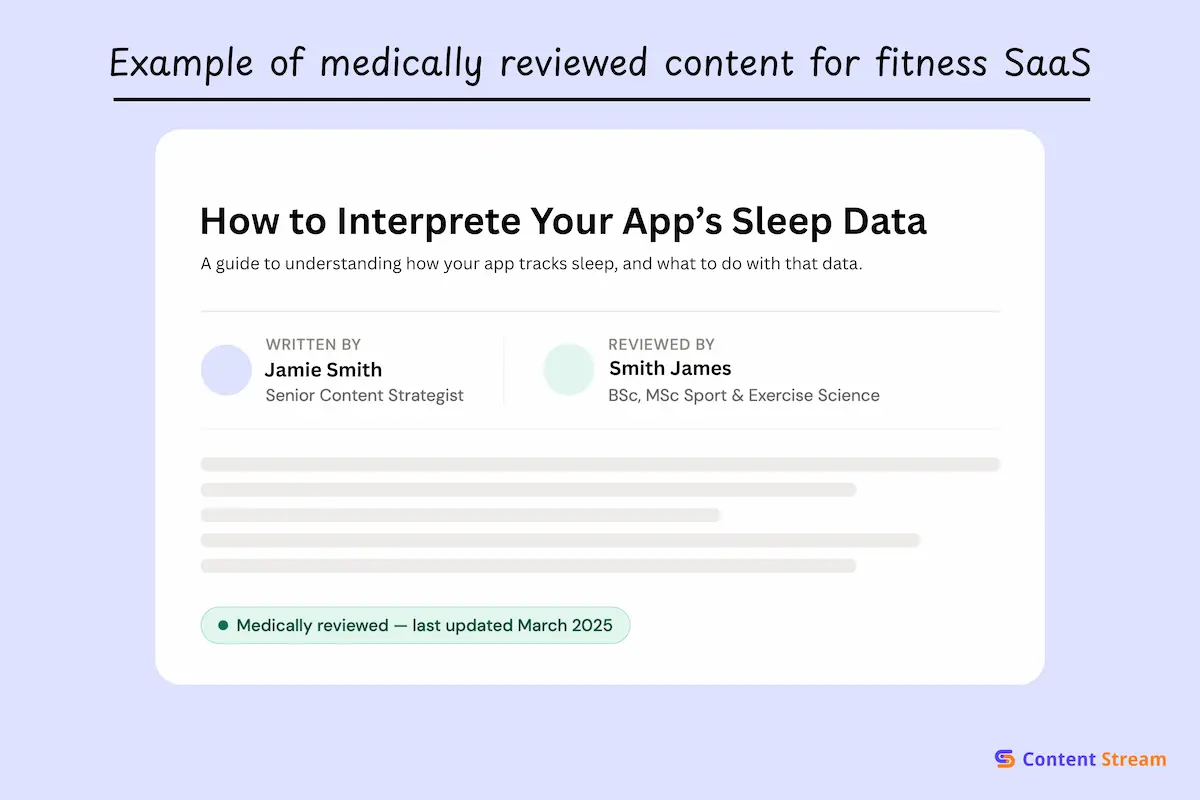
If your content regularly touches health, fitness, or nutrition territory, aggregated data alone won’t help. The solution is to either bring a qualified professional onto your content team, or establish a review process where a certified expert checks health-adjacent content before it goes live.
Verywell’s dedicated review board is a great example of this. The members of the board vets their content before it goes live, signaling the utmost credibility.
Depending on your focus area, that could be a registered nutritionist, a certified personal trainer, a physiotherapist, or even a psychologist.
Their involvement doesn’t need to be full-time. But, you need to credibly say that a qualified professional has reviewed the content. And then have their credentials published alongside the content.
When your content needs to reference health outcomes (because it will often need to), the claim needs to be anchored to something. Could be a published study, a cited expert, or a named professional. And obviously the hyperlink needs to follow.
This doesn’t absolve your content of the need for EEAT signals (as we discussed earlier). But, it will add the extra credibility you need.
YMYL standards protect readers from bad health advice. And if your brand can adhere to the guidelines and produce genuinely helpful content, the filters can even be an advantage, especially as you build topical authority in the space.
The good news is that you don’t need a full medical editorial team to get there. A clear content scope, a credentialed reviewer attached to your health-adjacent pieces, and strict content guidelines are a great place to start.
Need help? Read our blog on Building content clusters for fitness SaaS brands. Or, request a free audit for some outside perspective on your content.

I’m Matthew, a personal trainer turned SEO who’s worked with brands like Gymfluencers, Sailo, ClickCease, and Fraud Blocker. These days, I help small to medium sized companies grow their reach with smart, search-focused content.
