Influencer-Owned Gyms: Does Online Fame Translate Into Search Visibility?
Influencers who own commercial gyms have an existing audience, and that makes up an advantage that many independent gyms have to build over time. A famous fitness creator may have the following, social content, industry connections, and media coverage before deciding to open a gym. That already creates online recognition not many new independent gyms have from day one
But does online recognition translate into search?
Recently, our supplement SEO report revealed that some brands were generating significant visibility despite limited SEO effort due to strong off-site signals. We wanted to find out if the same applies in the fitness industry.
To answer, we looked at four influencer-owned gyms and compared them with independent gyms operating in the same markets. We analysed their organic search performance, backlink profiles, top-performing pages, content strategies, and visibility across AI-generated search results.
Will they surpass gyms in the area? Read on to find out.
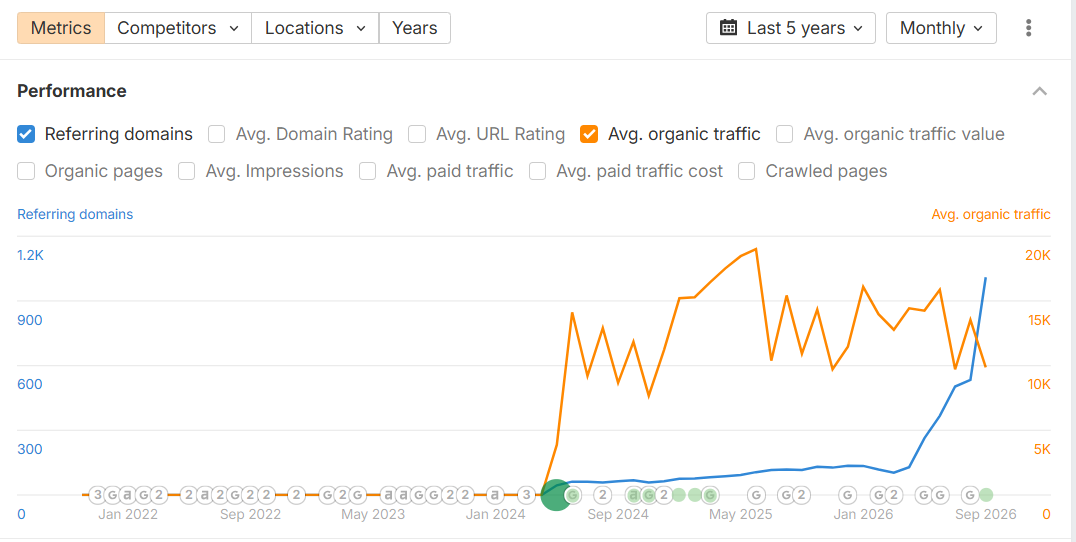
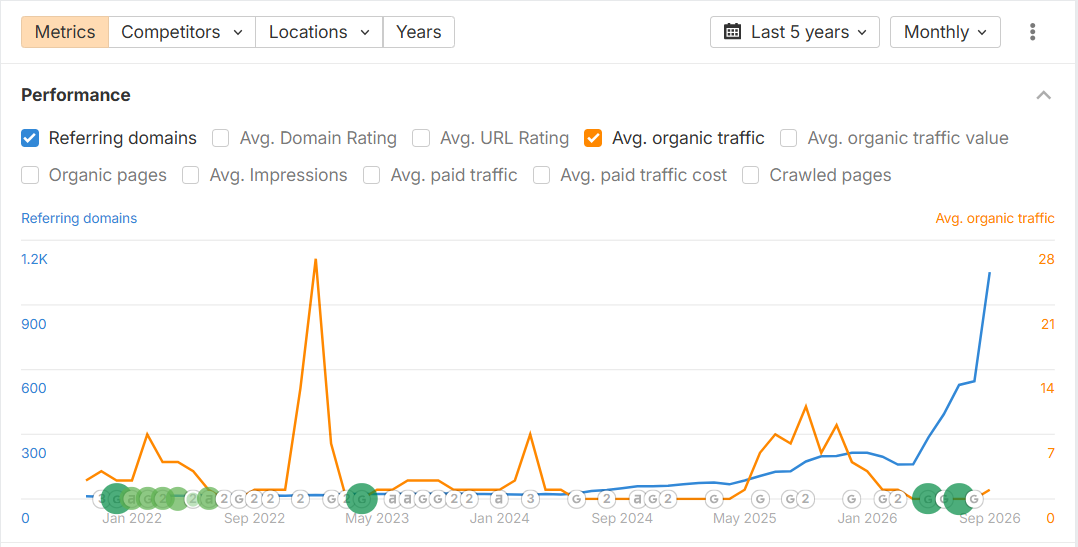
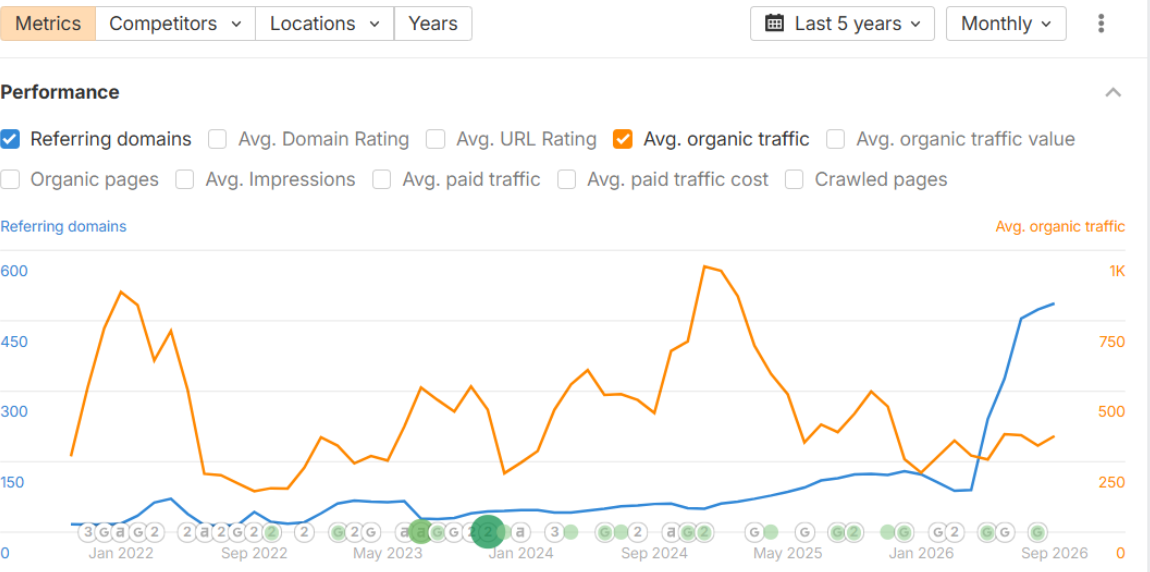
⚠️ Important note: Across all charts from ahrefs, we see a huge spike in referring domains. This is likely due to ahrefs recalibrating its data than to all gyms in this case study suddenly ramping up their backlink profile.
Spanning 18.5 acres in Missouri City, Texas, Alphaland combines three gyms, Alphalete flagship store and other amenities. Guzman had already built a large audience around his training and fitness content, and was one of the first YouTube fitness creators back when the space was new.
Before the opening of Alphaland, Christian Guzman founded the renowned athleisure brand, Alphalete in 2015. Since then, he has founded other businesses like beverage and sports nutrition company 3D Energy, the annual Summer Shredding fitness and bodybuilding competition series.
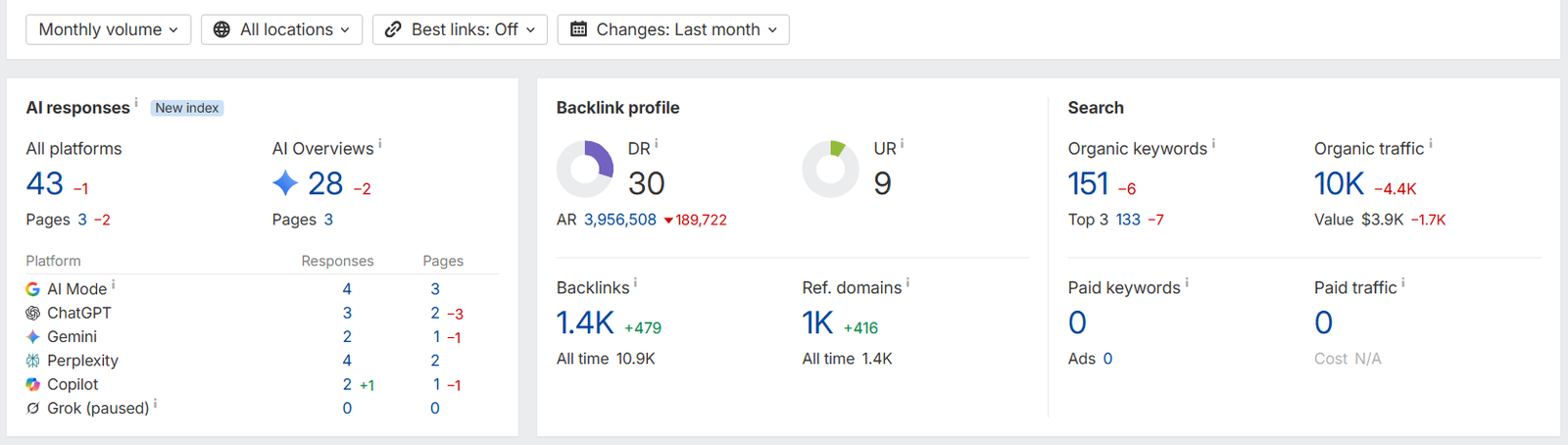
According to Ahrefs, Alphaland has a Domain Rating of 30, ranks for 151 organic keywords, and generates an estimated 10K monthly organic visits.
Although Alphaland has built a genuinely large backlink profile and pulls in thousands of monthly visits, most of that visibility comes from people already looking for Alphaland by name. Ahrefs currently records Alphaland in 43 AI-generated responses, including 28 Google AI Overviews.
We know this because the homepage accounts for 87.9% of the site’s organic traffic, and “alphaland” is by far its dominant keyword, with an estimated 10K monthly searches and a #1 ranking. In contrast, the Memberships, Join Alphaland and Sports & Events pages attract 3.3%, 2.6% and 2.3% of organic traffic respectively, a cumulative 8.2% compared with the homepage’s 87.9%.
In summary, we see that Alphaland has a strong organic profile, despite its negligible organic strategy.
Alphalete runs a retail store inside Alphaland, and the facility hosts athletes, creators, and fitness events. Alphalete’s current athlete programme also runs campaigns, shoots, and exclusive events for its roster, another channel that generates content and attention around the same physical space.
Alphaland is not just a training facility, it’s also an events venue. Alphalete Games were held there for the first time in 2026. Its events and activities also give the venue reasons to attract visitors and generate coverage beyond day-to-day gym use. These signals help explain why Alphaland has a presence beyond its own search rankings.
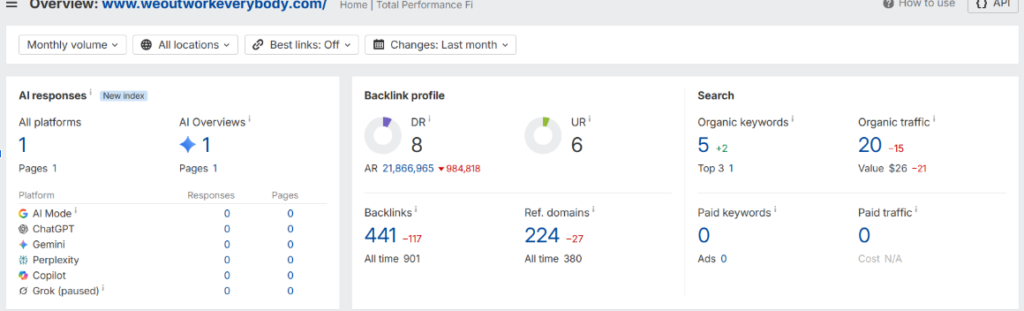
To get better insight on Alphaland’s search performance, we compared it with Total Body Performance Fitness Center, an independent gym in Missouri City. Both gyms operate in the same local market, allowing us to compare an influencer-backed gym with a locally established business competing for a similar audience.
The comparison looks at the same organic and AI visibility signals used throughout the study.
| Metric | Alphaland | Total Body Performance Fitness |
|---|---|---|
| Domain Rating | 30 | 8 |
| Organic traffic | 10K | 20 |
| Organic keywords | 151 | 5 |
| Referring domains | 1k | 224 |
| Backlinks | 1.4k | 441 |
| AI responses | 43 | 1 |
| Google AI Overviews | 28 | 1 |
Total Body Performance Fitness gets only around 20 monthly organic visits, with about 95% going to its homepage and most of that traffic coming from its own brand name. Alphaland also relies heavily on branded search, but “Alphaland” gets around 9.1K searches a month, giving it a much larger existing audience to capture.
This is unsurprising since Total Body Performance Fitness has neither an active organic strategy nor a strong influencer brand behind it. Also interesting to note that Alphaland’s organic presence surpasses even many established gym brands.
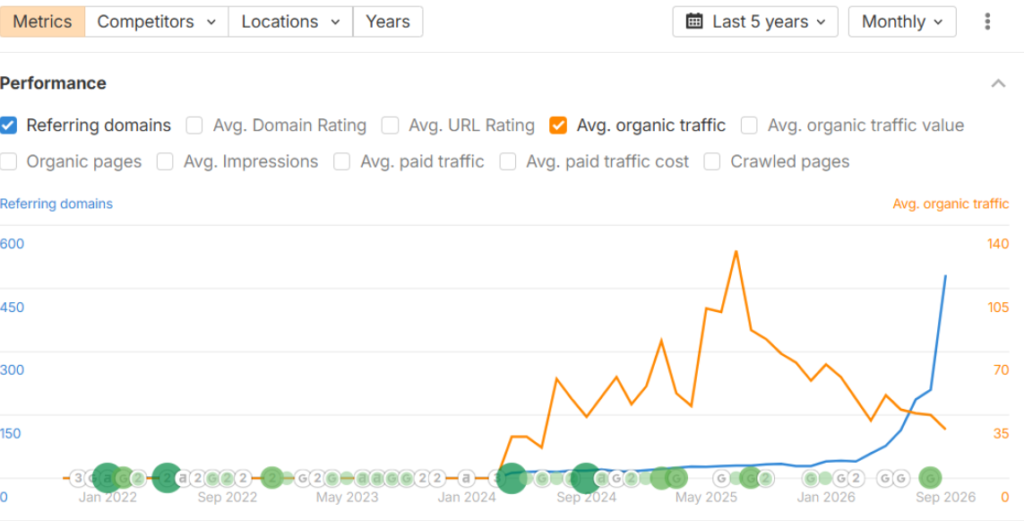
Fitness creator and YouTube personality, Bradley Martyn founded Zoo Culture in Encino in 2015. He already had a large audience around bodybuilding and lifestyle content, turning the gym into an extension of the media ecosystem he had already built online.
Zoo Culture’s online presence is built around Bradley Martyn, and that shows in its search performance. The Encino-based gym has a Domain Rating of 19 and ranks for a small set of organic keywords but still generates meaningful search traffic of about 1.2k.
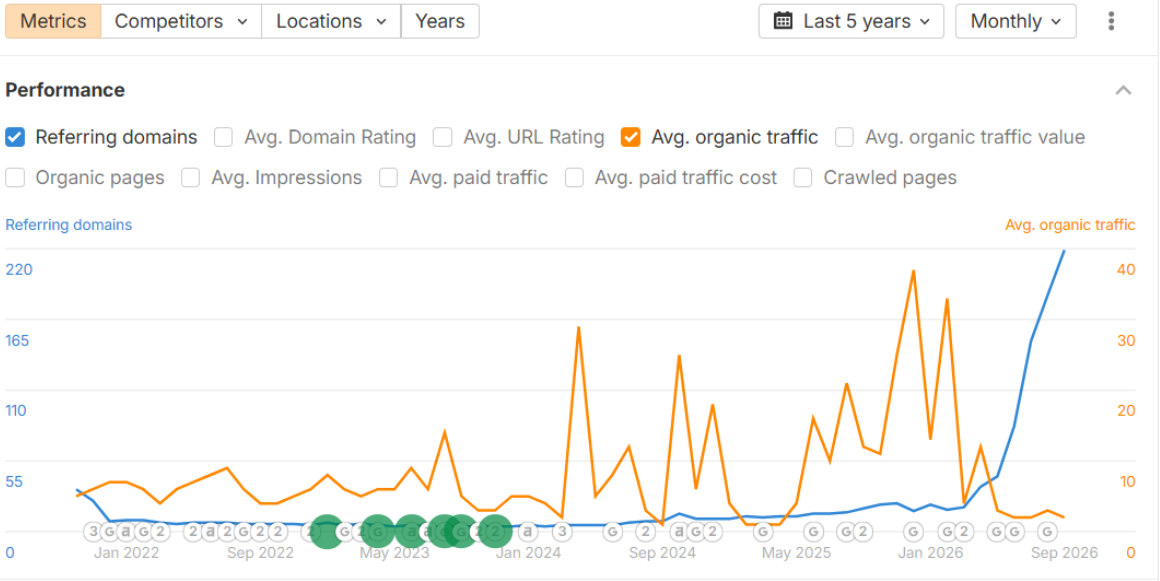
Over the past five years, Zoo Culture’s organic traffic has experienced fluctuations but still manages to attract backlinks likely due to other creators featuring the gym in their content. The homepage gets most of the organic traffic, while the About and Encino pages account for most of the remainder.
Zoo Culture shows up in 51 AI-generated responses, including 26 Google AI Overviews. The gym has a much larger online presence than its website alone. It gets its online visibility from YouTube videos, creator content, media coverage and other third-party sources.
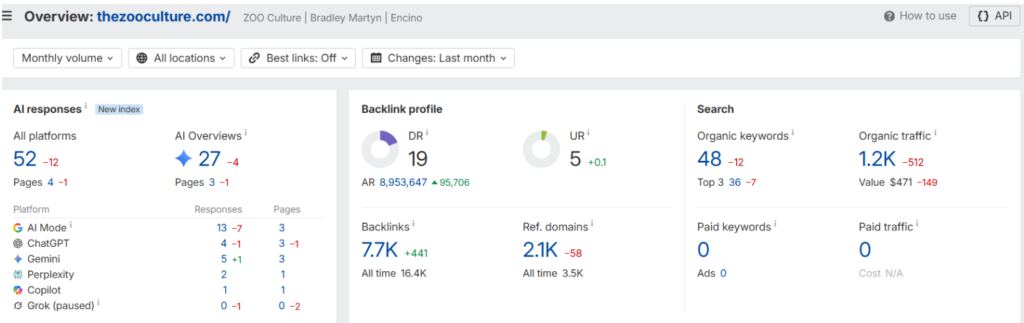
Bradley Martyn YouTube channel has around 3.2 million subscribers, and his content regularly features the gym and the people who train there.
During the COVID-19 lockdowns in 2020, Zoo Culture became the subject of significant media coverage after Martyn refused to close the gym in accordance with California’s health restrictions. This incident gave the gym independent coverage that was directly tied to its physical location and operation.
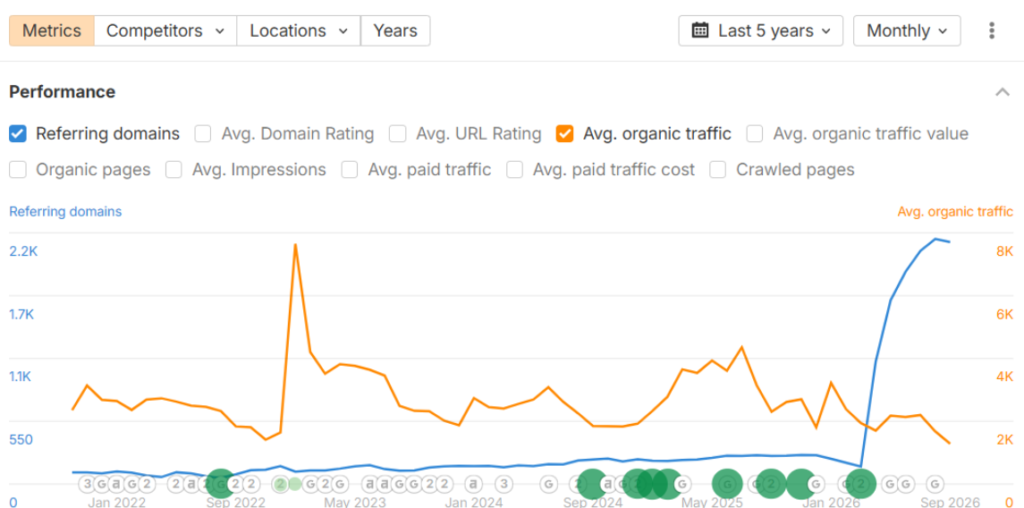
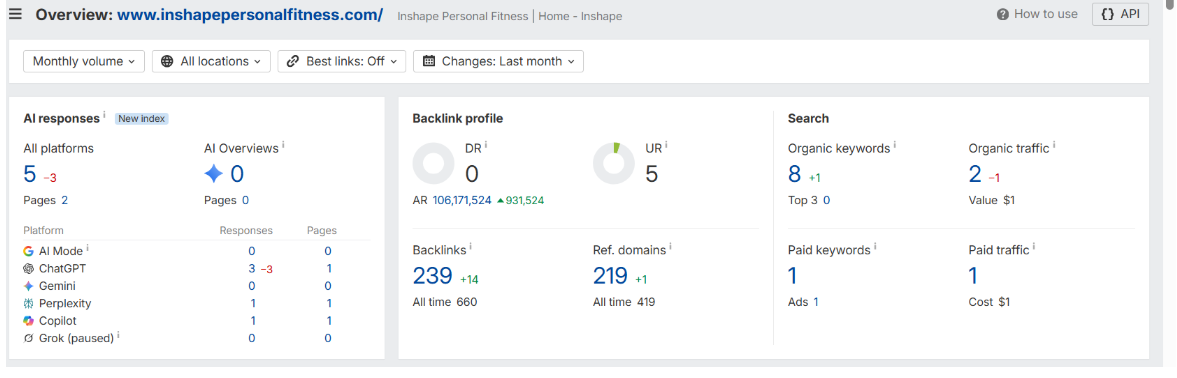
InShape Personal Fitness is an independently established training facility in nearby Lake Balboa. We compared both gyms to see if Zoo Culture’s existing audience and online presence translate into a much larger search footprint.
| Metric | Zoo Culture | InShape Personal Fitness |
|---|---|---|
| Domain Rating | 19 | 0 |
| Backlinks | 7.7K | 239 |
| Referring domains | 2.1K | 219 |
| Organic traffic | 1.2k | 2 |
| Organic keywords | 48 | 8 |
| AI responses | 52 | 5 |
| Google AI Overviews | 27 | 0 |
Zoo Culture, unsurprisingly, has a larger organic traffic, despite InShape’s larger referring-domain profile. Zoo Culture’s homepage captures most of its traffic through searches for the brand, while InShape’s limited traffic comes primarily from its own branded search.
The difference in both gyms isn’t just the number of links each site has, but the much larger audience and brand demand surrounding Zoo Culture.
Read more about optimising your Google Business Profile
Iron Addicts is associated with C.T. Fletcher, who opened the original Signal Hill facility in the mid-2010s. Like Guzman and Martyn, Fletcher had already made a name for himself in strength sports and fitness media, while Iron Addicts developed its own identity around the hardcore training culture associated with him.
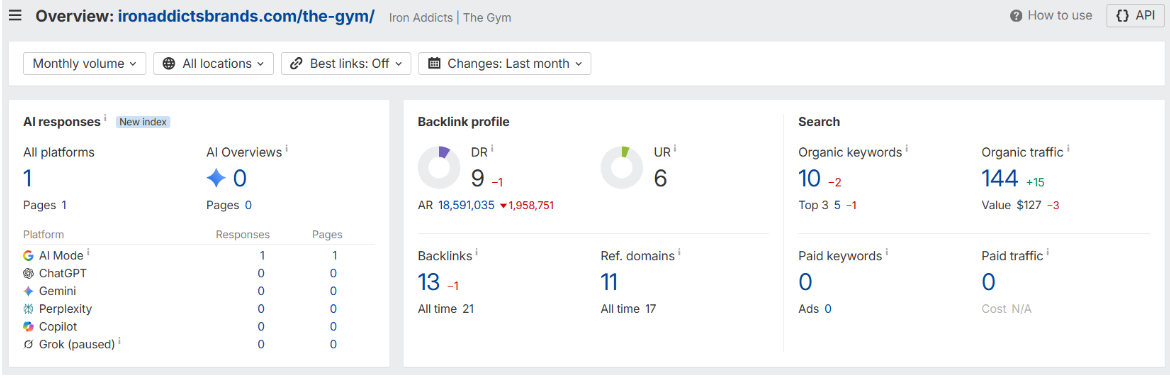
Iron Addicts’ organic visibility comes almost entirely from a single page. The /the-gym/ page accounts for 100% of its estimated organic traffic, just 144 visits, and ranks #1 for “iron addicts gym” and #3 for “iron addicts”. With a Domain Rating of 9, the site ranks for just 10 tracked keywords and has very limited visibility in the AI search results. The site appears in one AI Mode result, while recording 0 Google AI Overviews. Given Fletcher’s recognition, the figures are rather surprising.
That’s a thin footprint for such a recognisable name. The cause of its limited organic presence might be due to significant business disruption over the years, alongside Fletcher’s health issues, including a heart transplant.
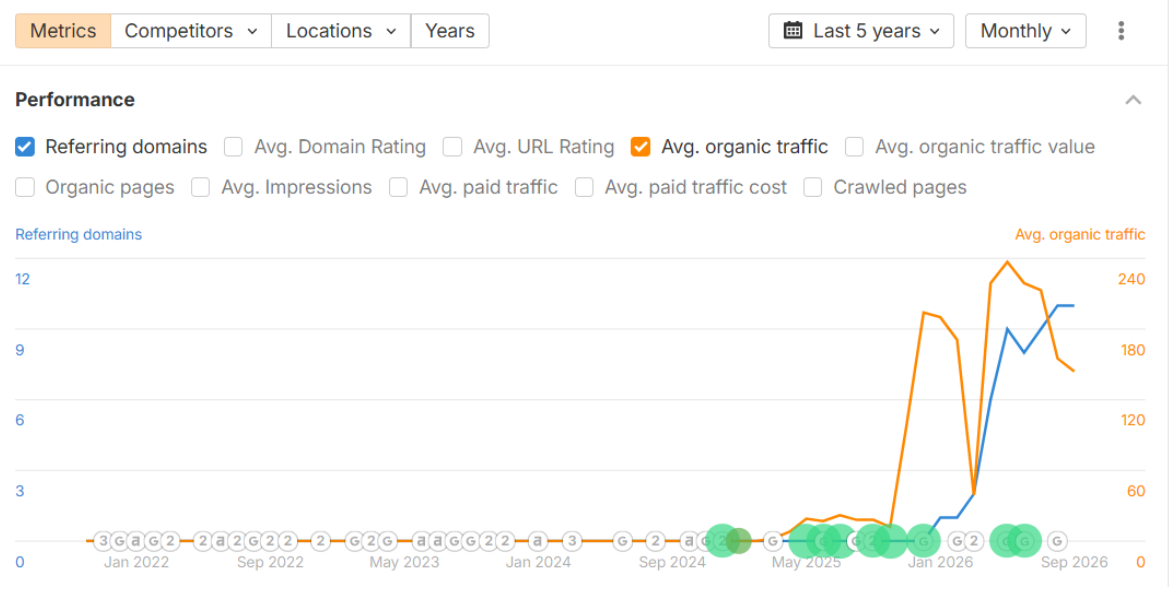
Much of Iron Addicts’ wider visibility comes from the reputation C.T. Fletcher built before and alongside the gym. His YouTube presence, motivational content, media appearances and strength-sports background gave the Iron Addicts the recognition it has today.
The brand has also extended beyond the physical facility through merchandise, training and media-related activity. Its core content is centred around the gym itself, merchandise and training-related offerings, with the /the-gym/ page providing the main destination for people looking for information about the physical facility.
Fitness publications have covered Fletcher and the gym, while strength-sports media and brands have featured the facility and its training culture.
CrossFit Signal Hill gives us a useful local comparison: both gyms operate in Signal Hill, but CrossFit Signal Hill has built a much larger backlink profile.
| Metric | Iron Addicts | CrossFit Signal Hill |
|---|---|---|
| Domain Rating | 9 | 15 |
| Backlinks | 13 | 1.2K |
| Referring domains | 11 | 539 |
| Organic traffic | 144 | 0 |
| Organic keywords | 10 | 1 |
| AI responses | 1 | 0 |
| Google AI Overviews | 0 | 0 |
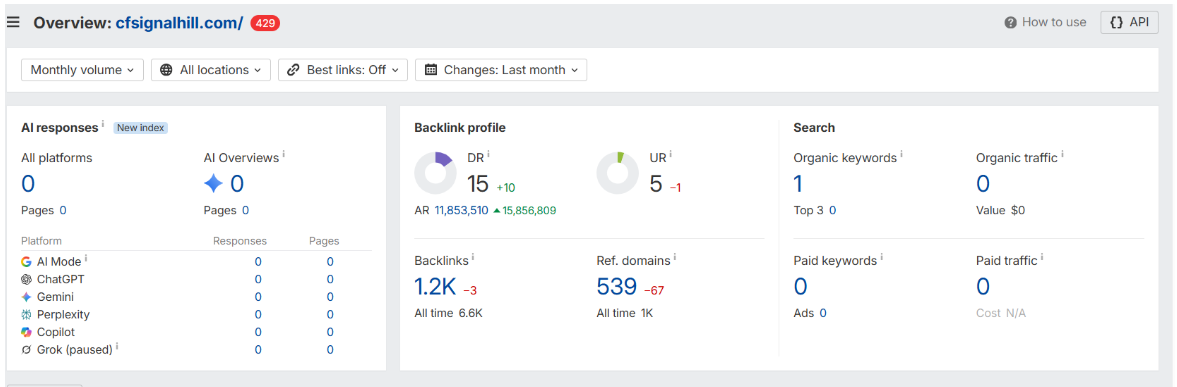
Despite CrossFit Signal Hill having substantially more backlinks and referring domains, both sites have very limited organic visibility. Iron Addicts’ traffic is concentrated around branded searches, while CrossFit Signal Hill currently ranks for just one keyword, “maureen miller”.
For more tips on how to optimise your website, see our technical optimisation guide
Flex Lewis brought his bodybuilding reputation to Dragon’s Lair when the gym expanded into its Las Vegas location. As a seven-time 212 Mr. Olympia champion, Lewis already had strong connections across professional bodybuilding, while the gym has become a training destination for athletes, fitness creators and visitors to Las Vegas.
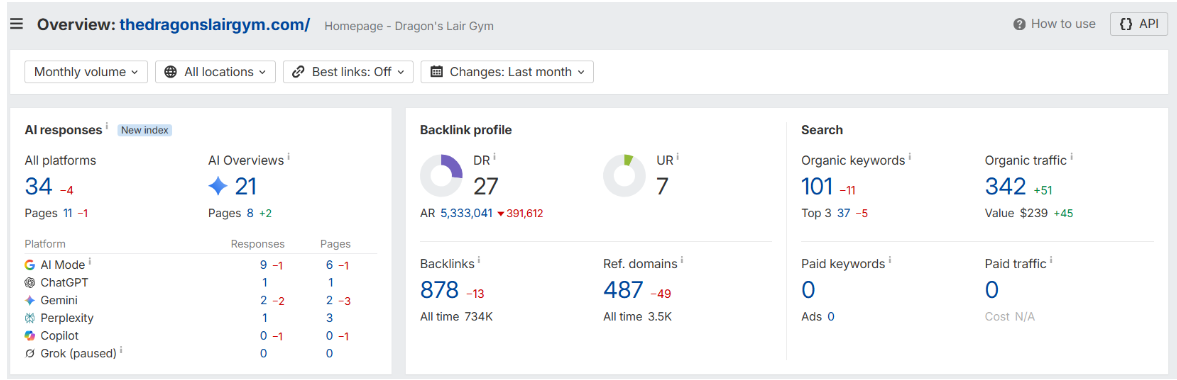
According to Ahrefs, Dragon’s Lair generates an estimated 342 monthly organic visits and has a Domain Rating of 27 and 487 referring domains. The site ranks for 101 organic keywords and, including 37 that appear in Google’s top three results.
It also appears in 34 AI-generated responses across tracked platforms, including 21 Google AI Overviews. Google AI Mode accounts for nine responses, while the site also appears in ChatGPT, Gemini and Perplexity results.
While the homepage still brings in 78.8% of Dragon’s Lair’s organic traffic, other pages attract visitors through membership and e-commerce searches as well as broader fitness topics. Articles covering subjects such as “weightlifting vs. bodybuilding” (5.3%), “what is volume in weightlifting” (2.1%) and “how many calories does lifting weights burn” (1.5%) bring in non-branded traffic.
What’s interesting is that Dragon’s Lair isn’t relying solely on people who already know the brand. Its content gives the site opportunities to appear when people are searching for fitness information more generally, creating a broader route into the business. That gives AI systems more relevant material to draw from when responding to training-related searches.
Although Dragon’s Lair is linked with Flex Lewis’s name, the gym has grown more than Flex Lewis. Dragon’s Lair’s status in bodybuilding attracts professional athletes, fitness creators and bodybuilding competitors through its walls, which means that there are opportunities for content and third party coverage surrounding the gym.
The facility itself provides the brand with unique points of conversation, like the Posing Room and Torture Room. Located in Las Vegas, the city adds to its appeal especially because Las Vegas hosts bodybuilding events and draws in participants from around the country. Its Las Vegas location also puts it close to the annual Mr. Olympia contest.
Dragon’s Lair has gone on to create a name for itself and Lewis’ name continues to build an audience for the brand.
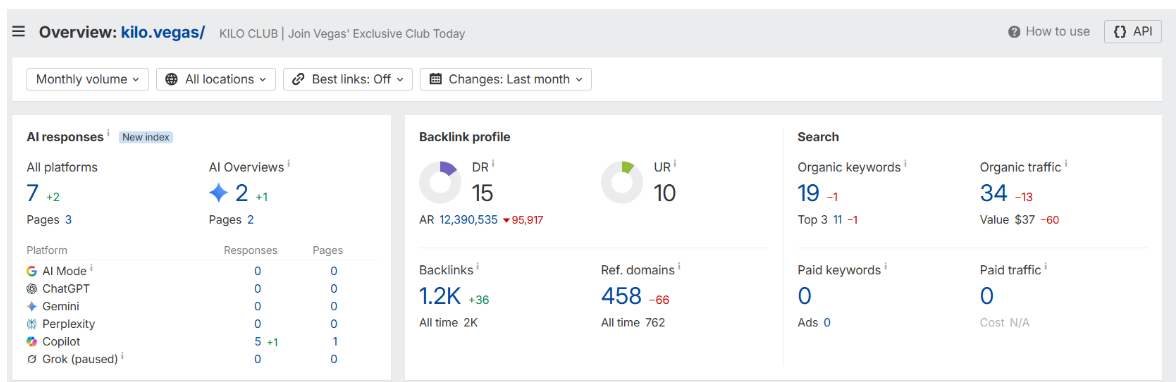
We put Dragon’s Lair side-by-side with an independent gym to see how the two compare. KILO CLUB operates in the same Las Vegas market and has a similar backlink profile, making it a useful comparison for looking at how those links translate into actual search visibility.
| Metric | Dragon's Lair | KILO CLUB |
|---|---|---|
| Domain Rating | 27 | 15 |
| Backlinks | 878 | 1.2K |
| Referring domains | 487 | 458 |
| Organic traffic | 342 | 34 |
| Organic keywords | 101 | 19 |
| AI responses | 34 | 7 |
| Google AI Overviews | 21 | 2 |
Dragon’s Lair generates considerably more organic and AI visibility despite KILO CLUB having more backlinks and a similar number of referring domains. KILO CLUB’s traffic is concentrated around branded searches, with 94.1% going to its homepage, while Dragon’s Lair gets around 21% of its traffic from other pages, including informational content.
The comparison suggests that the breadth of content and search demand around a brand can matter alongside its backlink profile.
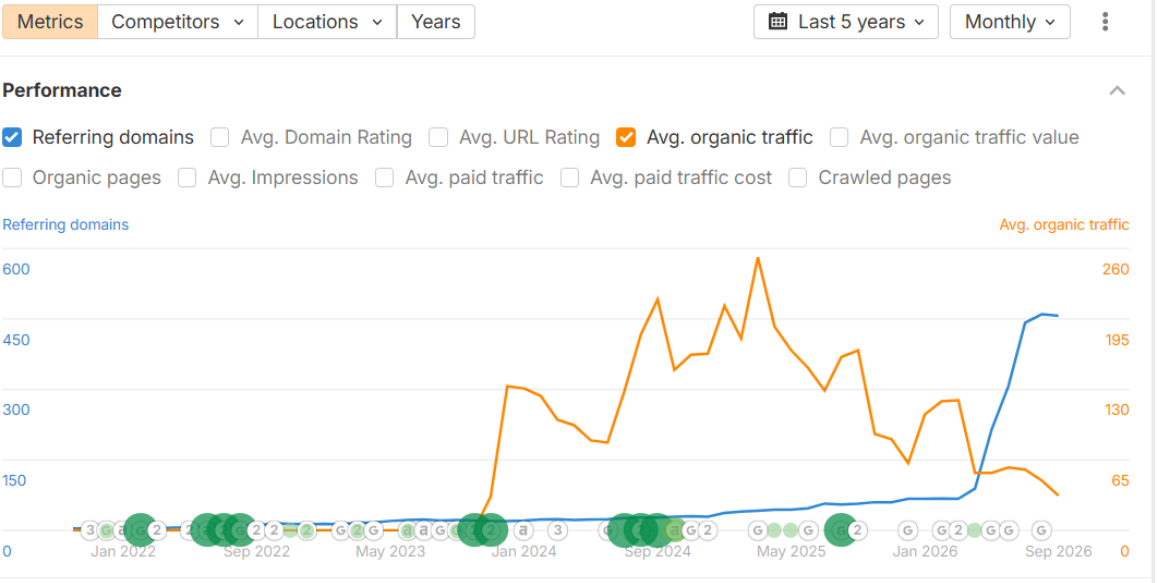
Looking across the four comparisons, influencer-owned gyms generally have a larger search presence than the independent gyms we compared them with. Alphaland, Zoo Culture, Iron Addicts and Dragon’s Lair all have stronger organic traffic and broader keyword visibility than their respective counterparts.
The biggest difference is how much existing demand surrounds each brand. Alphaland and Zoo Culture receive most of their organic traffic through searches for the gym itself, while Iron Addicts also relies almost entirely on branded searches.
Dragon’s Lair is different because its website has built additional visibility through informational content, allowing it to reach people searching for broader fitness topics. This suggests that an influencer’s audience can give a gym a substantial starting point, but the way that attention is connected to the gym’s own website matters.
Influencer-owned gyms clearly enter the market with an online visibility which often reflects in their organic visibility.
What does is when the gym also has a strong digital presence, genuinely useful content, and clear routes for people to discover the business beyond its name. This shows that whether you’re running a single independent gym or managing SEO across a growing chain, a well-known name can open the door and lay an organic visibility foundation.
If you don’t have influencer partnerships, you can still build your gym the old fashioned way. Start by reviewing our guide to gym seo.
If you’re not sure where your own gym’s visibility currently stands, or where to begin, book a free consultation with Content Stream. We can look at your current search and AI visibility, benchmark it against gyms in your market, and help you build a winning strategy.

I’m Raechelle, a content writer and editor specializing in SEO and health content. With over six years of experience, I help brands turn complex health topics into clear, well-optimized content that ranks.
