The Supplement SEO Audit Checklist: Identify and Fix Technical Debt
Run an SEO audit on your supplement site, and you’ll end up with a long list of things to fix. Broken redirects here, thin content there, a missing author bio, a handful of 404s. On paper, it can look like everything on that list deserves the same amount of attention.
For your brand, that matters. You have limited time and resources, and not every recommendation has the same impact on organic performance.
So, we looked at 116 supplement domains to find the correlation between audit factors and organic traffic, to help you prioritise those decisions. Read the full findings in our Supplement SEO Report. This guide covers those findings, starting with the technical factors, then the strategic factors such as keywords, authority, and site structure.
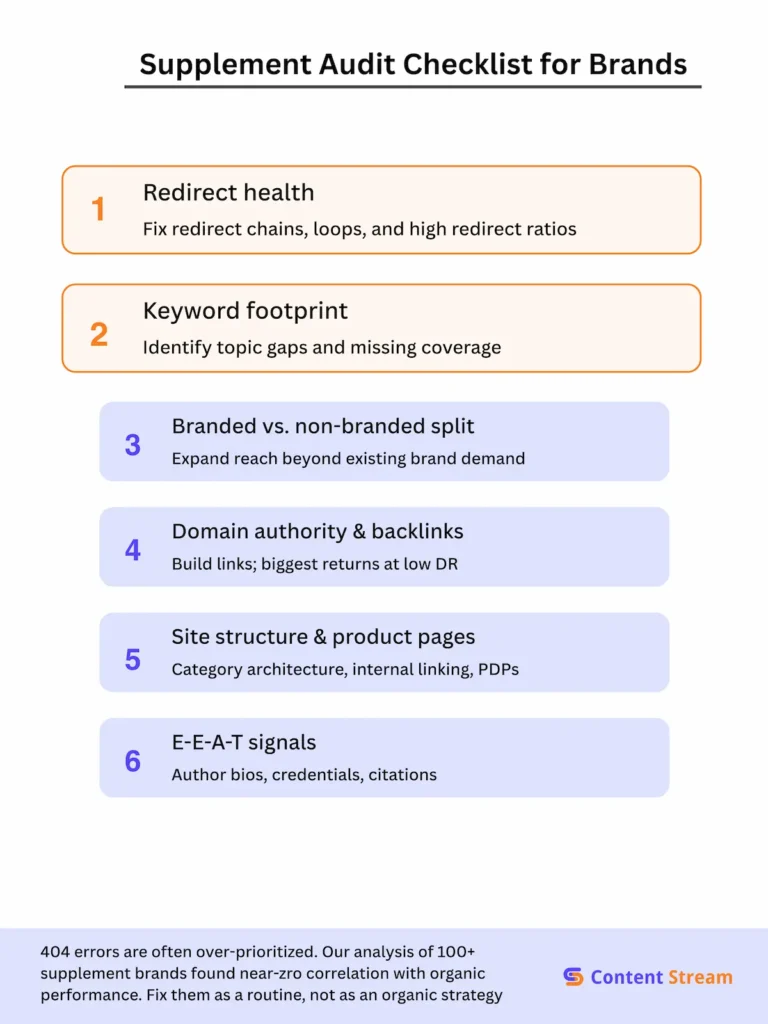
When you audit your supplement website, it’s tempting to treat every broken redirect and every 404 error as urgent. Our data suggests otherwise.
A redirect sends visitors and search engines from one URL to another, usually because someone has moved or renamed a page. Websites typically pick up redirects over time through site migrations, product updates, and navigation changes. A 404 error means a page no longer exists at the URL being requested.
The typical supplement site in our sample carries 1.24 404 errors and 2.92 redirects per page, and 81.6% of sites have more redirects than pages, so if your audit turns up a long list of both, you’re not unusual. What surprised us is that neither factor showed a clear relationship with organic performance, even after accounting for domain authority. Sites with heavier redirect chains and higher 404 counts didn’t consistently perform worse than cleaner sites.
That doesn’t mean ignore them. Broken links and redirect loops are still bad for user experience, and unchecked technical debt tends to compound over time. But if you’re deciding where to spend a limited audit budget, our data doesn’t support making this your first stop.
3 practical checks to run
Keep these on your list as good housekeeping, but don’t expect fixing them to move your traffic numbers on its own. The bigger opportunities are further down this checklist.
Read more about optimising supplement sites for AI visibility.
Once your technical housekeeping is scheduled, the next thing worth checking is your keyword footprint.
This is the number of unique keywords your website appears in search results for, not just the ones where you’re at the top of the results. A page can rank for dozens of related terms without you ever noticing, and it’s the total spread of these terms across your whole site that makes up your footprint.
It’s a factor worth prioritising, because of the clarity it gives you in separating the best supplement sites from the rest. In our sample, the top 20 sites ranked for 8.7 times more keywords than the rest of the market, despite having a domain authority only 1.3 times higher. Trust and brand recognition with Google play a smaller role in that gap than most people assume.
In other words, the gap in keyword coverage between top performers and everyone else is far bigger than the gap in authority. That’s a strong signal that the real opportunity lies in ranking for more terms. Chasing a higher authority score won’t close that gap nearly as fast.
Reviewing your keyword footprint is straightforward:
If your keyword footprint is relatively small, that usually points to gaps in topic coverage. Your existing pages are probably fine. In most cases, the solution is to publish content that fills those gaps and leave the pages that already perform well alone. Our Supplement Brand’s Content Playbook breaks down which content formats close those gaps fastest.
Use these insights to shape your content calendar. Missing clusters such as ingredient comparisons, dosage guidance, or supplement-specific FAQs can help you prioritise what to create next.
Next, look at how much of your organic traffic comes from branded versus non-branded searches.
Branded searches include your company name and close variations, such as “YourBrand vitamins” or “YourBrand reviews.” Non-branded searches are broader queries, like product categories, ingredients, or symptoms, from people who may not know your brand yet.
Our analysis found that sites with a higher share of branded traffic tended to have lower overall authority. Branded searches are valuable, but relying on them too heavily can mean your site isn’t attracting enough new visitors through broader, non-branded searches. For more on building that kind of link-earning, citable content, see our guide to link building for supplement brands.
Google Search Console contains everything you need:
| If you see | It likely means |
|---|---|
| High share of branded traffic | Limited new customer discovery through organic search |
| Low share of branded traffic | Traffic is coming from topical coverage rather than existing brand awareness |
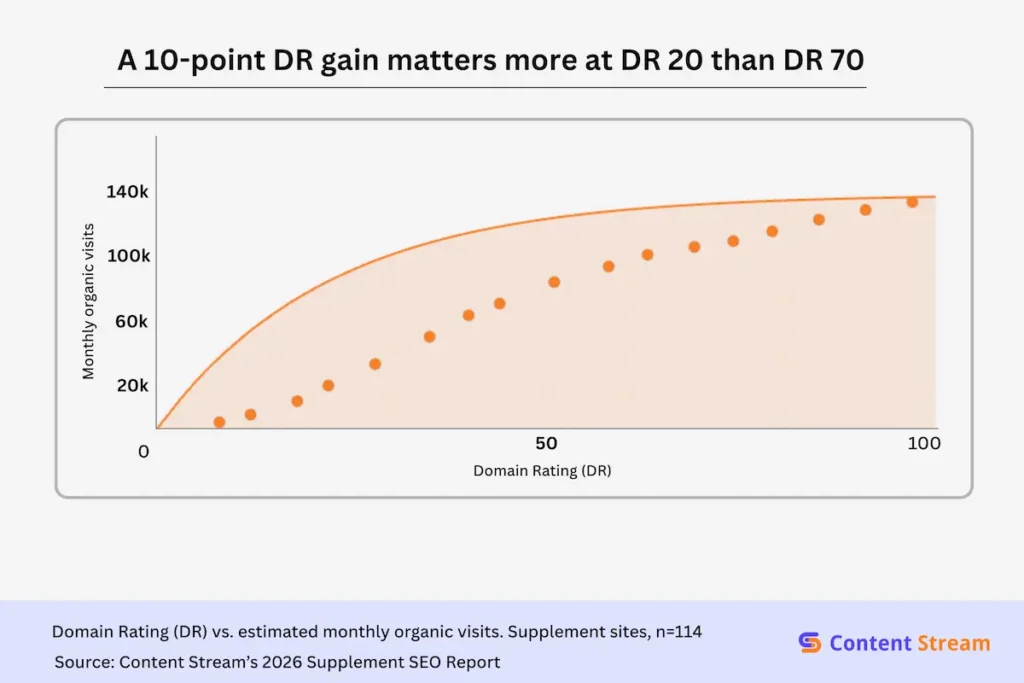
Domain rating (DR) is a score that estimates how authoritative a site looks to search engines, based largely on the quality and quantity of other sites linking to it. SEO professionals cite it more than almost any other metric, and for good reason: our data shows a strong relationship between domain rating, referring domains, and organic traffic, a 0.83 correlation with traffic once you correct for outlier skew, versus a misleadingly weak 0.31 if you compare raw numbers side by side.
That relationship isn’t a straight line, though, and it’s worth understanding before you set any targets around it. A simple side-by-side comparison of DR scores can make authority look like it barely matters, because the real relationship only shows up once you look at it on the right scale.
A 10-point increase from DR 20 to DR 30 will have a much larger impact on your organic visibility than a 10-point increase from DR 70 to DR 80. As authority goes up, the gains diminish. Both are 10-point gains on paper, but they don’t carry anywhere near the same weight in terms of traffic.
One interesting thing to consider is which page on your site receives the most organic traffic. In our sample, 76% of supplement sites got most of their organic traffic to their homepage rather than any blog post or product page, a pattern that held for 14 of the top 20 highest-traffic domains too.
Keep this in mind before you compare your site to others. When a content strategy is working, it’s easy to assume blog posts or product pages will eventually become the primary source of traffic to the homepage. For most sites in this category, including the highest-performing ones, the homepage keeps that position long-term.
One interesting thing to consider is which page on your site receives the most organic traffic. Among the most-visited supplement websites, the homepage typically gets the most traffic, ahead of any blog post or product page.
Keep this in mind before you compare your site to others. When a content strategy is working, it’s easy to assume blog posts or product pages will eventually become the primary source of traffic to the homepage. For most sites in this category, including the highest-performing ones, the homepage keeps that position long-term.
Here’s how to see where your own homepage stands:
Content can build up real value over time, but it’s not a sign that something’s gone wrong if your homepage is still your top-traffic page. For most sites in this category, that’s simply the normal pattern.
E-E-A-T stands for experience, expertise, authoritativeness, and trust. For your website, that often means showing author information, relevant credentials, and credible sources.
The data tells a more nuanced story. On-page E-E-A-T signals don’t appear to have an independent effect once you account for the site’s overall authority. Larger, more established brands are naturally likely to have stronger E-E-A-T signals on their pages, and that looks like a byproduct of the authority they’ve already built.
In other words, solid sites have high authority, and they also have bios and citations, but the authority is doing the actual work here.
That doesn’t mean these signals are worth skipping. Author bios, clear credentials, and proper citations are still good practice, especially for a category like supplements where trust matters to your readers.
This just means that if you’re working through a list of things to fix, E-E-A-T isn’t as important as the other points this article covers. Treat it as a standard measure to keep in place. It won’t move the needle much on its own if you’re chasing a meaningful jump in traffic.
Run SEO and paid advertising side by side as complementary channels.
Paid search can generate immediate visibility for competitive keywords and new campaigns, while SEO generates long-term organic traffic. Our data shows the same pattern among the strongest performers in our own sample, the top 20 organic performers in the supplement category still drew 13.6% of their traffic from paid, more than double the typical brand’s 6.6%, and well above the 1.8% seen at the bottom of the market.
As your organic reach expands, you can use paid campaigns in more targeted and efficient ways, but there’s no guarantee you’ll spend less on advertising.
Industry forecasts suggest this is how many businesses are approaching search in 2026. The IAB’s 2026 Outlook Study projects overall US ad spend to grow 9.5% this year, with digital channels leading that growth. Many businesses are investing in both SEO and paid search at once, not treating one as a replacement for the other.
When you present an SEO audit to stakeholders or clients, it’s worth setting this expectation early. Improving technical SEO and content quality is about building a better website, one that makes all of your marketing channels more effective and supports long-term organic growth alongside your paid campaigns.
Your product pages and site structure play a big role in determining which pages search engines surface. Even if your technical SEO is in good shape, poor site architecture can make it harder for Google to understand which pages should rank.
As part of your audit, check that:
If your audit uncovers gaps in any of these areas, our guide to ecommerce SEO covers site architecture, category pages, product optimisation, and platform-specific recommendations for Shopify, WooCommerce, Wix, and Squarespace in more detail.
A good SEO audit doesn’t just uncover issues. It helps you prioritise the ones most likely to improve organic performance. Technical health, keyword coverage, authority, and site structure deserve more of your attention, while areas such as E-E-A-T function best as important baseline practices.
You don’t need to tackle every recommendation at once. Start with the areas most likely to move the needle, measure the impact, then work through the remaining improvements over time.
If you’d rather have a second set of eyes on your audit, get in touch with our team and we’ll help you find exactly where to start.

I’m Raechelle, a content writer and editor specialising in SEO and health content. With over six years of experience, I help brands turn complex health topics into clear, well-optimized content that ranks.
